

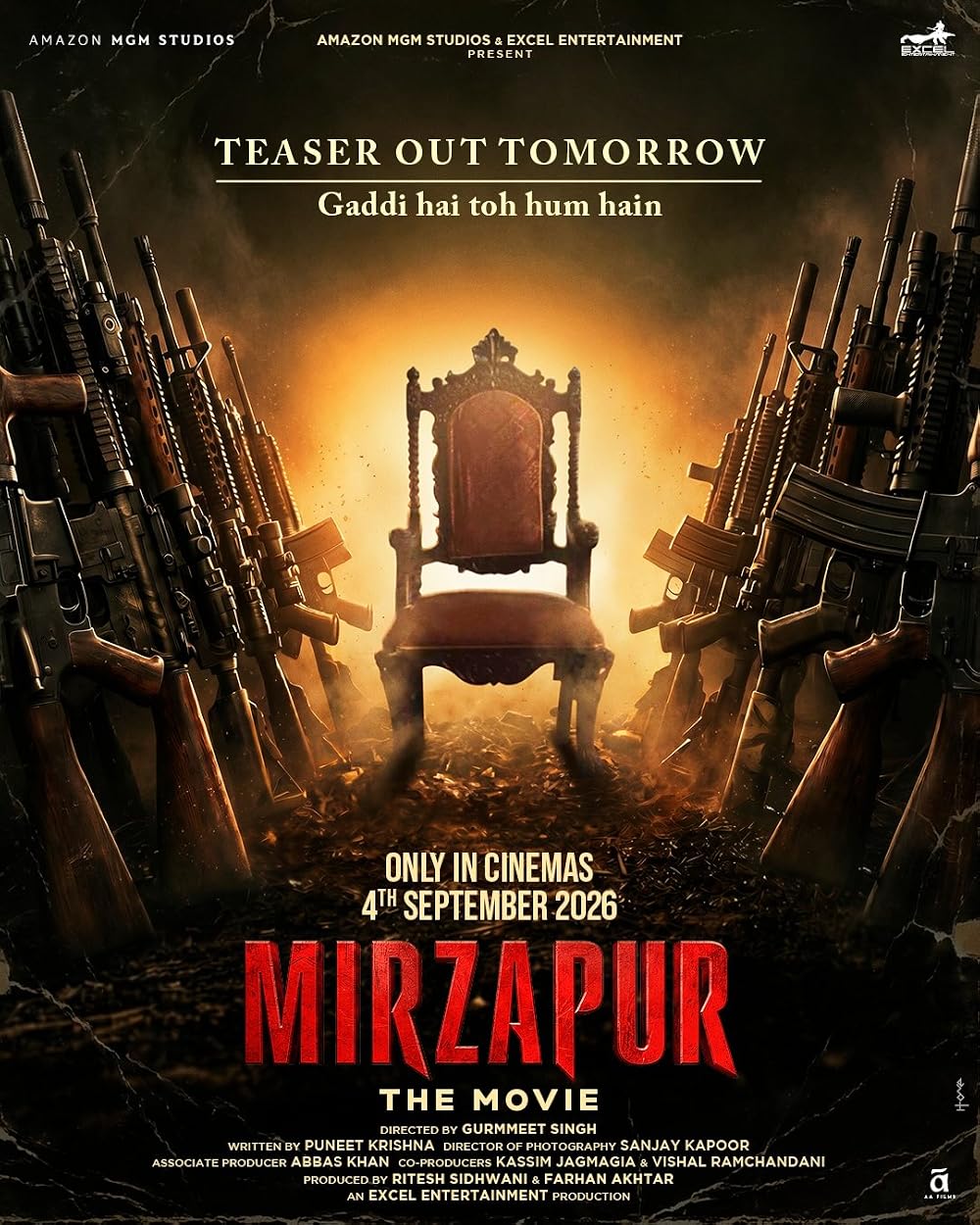
There is a hint of nostalgia that lines the narrative of the new Hindi film Mirzapur, a spin-off of a very popular webshow on the OTT space. The timeline stands at 2018, even as you are introduced to some of the popular characters from the show. And given that this timeline is sandwiched between the 6th and 7th episode of the first season – you are witness to even those characters that are dead as of the end of the third season of Mirzapur. Personally, I was a little skeptical of this approach simply because knowing the fate of the characters was going to directly act as a spoiler for this film, specifically speaking.
And yet in its opening scene wherein you witness a stoic Kaleen Bhaiya (Pankaj Tripathi) interrogating one of his ‘dishonest’ men, only to (re)-kickstart a game of power and politics, or the inseparable yet different Pandit brothers – namely the bulky and impulsive Guddu (Ali Fazal) and the calculative and visceral Bablu (Jitendra Kumar; ironically a more believable ‘calculative’ casting choice to Vikrant Massey) overcoming a late flourish from a pinned down character to pump a bullet in his head, or even the crowd-favourite Munna Bhaiya (Divyenndu) blurting his trademark ‘colourful’ phrases laced by flair and audacity – I just felt that the nostalgia trait of Mirzapur was just so real, and that one ingredient that was woefully missing from ita third season. But having said that, my red flags were still in place – for this nostalgia alone would not count for a good film! And I was so wrong here – for the ride here wasn’t only wild but thoroughly entertaining!
Written by Puneet Krishna, the world of Mirzapur has traditionally thrived on the dynamics between characters, all of whom have been vying for the ultimate throne of the town of Mirzapur. In an alternate universe, the audacious trait of this world could be equated to something on the lines of The Game Of Thrones (2011), wherein the lines of separation are always drawn between characters. So whilst you witness the early seeds of resentment and frustration between Munna and Guddu, both of whom would ultimate have a bloody face-off at the end of season one, or Kaleen Bhaiya’s face-off with another gangster from the vicinity of Jaunpur, Shukla (Shubhrajyoti Barat), or the face of the politics of the land in the form of a local minister JP Yadav (Pramod Pathak) – the broader lines are drawn through the inclusion of another character called Babban (Ravi Kishan), a trojan horse in a political setup who would invariably be pitted against the Tripathis and the Pandit brothers.
The character of Babban remains an interesting nemesis, given how he feels he is the protagonist of his own story. A Fugitive in the making, having escaped with the ‘goods’ from his employer, you notice an unhinged energy that is lacing his character. In his hilarious introduction scene, you see him correcting the musical tone of his love Mumtaz (Sonal Chauhan; notice the name that makes him feel like an ’emperor’), only to reach a creative orgasm on the beat of a bullet piercing his fellow passenger. He comes across as chivalrous with a nod to his ambitious streak – often choosing his warmth to gain information about the characters, in his bid to rule Mirzapur. In the spirit of the vicious setting, he can be equated to a snake that wishes to diss the ‘lions’ of the land!
The initial skepticism that I had about the drama being predictable, in-turn works in the favour of the writing – particularly given how you already have context to their future actions, in hindsight. So while you are witness to the subdued nature of the love interests of Guddu and Bablu – namely Golu (Shweta Tripathi Sharma) and Sweety (Shriya Pilgaonkar), the latter being the queenpin for the conflict between Guddu and Munna, both of whom vye for the same girl, I was also intrigued with the familiar but different dynamic of a character like Beena (Rasika Dugal), who has an interesting arc of her own here. And this not only adds layers to her character, but also adds to her unpredictability – a trait that cuts through the facade of lust governing her persona. If looks could kill, Beena would be the poster girl of it!
The beauty of the characterization often forms parallels with some of the characters in the mix. For instance, both Munna and Guddu are similar characters separated by a class difference. You see them having similar impulsive personalities, they both love the same girl, and both of them face daddy-issues with their respective fathers. On the other hand, Bablu and Compounder (Abhishek Banerjee) form a similar dynamic – both are the calculative superlatives of their respective characters that they support – often doubling up as a calming influence in the lives of both Guddu and Munna.
I liked how the writing utilizes the effect of Chekhov’s gun really well. Be it a simple object like a wrist watch that not only elevates the brewing dynamic between Guddu and his mother (Sheeba Chadha), but only ties its way to the main plotline involving the character of Babban. Likewise, there is a specific plot point involving a character using a camel’s injection in a hilarious sequence that eventually circles back at a pivotal point at the end. This concept also extends to its characters – a humble newbie introduced acts as a foreshadow for his own death later on in the narrative. All of it whilst maintaining the campy tone of the show through its competitive dynamics between Guddu and Munna – both of whom indulge in a crazy car chase sequence, or even a whiff of nostalgia featuring Kaleen bhaiya who chooses to standup for his ‘ch*tiya’ son in an instance. The high points are just so enjoyable here.
My minor gripe with the writing was during a moment in its final act that briefly gave me an impression that the makers were in a hurry to wrap up the proceedings. The linear form of storytelling was pretty evident in a simplistic moment of combat, probably knowing fully well that the set timeline was a giveaway that none of the major characters would be bumped off. A case in point being a minor faceoff between the two loyalists of the respective gangs – Birju (Mohit Malik) and Maqbool (Shaji Choudhary), a sequence that felt simplistic and short-lived. And yet, the twin post credit scenes place the narrative back on track with its campy undertones and a twist that closes the arc of all the characters. The screenplay here is thoroughly enjoyable and ably catering to some unhinged fan-service that was a lot of fun to witness, with hints of nostalgia!
The dialogues are massy but incredibly well written, being pretty self-aware with its ability to tap into a whiff of nostalgia with streaks of humour. So in a scene when Kaleen bhaiya says ‘Ch*tiya Hai Yeh Important Nahi, Humaara Ladka Hai Yeh Important Hai’ – you feel the sentiment of the character with amusing highs sandwiched in the moment. And the drama is filled with similar quirky one-liners that had made the first season iconic, back in the day. The music is peppy, but some of the song placements slightly stall the kineticism of the narrative, briefly putting on breaks. But barring this, at no point did I feel completely disconnected from the drama because of the songs. The BGM is peppy and pulsating, while elevating the stature of so many engrained moments in the narrative, and also ably filling up empty transition spaces.
The cinematography comprises of frames that maintain a beautiful aesthetic of violence, be it the red hues engulfing the water after a character is shot in the head, or even the wide-angle shots that ably capture the gun battles. And yet, the quirkiness of the characters remains a direct extension of the frames that ably cater to the fan-service – creating a medium to capture the ‘colourful’ dialect of the land, or a means of allowing you space to invest in the emotional core of the characters.
The editing pattern is crisp and sharp, while wonderfully holding the narrative together. Since this narrative gave an impression of a mini season, or specifically three to four episodes stitched into one – the subplots needed to be precisely engrained in the narrative, without feeliing isolated in anyway. But the transitions and the emotions sandwiched between them was superbly intact, allowing the dynamics of the land and its characters to do majority of the talking!
Director Gurmmeet Singh excels in every sense of the word here. It definitely did help that he was aware of the fabric of his world and the characters, allowing his crucial space to focus his energy on some of the newer introductions here. But I liked how he kept the conversations engaging – often being an extension of the personalities of the characters, while forming integral dynamics of trust, betrayal and unforeseen friendship in the mix. He definitely showcased wonderful control, without allowing the movie to get too bogged down – a vital lesson that may have been learnt from the dragging third season. The entertainment quotient is high here – a direct sign that the filmmaking is brilliant here.
The performances are wonderful to witness by the members of the cast. The likes of Priyanshu Painyuli as Robin, Anjum Sharma as Sharad, Nitin Joshi as Raja, and Meghna Malik as Shakuntala form vital nuggets of nostalgia through their brief appearances here. Rama Krishna Dixit has his moments to shine, while being a key contributor in kickstarting the narrative. Manuj Sharma as Chhedi Lal is terrific to witness here. Shubhjyoti Barat as Shukla and Pramod Pathak as JP Yadav are competent while also doing their bit in catering to the nostalgia wave that the drama has to offer. Both of them are a joy to witness here. Prashansaa Sharma as Radhiya shines despite a limited screentime, almost being a foreshadow to the late flourish of the character in the later seasons of the show.
Satendra Soni as Chandu Puncture is an interesting addition to the cast here, and he showcases a lot of flair through his unhinged act. Sushant Singh as Bhairon has such a brilliant screen presence, something that had me take notice of him despite a limited screen time. The same goes for Shaji Choudhary as Maqbool who literally has a towering screen presence, while being utterly impressive with his act. The trio of Shweta Tripathi Sharma as Golu, Shriya Pilgaonkar as Sweety, and Harshita Gaur as Dimpy manage to leave a mark, despite me having a little gripe that all the three characters didn’t really have enough meat here in the context of the drama. But knowing their fates and transformations in the latter seasons, I can’t complain much. Rajesh Tailang as Advocate Ramakant and Kulbhushan Kharbanda as Bauji are sincere and earnest with their respective characters – each being on the opposite end on the scale of morality.
Sonal Chauhan as Mumtaz looks beautiful here and has a solid screen presence, while managing to hold her own. Anangsha Biswas as Zarina is a trojan horse of sorts here, particularly given how her character opens a whole new world for the character of Babban. She is incredible to witness here, while leaving a lasting impression. Sheeba Chadha as Vasudha has a definite texture to her character – a mild arrogant trait knowing that she is the mother of the two most-wanted gangsters in town. And this subdued flair is wonderfully exploited by her in a restrained but supremely impactful act.
Rasika Dugal as Beena is such a layered character, an extension of Lady Macbeth in many ways – given the unpredictability of her character. She uses her expressions and bosy language to such great effect, putting forth a towering act that makes her stand her ground in a universe that is majorly ruled by men! She was brilliant as ever here! Mohit Malik as Birju is subdued and restrained in a character that is simmering with a flair of vengeance. And he wonderfully taps into this trait while putting forth a commendable act. Abhishek Banerjee as Compounder is a sedate and calculative figure who doubles up as the ‘manipulative’ guiding light of Munna, and he wonderfully extracts this trait through his superior act.
Jitendra Kumar as Bablu successfully crafts a distinct and refreshing identity for the character<span;>. He serves as the sharp, calculated brain behind the empire, holding his own beautifully alongside seasoned action-heavy leads. His performance is grounded and brilliant, capturing the methodical stillness required to balance out the chaotic violence of the Mirzapur underworld.
Ravi Kishan brings a brilliant, localized authenticity to the big-screen adaptation, completely owning his space as the menacing yet deeply entertaining Babban Yadav. He brings a chilling persona in the mix that heightens the intimidating moments in the narrative. He strikes a perfect balance between a formidable, power-hungry threat and a crowd-pleasing performer, giving his character a distinct layer of raw, rustic gravity, while being a perfect nemesis to the Tripathis and Pandits
Radiating intense, raw screen presence, Ali Fazal delivers an exhilarating and fiercely physical performance as the erratic Guddu Pandit. He handles the grander cinematic scale effortlessly, convincing the audience entirely as a volatile man who leaps headfirst into action before thinking. His character’s relentless determination and high-octane aura bring massive energy to the unfolding explosive battles onscreen! He is the desi-Hulk of this universe!
Resurrecting the fan-favorite Munna Bhaiya for this big-screen timeline, Divyenndu returns with his unforgettable, reckless attitude. He strikes the perfect chord by blending chaotic vulnerability with unpredictable aggression, reminding everyone exactly why audiences fell in love with his unhinged character. In hindsight, he was the ‘fizz’ that was missing in the third season – a winner of a character that will take you on a roller coaster ride!
Returning to his signature role with absolute authority, Pankaj Tripathi proves once again why Akhandanand “Kaleen Bhaiya” Tripathi is a legendary character. He delivers a masterclass in subtlety, weaponizing his signature quiet menace, deadpan humour, and regal posture to rule the big screen. His unmatched command over dialogue delivery anchors the narrative, bringing a steady, magnetic gravity to the high-stakes gang war. He was brilliant as ever here!
Featuring unhinged performances, Mirzapur: The Movie is a campy, intensely entertaining fan-service vehicle that masterfully blends nostalgia, dark humour, and signature violence. By deliberately channeling the raw energy of its iconic first season and resurrecting unforgettable characters with their trademark traits, the film successfully capitalizes on nostalgia bait. The result is a high-stakes kinetic drama that delivers absolute, guaranteed ‘Bhaukaal’ – a definitive wet dream for loyal followers of the original crime franchise that has since birthed an entire genre of clones. All hail the OG! Available in a theatre near you, and Highly Recommended!


