

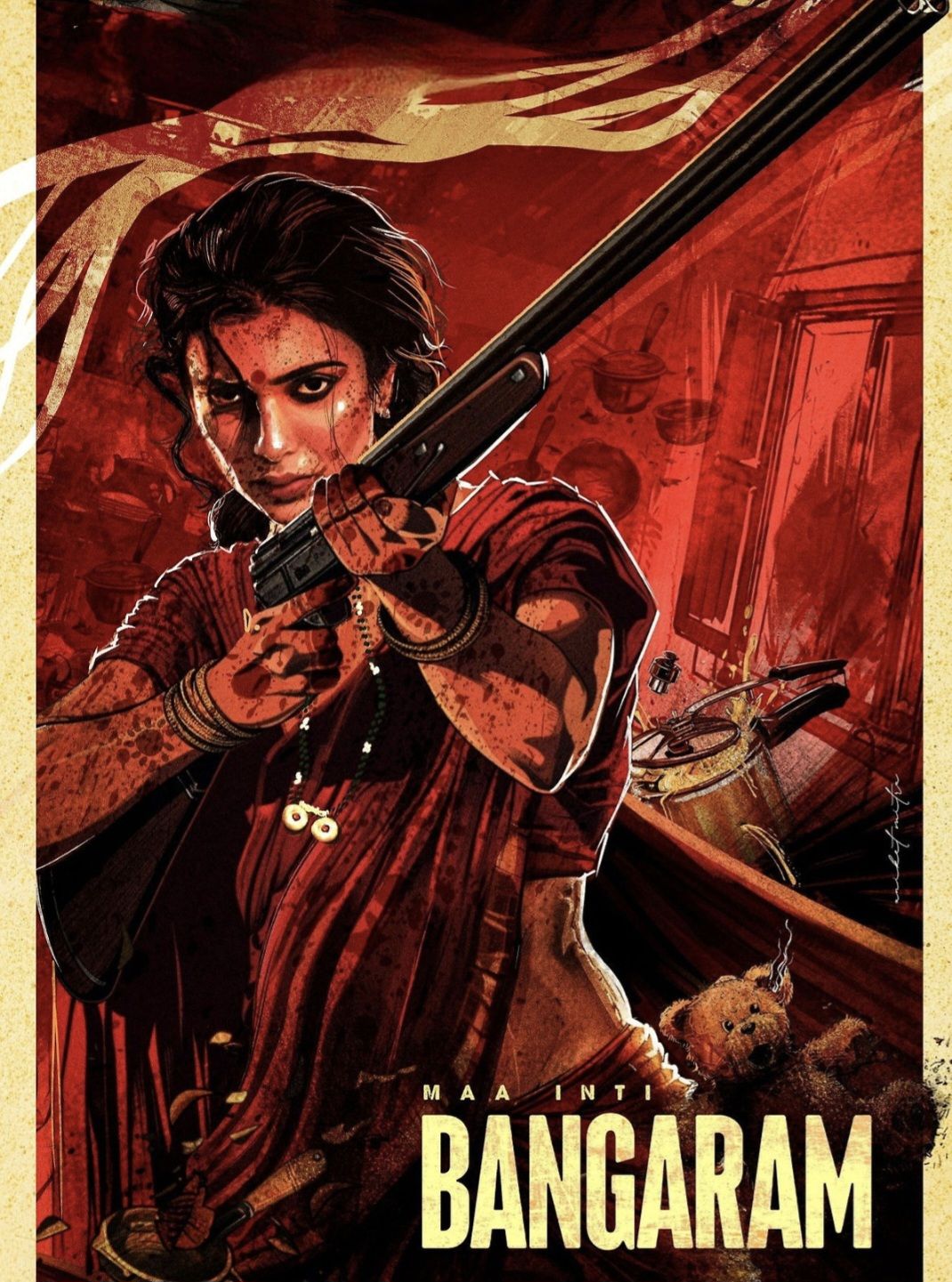
There was an eye-catching byline to the 2017 Hindi film A Gentleman that accurately summed up the twisty and pulpy action drama – ‘Sundar…Sushil…Dangerous’. The new Telugu film Maa Inti Bangaram borrows the same structure of the former Hindi film, while switching genders. So when you are first introduced to Jhansi (Samantha Ruth Prabhu), she is seemingly a sari-clad woman who is gingerly headed home with her husband Anirudh (Diganth Manchale). The context remains that the couple had previously eloped, but are headed home in order for Anirudh’s folks to finally accept their marriage, in what would potentially be their happily-ever-after. You can view Jhansi as ‘Sushil’ – even as she tries her best to blend into the patriarchal surroundings, even with her inability to cook. Jhansi is also ‘Sundar’ – given how the women of the household immediately want to inquire about her caste, or her parents, a step ahead from the ‘looks’. But Jhansi is also ‘Dangerous’ – a hidden secret that would soon come to the fore at some point in the narrative.
Written by Raj Nidimoru, Vasanth Maringanti, and Prahas Boppudi, the main USP of Maa Inti Bangaram remains the traditional template of a Telugu mass film flipped on its head with the role reversal in gender. And if I were to go a level deeper, the writing also felt like a nod to the Hindi show The Family Man, wherein the protagonist’s family remain unaware of the whereabouts of his profession. Here, Jhansi isn’t a normal woman but a deadly assassin – a plotpoint that has its seeds interspersed in the first half.
For instance in a scene, you see the protagonist asking a character to back-off, even as the latter seemingly finds her familiar. Even when you are introduced to the antagonist Karuna (Gulshan Devaiah), you see him telling his henchmen to try and kill Jhansi – citing that if they are able to, she isn’t the woman that they are seeking, but if they can’t…..well, they will end up being dead, while confirming her identity to him. It is a quirky exterior that houses a familiar character trait for the protagonist.
The proceedings in the first hour are sprinkled with subtle bouts of humour, although the humour in itself isn’t entirely groundbreaking. The passing inferences of the protagonist’s identity not withstanding, you see her seeking help from her best friend Kiranmayi (Manjusha Mukkavilli) to cook food, just so that she is able to compete with a fellow daughter-in-law Anasuya (Sreemukhi). In fact, you see a subvert of the genre through one of the lines uttered by the protagonist – ‘Be a hero or a housewife…’, something that is quirky, while immediately being followed by the protagonist confronting another character with the line – ‘Do You Know Who I Am’. It remained a direct counter to patriarchy – an element that finds prominence in the Telugu Film Industry, and it was a wonderful sight to see a woman standing up to it, in a searing meta-commentary on it.
And yet, I wasn’t fully satisfied with the writing that didn’t have enough quirks that one would associated with a Raj and DK film (here, Raj remains one of the co-writers). For instance, one immediate drawback remained the characterization of the antagonist that felt too simple and one-dimensional, without really getting a peek into his psyche (that is a different argument on how the performance elevated the source material). <span;>And add to that, multiple subplots that felt extremely half-baked and convenient. For instance, a potential political subplot involving a character began with such promise – but inexplicably abandoned while concluding on a whimper.
The same holds true for the origin story of Jhanvi – something that immediately had traces similar to the soon-to-be-released Alpha (2026), but not enough to fully invest emotionally in her journey. It almost felt like a quick montage as opposed to a steady introduction to her ‘deadly’ personality, that never really found a footing in the narrative.
As a result, the complex template of A Gentleman (2017) wherein there were two parallel narratives unfolding at the same time to create an air of mystery, is entirely missing here. The idea of simplifying the structure in order to cater to the lowest common denominator wasn’t as good as it may have sounded on paper, simply because the mystery was revealed at the halfway mark – and from thereon, the template became even more stereotypical in a classic good versus evil formula.
Hence, I also get a considerable lag in the second hour – sandwiched between entertaining sequences of one-upmanship. The drama slightly peaks in the final act with the protagonist going in full Tom-Raider mode while donning a sari – a quirky and an empowering moment that engulfed the spirit of the drama. If only the writing was sharper to aide this sentiment throughout – something that overall resulted in a momentary glow, as opposed to a consistent one.
The dialogues present quirks in patches, with some whistle-worthy one-liners that fairly elevate the impact of the narrative. At the same time, there are a few dubbing issues too pretty evident in a few scenes, something that balance the impact of the drama. The music is decent but the real deal is the BGM that truly is pulsating, while switching the tonality of the drama pretty seamlessly. So the sober notes of a family drama give way to some pulsating ones in intense action set-pieces, and all credit must go to Santhosh Narayanan for the same.
The cinematography truly peaks in the frames capturing the action set-pieces – be it hand-to-hand combats or some swirling moves, while ditching the slow-mos and the anti-gravity elements, thereby elevating the stature of the drama. In fact had the writing being a bit better, the impact of these incredibly choreographed action set-pieces would have been higher. The editing pattern is fairly decent too, switching ably between the twin tonalities of the drama. This, although the lags in the narrative were evident, and something that needed to be ironed out for a smoother narrative.
Director B. V. Nandini Reddy has a mixed outing here – scoring fairly well with the portions involving a family drama, and also hitting the bullseye with the action implemented in the narrative. But the specific issue for me was in the empty space in between – be it the characterization outside the protagonist, or the origin story of the protagonist, that didn’t quite have the same emotional connect that was intended to be. The proceedings oscillate between being intense to flat and uneventful, and that onus lay with the filmmaker to counter. The direction is middling to say the least.
The performances are pretty good by the members of the cast. Srinivas Gavireddy as Buchiraju has his moments to shine. Diganth Manchale as Anirudh, Chaitanya Krishna as Sharath and Anand as Anirudh’s father are sincere and earnest while putting their best foot forward. Sreemukhi as Anasuya and Manjusha Mukkavalli as Kiranmayi are wonderful actors with a resounding flair for comedy, and both of them manage to tickle your funny bone.
Gulshan Devaiah as Karuna is intimidating in a performance that is daunting in many ways. He has such an unhinged body language with his cold eyes doing the talking, that he did send a shiver down my spine. This is an even better performance because the writing didn’t offer much to his character’s persona – but his exceptional acting papered over its cracks. He was incredible to witness here (and how)!
Samantha Ruth Prabhu as Jhansi aka Swarna is outstanding here, and quite honestly, the soul of the film. She is the perfect representation of the meme that goes by the template – ‘She Can Do This, She Can Also Do That’. She does bring sprinkles of humour as the sari-clad protagonist, before switching on her deadly mode and whipping some a*s! She excels in hand-to-hand combat sequences, also rising up to the occasion with some flawless moves, whilst retaining the original flavour of her character. So despite the mediocre writing, if this film is atleast watchable then it is due to Samantha and her brilliant act that infuses life into the proceedings. If only the writing was a little better….
Despite excellent performances and brilliantly choreographed action set-pieces, Maa Inti Bangaram suffers from predictable, convenient writing that stops the drama from truly soaring. The film flips traditional gender roles to offer a fresh perspective, yet it lazily borrows its structural template from the 2017 film A Gentleman. Because of this formulaic execution, the movie only works in fits and starts, making it an above-average watch at best. Available in a theatre near you.


