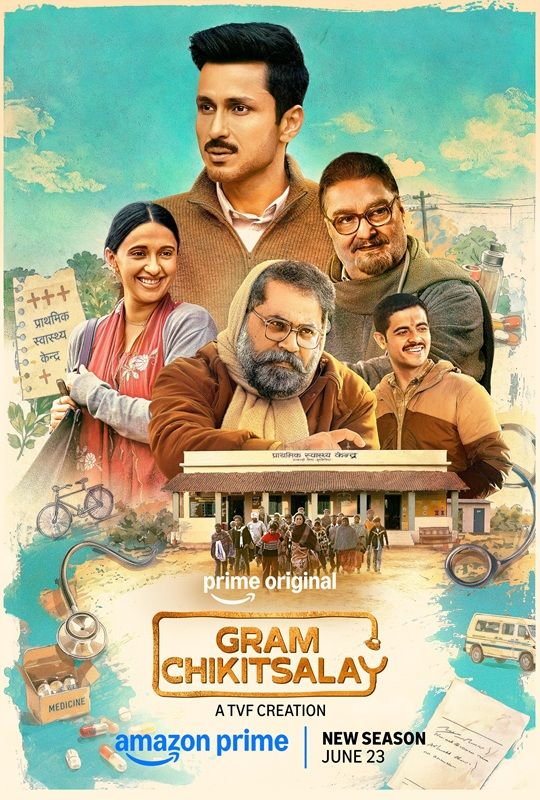

One of the main criricisms that I had for the first season of Gram Chikitsalay was that it remained too Panchayat-coded in its approach. Right from the world to its characters, everything felt like a prototype of the brilliant TVF show that had captured the minds and hearts of the people. And yet in doing so, the makers had then created a protagonist Dr Prabhat (Amol Parashar) that was eerily similar to Abhishek (Jitendra Kumar) in a show that immediately felt like a medical cross-over. Even the central conflict of the protagonist arriving and having to get used to the village life of Bhatkandi, instantly reminded viewers of Abhishek’s tryst with Phulera. In other words, the personality of the protagonist coincided with the familiarity of the world built around him.
But come the second season of Gram Chikitsalay, things have changed for the better. You immediately view the protagonist as a character who is an idealist, and much assured of his times in Bhatkandi. In another world, he would be Dr Vidushi from Who’s Your Gynac, but then I digress. As a result, not only do patients start trickling in – but there is a drastic improvement in the proceedings which wish to stand on its own pair of conflicts, without aiming at imitating the conflicts of another village (although this remains an official cross-over now). In other words, the distinct personality of the protagonist acts as a redeeming factor for the world that it is set in, something that immediately adds a unique flavour to the proceedings.
Written by Vaibhav Suman and Shreya Srivastava, the second season of Gram Chikitsalay taps into a variety of themes along the way, each of which act as a cohesive thread in the narrative. Immediately, the structure of the screenplay is better shaped than the first season – quietly beginning with Dr Prabhat’s unsaid conflict with a local quack Chetak (Vinay Pathak), who googles the symptoms of the patient before handing them over medicine.
The subtext remains a searing commentary on modern medicine and traditional quackery that remains a nod to the first season, even as Chetak enjoys support from a local MLA in the village. In a particular passage of play, you see an adamant protagonist handing over medicine to a village local suffering from an abdominal pain, even as the latter is handed over a bottle of toddy by the local quack. It remains one of the fleeting moments in the narrative that accurately establishes the face-off between the two characters, something that would later go onto have a payoff towards the end (with a little twist).
The underlying commentary of the show also extends to the systemic shortcomings of the location in terms of the medical supplies on offer – something that the protagonist has to deal with, along with the standard stigmas around healthcare with regards to the villagers. And much of this commentary is intertwined with the dynamics that the protagonist shares with the characters around him. For instance, he has the trio of Gobind (Akash Makhija), Dhelu (Kartikey Raj), and Phutani (Anandeshwar Dwivedi) at his disposal – three characters with distinct features that drive the humour in the narrative. For instance, Phutani has an inherited streak of laziness, despite fully providing his support to the protagonist. Likewise Dhelu and Gobind remain sincere with their respective stances, while also being Vikas and Prahlad (of Panchayat) to the protagonist.
One important dynamic that the drama focuses on, is between the protagonist and fellow Dr Gargi (Akansha Ranjan Kapoor) that drives the searing commentary of the lack of medical supplies in question. Here, the latter often acts as a friend and confidant, guiding the protagonist at various junctures – even while knowing which strings to pull with the authorities. It is on her suggestion that the protagonist wishes to register for the Adarsh PHC competition, wherein the winner wouldn’t have the shortage of medical supplies – a plot-point that leads to some unhinged humour in the narrative.
There is also a parallel track involving the supposed promotion of Gobind which is turned down by the local CMO Babu Saheb (Dinesh Lal Yadav aka Nirahua), that has an underlying tone of corruption and bribery tagged to it. Here, Gobind finds himself in a precarious position given how his 11-month contract with the protagonist is about to expire, even while having to shell out a hefty sum of Rs 1.5 lacs. Or worse, get himself married to a woman unknown to him – a preceding sequence that formulates bouts of humour along the way. There is an immediate purpose to his character, while the writing also taps into a heartfelt space by the end of things.
A few sequences for me did not land smoothly, particularly with regards to a late subplot that would go onto transform a particular character at the end. The seeds of that subplot needed to be interspersed in the narrative like breadcrumbs, that would eventually lead up to the transformation. Even the chaotic setup of the finale, sandwiched between a theme of collaboration between Dr Gargi and the protagonist did not land smoothly – given how it followed a sequence that had pitted the two characters against each other. As a result, even the emotional core at the end remained slightly compromised – although it still did enough to create a fuzzy feeling at the end.
But one of the reasons why the writing scores this season, is also to do with subtle bouts of humour that are sprinkled along the way. For instance, a patient visiting the protagonist with a sweet box that actually contains his stool. Or the histrionics of Chetak who believed that his ‘toddy’ medicine was his eureka moment of cure for his patient, or Phutani convincing Gobind to marry after describing the features of a woman while capturing her off focussed on his phone, or generally the resentment of the villagers in being treated by a professional doctor that invariably results in laughs. These fleeting moments are enough to put a smile on your face, in a piece of writing (and execution) that felt like a significant upgrade from the first season.
One significant upgrade from the dialogues-writing front remains on how the drama isn’t necessarily trying to be funny or heartfelt unlike the first season. There is a genuine attempt to keep things light and frothy, while invariably creating situational humour along the way. The desperation from the first season isn’t visible, and that in turn, also accounts for a rich vein of emotions that find their way in the narrative.
The BGM here isn’t as memorable as the iconic theme of Panchayat (I had to draw this comparison given how this is an official universe now), but it does work fairly well in the context of the drama. The cinematography comprises of frames that captures the texture of the setting pretty well, while distinguishing it from its neighbouring cousin – Phulera. The pleasant hues of yellow are eye-pleasing, something that significantly is attuned to the frothy themes of the narrative. This, even as the frames allow you to invest in the emotional core and vulnerabilities of the characters, which remained a key ingredient in the narrative.
The editing pattern is a lot more urgent than the first season that was filled with lags. The faster cuts and shorter scenes also meant that this particular season is binge-worthy, even while doing its bit in maintaining a cohesive thread throughout its proceedings. Director Lalitam Anand definitely brings his own visual language to the proceedings, by distinctly creating conflicts that are grounded in this world. Even the characterization works here, given that every character has a purpose in the narrative. The direction brings all these elements together in a blanket of emotions and humour that makes for a lovely watch.
The performances are wonderful by the members of the cast. Susmita Sur as Rohini Devi and Yogesh Parihar as Kumud are superb to witness here, and they definitely manage to tickle your funny bone. Divya Sharma fresh off the success of Raakh, yet again makes a mark as Juhi – despite her character being a touch underwritten. Himani Sharma as Vandana has a good screen presence, and she remains sincere and earnest with her performance. Priti Jha Tiwari as Daayan also has an interesting character, and she does a good job with it. Moushami Bharti as one of the patients balances traces of humour in her character with a rich bout of emotions, while putting forth a commendable act.
Shakti Kumar as Kishori Lal exhibits streaks of power tagged to his character with bustling energy, and he definitely has his moments to shine. The duo of Ashok Pathak as Binod and Durgesh Kumar Qais as Bhushan form the connections to the Panchayat universe, and both of them are in their elements, thereby putting a smile on your face. Vikram Pratap Singh as Arvind lends good support here, often managing to impress with his antics. Garima Vikram Singh as Indu remains sincere here, a direct extension of her character from the first season.
Kartikey Raj as Dhelu has such a natural flair for comedy, with a key ingredient being that he doesn’t try to be funny – thereby, invariably putting up a ticklish show. Anandeshwar Dwivedi as Phutani is a delight to watch – a character who is lazily laid-back and focused on everything else other than his work, while still wanting to contribute to the success of the clinic. This in-turn creates a hilarious conflict that results is laughs aplenty.
Vinay Pathak as Chetak is understated with his brand of humour, while definitely leaving a lasting impression. Despite his character being a touch underwritten and having a sudden (yet heartwarming) transformation – the veteran really accounts for understated bouts of humour and emotions that invariably make his character affable. Dinesh Lal Yadav aka Nirahua as Babu Saheb is in top form here – a character at the center of bureaucracy and corruption, who later undergoes a change of heart. His persona and body language are utilized to great effect in making his character work.
Akash Makhija fresh off the success of an intimidating antagonist in Raakh, does a 180 degree turn here. As Gobind, he is simple, tender and heartfelt – while also being sincere with his actions and attitude. Be it serving the protagonist without any qualms, or accepting the ‘medical flaws’ of his wife – he is earnest in a performance that is heartwarming and will put a smile on your face.
Akansha Ranjan Kapoor as Dr Gargi is beautifully understated, almost having a calming influence in the life of the protagonist while alwaya willing to help out without any transactional expectations. There is a beautiful quality of groundedness and sincerity that christens her character, something that makes her instantly affable despite a few fleeting flaws to her traits (she sends gifts to the higher official as a ‘favour’). Akansha is a treat to witness here, in a job well done.
Amol Parashar as Dr Prabhat is yet again in top form in a character that defines the tempo of the world around him, the second time around. There is an air of assertiveness and idealism that christens his character, something that drives his character towards perfection. You also witness moments of him losing his temper that remains a byproduct of his idealism, even as the core sentiment of service and sincerity remain intact. He is brilliant as ever here, while delivering a well measured performance.
Backed by stellar performances, the second season of Gram Chikitsalay vastly improves from the first outing. It serves subtle humor and deep emotion without ever feeling preachy. By letting the harsh realities of rural healthcare speak for themselves—softened only by witty banter and warm human connections—it delivers a highly impactful, solid watch. Available on Amazon Prime.