

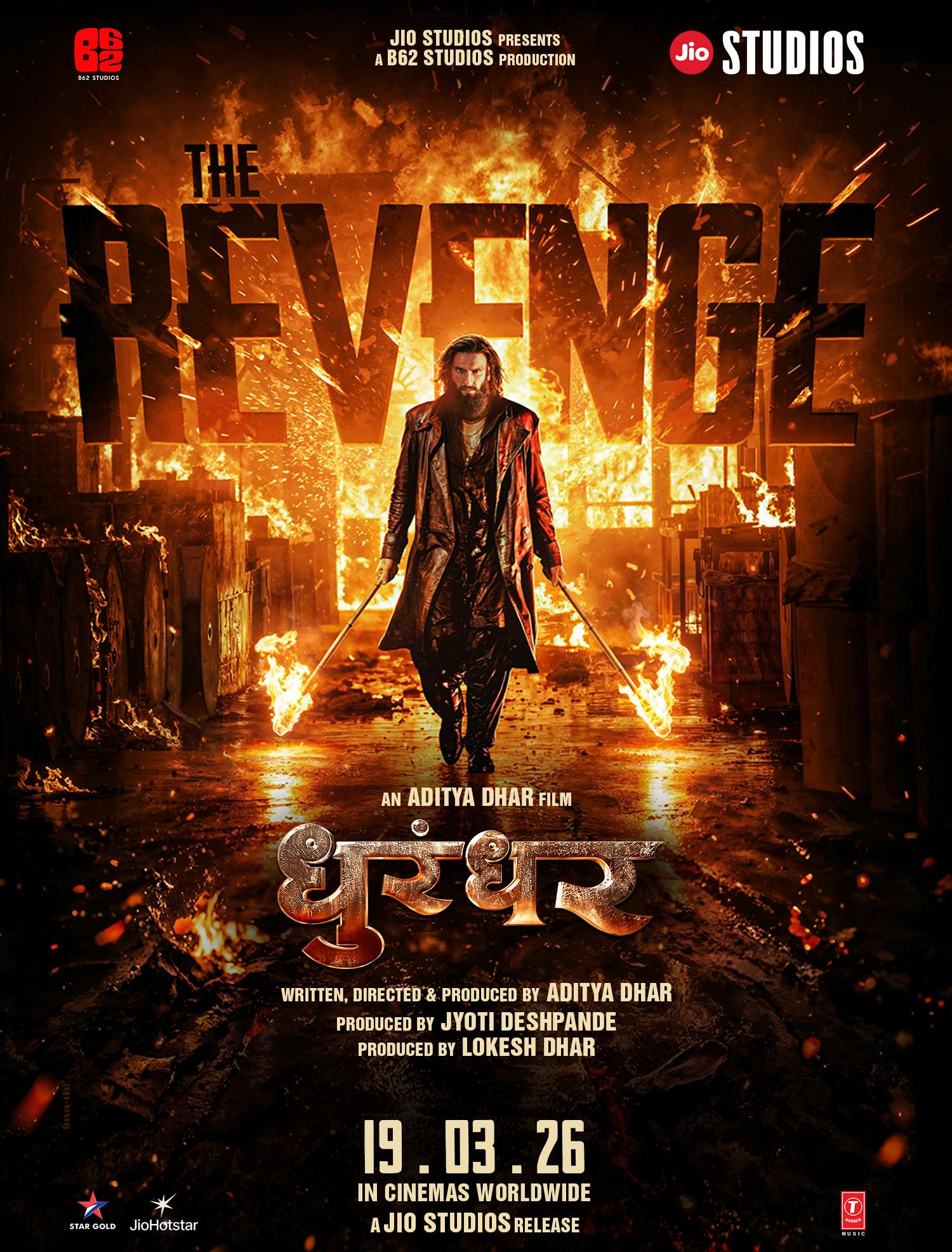
The masculinity in the world of Dhurandhar is established as a two-fold process. At the start of Dhurandhar The Revenge, you get a glimpse of Jaskirat Singh Rangi (Ranveer Singh) and his family. The freeze frame is quick to acquaint the characters around the protagonist who dons a short crop of hair – contrary to the long locks of Hamza (meaning lion; he has a mane too) that marked his introduction in Dhurandhar (2025). And yet in an adjacent sequence when you witness a shootout, you are acquainted with the masculinity of Jaskirat – fighting to honour the rights and morals of his family, particularly his sister(s).
The second phase of masculinity comes in the form of Ajay Sanyal (R Madhavan), when he crosses paths with the protagonist. In a scene, you see him reminding Jaskirat on how males (read : Mard) are designed to endure pain while having to fight their dreams and aspirations. It remains a very specific reference of the word ‘sacrifice’ (read : Balidaan) that would tie itself in the narrative at a latter point. And in between these references lies the survival and revenge story of the protagonist who has freshly ousted Rehman Dakait (Akshaye Khanna) while taking a step closer to rule the township of Lyari in Pakistan.
Written by Aditya Dhar, the biggest challenge of Dhurandhar The Revenge remained on kickstarting an already established world, something that had already peaked in the first part. Amidst the sky-high anticipation, I found the start of the drama here to be slightly underwhelming, given how there was considerable caution in instantly raising the stakes in the drama. I went in expecting a gut-wrenching backstory of the protagonist in the war-torn parts of Punjab, but instead the drama felt much simpler without finding the need to build on some of the characters who would have potentially contributed to the emotional core of the protagonist. I almost sensed a case of urgency to get past the passage of the past, wind up the little context of Lyari and then get to the juicy part – the revenge angle promised to the viewers. And therein lay a small wobble, although this remained only a relative minus point in the grander scheme of things.
The entire screenplay resembles a set of cricket matches being played between India and Pakistan. The position of India being the ‘New Hindustan’ has a journey of metamorphosis of its own – almost losing ‘matches’ to the arch rival before completely owning the arena. And like players retiring, the Pakistan team always felt like the weakened of the two after the demise of Rehman Dakait – a case exploited by Jaskirat aka Hamza Ali Mazari to make inroads to the famed batting lineup. For starters, the gangwar between Uzair Baloch (Danish Pandor) and Arshad Pappu forms the starting point of the Lyari chapter – something which is aided by the participation of SP Chaudhary Aslam (Sanjay Dutt).
While most of the story revolves around Jaskirat Singh Rangi, I liked how the emphasis was given to his nemesis in particular – Major Iqbal (Arjun Rampal). In a scene, you see a humane side of Iqbal playing with his differentially abled daughter – a sharp contrast to the kind of hatred that the man deserved for plotting the 26/11 attacks. In the same scene, you also are witness to his rocky relationship with his nagging father, another reminder of his humane traits that result in his power being grounded. Like every organization, he follows a hierarchy too – obeying the commands of Bade Sahab, whilst plotting the downfall of India under the watchful eyes of Jaskirat. The power dynamics also allows a sneak-peek into the hitlist of Jaskirat, a series of tasks that would be the ultimate goal of revenge.
There is a subtext of socialism with regards to certain plot points in the drama that range from the illegal transport of weapons in India, or the encroachment of drugs from across the border, or even a cash-stack that would weaken the currency of the drama (a hint of demonetization coupled with a ‘cleanup’ job notwithstanding). And each of these subplots is layered, even as the drama begins to gain control after a partially frantic start. There is method to the chaos that ensues even a character is tied back to the past of Jaskirat – a very specific chain of events that elevates the stakes of the drama including a murder surmounting to an exposé and a tragedy, and the subsequent revelation involving Yalina (Sara Arjun) who begins getting suspicious about her husband’s whereabouts.
The events follow a very specific timeline (at times jumbled up too) that corresponds to the politics of Pakistan back in the day. But more specifically, the focus remains on the ‘Eendhan’ (ironically the fuel that has a shortage today) that translates into ‘Badla’ (revenge). And this is also where the narrative gets simpler whilst resembling a video game – even as the body count of the enemies begin to rise. The sequences are ballistic – allowing you no real respite between the kills, even while stylizing the events to the point of violence and euphoria.
I couldn’t deny on how involved I was in the narrative even with the stakes being evened out, invariably building towards a finale that would pit Jaskirat with Major Iqbal. If anything, the provocative style of the 26/11 attacks as seen in part one, doesn’t find its voice with the reference of the Uri attacks that are played in the backdrop. And that for me will go down as a classic case of a political bias – but thankfully, it doesn’t derail the drama.
The twenty minute final act resembles the drama on steroids, even as a potential commercial route elevates the intensity of the drama leading to a memorable and ballistic sequence that explodes and how! I also enjoyed the layers in the outro along with an unforeseen twist that closed the loop with the right amounts of emotions at the end. But where the real politics in the drama lay during its end credits wherein a Muslim man was seen training Jaskiran and other boys for their mission across the border. This is in sharp contrast to characters of the minority being shown as ‘villains’ at the start of the film. That is enough to tell you that the drama here is balanced while never towing the line of being a propaganda (as mentioned by a few during the release of Dhurandhar 1). And that remains a win for me in a screenplay that is brilliantly penned.
Largely, the dialogues remain understated, almost complimenting the sombre mood of the drama. The dialogues add layers of authenticity while landing wonderfully and never deviating your attention from the layered drama in sight. I really wished though that the Censor Board was kinder to the abuses that were muted, and often felt like a minor speedbreaker during multiple scenes. The music and BGM by Shashwat Sachdeva is nothing short of a banger here. It just goes to show on how well Shashwat has understood his assignment here, while virtually adding life to innumerous action set-pieces that play out against the backdrop of yesteryear’s numbers with catchy beats, or some original bangers that boost the impact of the sequences. The same is also complimented by a superb sound design that often keeps you on your toes. If anything, the BGM for me felt slightly overpowering for me – so much so that I had to strain my ears to the dialogues being mouthed by the characters.
The cinematography by Vikash Nowlakha is absolutely stellar to say the least. The action set-pieces are choreographed and captured with a certain amount of flair that rotates between slow-motion shots to some complex movements in a confined space (for instance, a building at the start of the drama). Another huge positive remains on how the frames don’t shy away from showcasing the gore and blood while seamlessly blending it in a world that oozes of a strong emotional hinge with respect to its characters. Also, the creative decision to alternate between actual documentary footage and fictional setups, adds authenticity to the drama.
The costumes by Smriti Chauhan compliment the greyness of the characters with similar shades in their attire. The only character given a brighter shade with respect to her attire is Yalina, something that depicts the innocence and empathy of her character. The prosthetics department deserves a raise too for some incredible work with the getups of the characters, as well as the use of blood and gore with respect to the body parts.
The editing pattern remains an interesting aspect here given how on paper, the length of the drama standing at nearly 4 hours is cruelly whopping. But I must admit that the transitions remain engrossing without really exhibiting a sense of lag in the narrative, something that remains a green tick in the report card of the editor. Also, I liked how the BGM was placed perfectly in sync with the editing pattern. Every small movement would either add a new dimension to the background score, or alternately stop it completely. That said, the faster edit in the first one hour didn’t really allow emotions to settle in with respect to the protagonist.
Director Aditya Dhar shows yet again on the technical supremacy that laces his craft, last that he exhibited so brilliantly in Uri (2018). And yet here, he is willing to showcase his calibre as a filmmaker who wishes to delve deep into the character dynamics against the backdrop of an intriguing world building, while completely going berserk with the intensity. In that sense, the drama here is chaotic and ballistic – two important virtues that ground the narrative to a very large degree. Make no mistake, Aditya Dhar the filmmaker is prolific in every sense while stamping his authority yet again in an ambitious drama that lands beautifully.
The performances are excellent by the members of the cast and it is yet another casting director Mukesh Chhabra who scores with the casting here. Yami Gautam is effortless as ever in her cameo, as is Bhasha Sumbli as Veena who shines despite a limited screentime. Mustafa Ahmed as Rizwan and Udaybir Sandhu as Pinda are such fine actors who seem natural to the core while blending perfectly with the surroundings. Suvinder Vicky as Brig. Jehangir is efficient in a character who is often shown to be nagging, and he does a fine job here. Ankit Sagar as Javed, Ashwin Dhar as Arshad Pappu, Raj Zutshi as Samshad Hasan and Bimal Oberoi as Shirani have strong individual traits of menace and power, and each of them have their moments to shine. Danish Iqbal is such a fine actor and it is a sight to withhold on how well he uses his physicality in essaying the role of Bade Sahab. He is brilliant to the core in a performance that is nothing short of a mini acting masterclass. Vivek Sinha as Zaroor had made my blood boil in the first part, and he extends the same ‘solid’ streak here albeit a poetic end that makes for a solid watch.
Saumya Tandon as Rehman’s wife has little to do here in one of the only characters that really felt underwhelming in the context of the drama. Manav Govil as Sushant is fabulous to witness here while showing earnestness with his performance. Gaurav Gera as Mohammed Aalam is brilliant here despite a limited screentime, almost doubling up as an emotional cushion to the protagonist Hamza. Danish Pandor as Uzair is marginally sidelined here. But despite that, he definitely shows restraint here while managing to hold his own. Jameel is a scheming character as Rakesh Bedi touches upon the greyness and insecurity of his character beautifully here. There is a touch of playfulness even as the veteran remains well within the boundaries of his character without drifting away from its core. And he remained a delight to witness in a character that did undergo a metamorphosis of his own. Just for that, he remained my favourite character!
Sara Arjun as Yalina boasts of a solid screen presence while tactfully tapping into the emotional core of her character. She was terrific to witness here. Arjun Rampal as Major Iqbal is intimidating to the core while restricting his gestures that adds layers of menace to his character. His scheming presence is enough to keep you on your toes, and he also excels in a handful of combat sequences at the end. R Madhavan as Ajay Sanyal shoulders the grace and dignity of his character with a touch of flair and swag. His posture is on point while leaving a lasting impression with his performance. Sanjay Dutt as Aslam is menacing while adding a layer of intrigue and intensity to the proceedings.
Ranveer Singh as Jaskirat Singh Rangi is terrific in a character that goes all guns blazing here. He once again proves on how you can’t keep a good actor down for too long. His performance oscillates between moments of vulnerability and intensity. And he uses his expressions and a flawless body language to such great effect that you as a viewer are always invested in him and his journey. You also see him aura farming at multiple instances here, in a performance that hits it out of the park. Ranveer Singh is well and truly back, and here to rule!
Boasting of strong performances, Dhurandhar The Revenge aka Dhurandhar 2 is a ballistic followup wrapped in a cinematic extravaganza of the highest order that makes for a brilliant watch. It is ‘Honsla.Eendhan.Badla’ at the Box Office in what may well be the Biggest Indian Film Of All Times. And Ladies And Gentlemen…You Are STILL Not Ready For This! Available in a theatre near you and Highly Recommended!


