

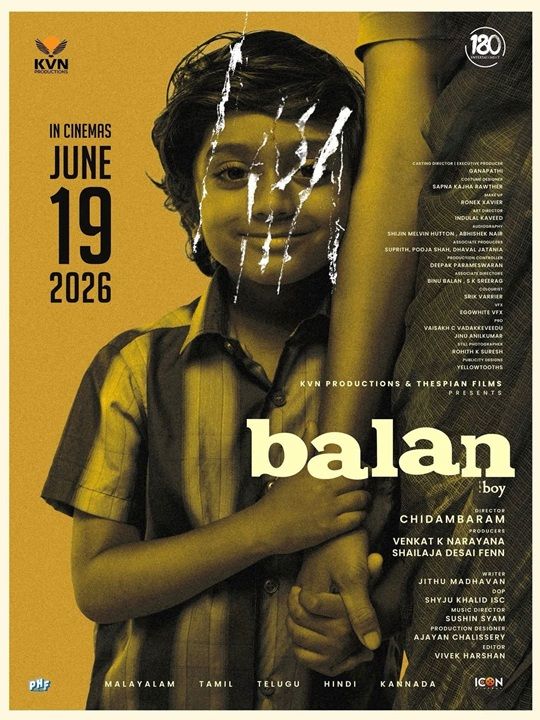
At one point in the Malayalam film Balan The Boy, you see the character of the ‘nameless’ mother (Farzana Palathingal) exclaim on how she doesn’t want her son (Adhisheshan K R) to be a demon or a slave – a searing insight into her past, while also being reflect of her surroundings. And so, the world of Balan can immediately be referred to a fractured fairytale deranged in a morally corrupt world. In fact, the opening setting of a prison is enough to give you a sneak peek into the dark, nightmarish lives of the mother and her son – something told through the crayon drawings on its walls. What seems like a normal story of displacement, also throws hints of abuse, trauma and murder that marks an origin story for the mother who has given birth to her son in the premises of the prison. So when she is about to leave its premises after serving her sentence, you would expect her and her son’s life to change for the better. But what you notice is a darker worldview of the drama that resembles a prison, even as the mother-son duo walk out of it. And that is enough to tell you that this ain’t a Cinderella story – in fact, this ain’t even a fairy tale – or perhaps a fairy tale that is darker in a world that wouldn’t even spare the innocence of a child.
Written by Jithu Madhavan, Balan – The Boy focuses on the dysfunctional and twisted dynamic between the characters of the mother and her son, both of whom are nameless in the context of the drama. The choice might seem to be deliberate, but it probably has more to do with the past of the mother – who has been a victim of trauma and abuse, to the extent that she isn’t able to fully trust anyone around. And the idea of keeping her and her son’s identity in check, is a product of this notion – even as you witness her telling her son that she would reveal their new identities soon.
The proceedings of the first half almost unfold in the form of a time loop – even as you are acquainted to the modus operandi of the mother-son duo – to don an identity and take up fleeting jobs only until a point wherein there are no obligations in play, and leave when a relationship is initiated. For instance in a scene, you see them working at a humble tea shop only until the owner wishes to give name to their relationship by asking the character of the mother to be his daughter. Likewise in another instance, you see the duo narrowly escaping after being partially identified by a fleeting character. The aftermath results in a different identity, a different religion, and a different origin story revolving around their same ‘dark’ past.
The characterization of the mother remains pretty interesting here. She wishes to protect her child from the cruel world, but in doing so, she invariably is responsible for destroying his innocence too. Perhaps in her eyes, the world is a big, bad place that is far from the one we would associate in fairytales – wherein all connections are fake and transactional, so much so that there are trust issues in her armoury, not only stemming from her past of committing a crime, but also how the world would perceive her crime through her times in prison. And yet, you see her softening after spending time with an old woman Ammoomma (Dolly June) in a home that she illegally enters while donning another false identity, with her son.
It is interesting on how Ammoomma could be an extension of the mother in a different timeline – a character who is left in a sea of solitude by her son who doesn’t stay with her. And so, the idea of the mother softening to the former stems from this sentiment also – even as she finally wishes to seek.a secured future for her son by sending him to school, reluctantly so. But at the same time, her protective instincts remain very much in play – something that takes a dark turn preceding an interval block for the ages.
It is interesting on how every norm of the second half is deconstructed from a screenplay writing perspective. Be it the tonal shift that transitions from a psychological drama to a resounding nail-biting thriller, or a structural change in the narrative that transitions from linearity to something that is non-linear – taking a time jump and later connecting the dots. Or even introduces characters late in the screenplay that don’t seem like an after-thought but integral cogs in the world that would make you question the moral ambiguity of the world that the drama is set in – something that finds its traces in the first hour.
There is a considerable shift in the POV even as the focus shifts on to the child (from the mother), who now has to implement her teachings, even as his innocence goes for a toss. The key ingredient remains that of survival – even as the explicit search for his mother begins. And you witness two key dynamics in play here with two very flawed characters – one involving a hot-headed and morally corrupt cop Pavithran (Jean Paul Lal), and the other an equally morally corrupt man with a heart of gold, Abbas (Tovino Thomas).
Both these characters remain on the opposite side of the law, but still the solace is presented through the latter who exploits the boy but also takes care of him, unlike the former who is seething with revenge in an unredeemable character. The emotional core explored of the little boy, now six years older (Muhammed Zinaan) is often kept at bay with regards to Abbas, also signifying the transactional dynamic that the world builds itself on. This, unlike the thorny equation with Pavithran, in what is a searing game of survival.
The idea of inculcating a street-smart approach while having to sacrifice ‘pawns’ and keeping his search for his Amma on the highest priority, is what forms the basis of the drama. And the resounding ending is both bittersweet and jaw-dropping in that regard – a reminder on how this fairytale offers no sugar-coated respite, but a harsh reality check of life that is caught on loop of morality (or the lack of it). So when the lines of morality blur at the end – the drama leaves you with a searing question on whether empathy can override survival? It is another brilliant form of storytelling that challenges your own value system.
The dialogues exude of pivotal cogs of a dark fairytale that offers no respite, in a rags to rags drama while tapping into a strong theme of survival at any cost. The music and BGM by Sushin Shyam is comforting and tender, often forming the (dysfuctional) emotional core of the drama with a resounding flair.
The cinematography by Shyju Khalid paints the world with hues of grey, aligning the darker elements of the fairytale with the gaze of the two protagonists. There is comfort in the intrinsic moments, while transitioning into a cat and mouse game of survival – often denoted by frames capturing objects like a gun, or an old tethered photograph, or even a camera-angle that is used to introduce a character late in the second half. Also notice how the camera doesn’t get too close to any of the characters other than the mother and the son, something that is symbolic on how their bond may be dysfunctional, but it still remains the strongest in the film. The editing pattern deserves a special mention given how the drama felt like three movies packed in one. And yet the transitions are seamless, while offering an emotional (and dysfunctional) gravitas that forms a connecting thread in the narrative.
Director Chidambaram absolutely hits it out of the park yet again after Manjummel Boys (2024). Both his previous two films had distinct emotions that were palatable – but the idea of treading a ground of moral ambiguity through its two flawed protagonists, and creating a palpably dark fairytale world around them, was a mark of a genius. There is purpose in his direction – never indulging in the emotional dynamics of specific characters, while focusing on the streaks of survival, thereby providing a more psychological edge to the proceedings, as compared to a standard narrative. At no point was my intelligence taken for granted, almost leaving me in a moral dilemma at the end that had me pondering about the ending long after the end credits had rolled out. In that sense, the prolific filmmaker has taken a giant leap, even as the direction remains brilliant.
The performances are wonderful by the members of the cast. The likes of Girish A.D., Beena Antony, Chandu Salimkumar, Sandra Chandran and Archana Padmini are pivotal cogs in thr narrative, and each of them manage to impress with their bouts of brilliance. Dolly June as Ammoomma is simply outstanding to witness with her theatrics in play, almost playing a future version of the character of the mother – and backing her antics with unhinged moments of flair.
Tovino Thomas as Abbas and Jean Paul Lal as Pavithran are essentially two very similar characters on the opposite sides of the law, each offering a transactional respite to the protagonist, while testing your degree of interpreting their moralities. And both of them are a joy to watch. Muhammed Zinaan as the elder version of Balan is wonderful to witness, while maintaining the emotional gravitas of his character intact.
Adhisheshan K R as the younger version of Balan epitomizes a child on the brink of losing out on his innocence – even as nursery rhymes seem like haunting chants of the real world, as viewed by him. In a scene, you see him telling a character on how she would be poisoned – a pivotal moment that offers a sneak peek into his psyche. There are darker shades in play that he essays with such effortless ease, that invariably made for a stellar act. Farzana Palathingal as the mother represents her fractured psyche with finesse, playing with her expressions and body language to showcase her vily side without losing sight of her past trauma. This remained a layered portrayal of dyafunctional individual, wrapped in a performance that exuded of complexity. She was brilliant to witness and how!
Driven by exceptional performances, Balan: The Boy unfolds as a dark, dysfunctional fairytale centered on the raw grit of survival. The narrative masterfully navigates the heartbreaking theme of lost innocence, subverting traditional storybook imagery with a grim reality. It stands as a deeply layered, moody, and visceral cinematic experience that commands your attention from start to finish. Available in a theatre near you and Highly recommended!


