

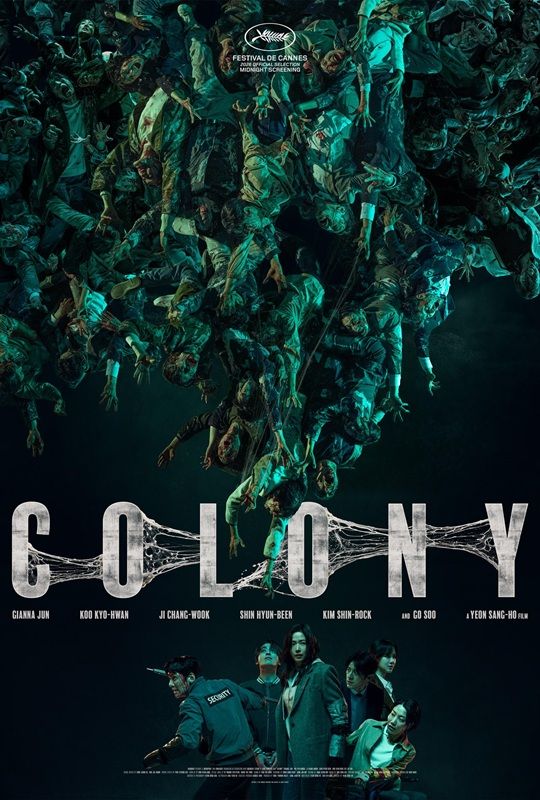
The immediate subtext of the Korean film Colony remains that of technology, which itself subverts the otherwise standard zombie genre. Here, the zombies can be correlated to the prevalence of artificial intelligence – a collective intelligence system that are pitted against the humans. This single plot-point acts as an innovative streak in the narrative as well, something that also adds a new dimension to the narrative. But having said that, the trade-off between the innovation and the lack of characterization turns out to be a pretty major flaw in the narrative – something that doesn’t really transpire into the required set of emotions. Remember Train To Busan (2016) and how the single dynamic between the father and the daughter acted as an undercurrent for an emotional payoff right at the end? The main issue with the narrative remains on the dynamics of the characters in the screenplay, or rather the lack of it – that makes this genre seem fun, but nothing beyond that.
Written by Yeon Sang-ho and Choi Gyu-seok, Colony begins on a very promising note with the focus being on a major Seoul high-rise that would soon be the center of a bio-warfare. The early conflict between scientist Seo Young-chul (Koo Kyo-hwan) and CEO Kang (Kim Jong-Tae) is palpable, stemming its roots with plagiarism and later showing signs of revenge – even as the former injects a slime mold in the latter, something that triggers a chain of events leading to a zombie-outbreak. Somewhere in between, the subtext of technology revolving around collective intelligence involving the cell regeneration leading up to a parallel cycle of evolution – forms the foundation of the drama. This information remains crucial to the zombie outbreak, wherein the information is synced across an entire clan of zombies – even as Young-chul remains the key for the vaccine in play.
You are introduced to the characters in a rather fleeting manner, lead by Kwon Se-jeong (Gianna Jun) – an unemployed professor who would soon find herself in the middle of an outbreak, with the entire building having undergone lockdown. The others include a security guard and his handicapped sister, a police officer, a citizen, an elderly character, Se-jeong’s ex-husband, and a group of Gen-Zs that formulate the narrative. One of the reasons for the drama to work early on, remains its intricate setting.
Much like a zombie attack on a train in Train To Busan (2016), or the one in an isolated piece of land in Peninsula (2020) – the Seoul skyscraper focuses its gaze on an isolated location that automatically offers thrills. Be it the sequence involving the survivors taking refuge in a store, or the hustle across the corridors or the lift, the fun element is introduced in the narrative – even as the writers choose to raise the stakes with a supposedly major character knocked off at the end of the first act. Yes, the lack of emotions are a bit of a deterrent – but the drama still papers over the cracks with timely thrills.
One of the themes remains a clear distinction between the evolution of humans, and the evolution of technology. While the collective intelligence of the zombies works perfectly in sync, you are witness to the lack of coordination being evident between humans – something that does turn out to be fatal in a few instances. As a parallel subtext, there is a searing commentary on the crumbling infrastructure of the authorities in protecting their own citizens – almost being unsure at the start to giving orders to ‘kill off’ the infected patients (read : zombies). And in the middle, the standard tropes of selfishness engulfs the narrative – with some of the survivors turning against each other, barring a couple of instances of sacrifice imposed by the characters.
The proceedings work the best in the first two acts, particularly when the structure of the narrative remains simple and linear, while being tagged with a purpose. For instance, the characters using an olfactory distraction in order to get to the third floor to a particular character who has vaccine injected in himself, or even the latter escaping while turning the zombies on a few characters inside the lift. But somewhere, I did get a feeling that the writers weren’t quite sure with what to really do with the concept – something that is evident as the events get increasingly convoluted against the run of play.
It felt like a clear sign of desperation in wanting to impress the viewers, as opposed to keeping things simple and allowing the standard tropes of the genre to do the talking. A specfic example can be the Taiwanese Zombie film The Sadness (2021) that didn’t try to go in overdrive mode in order to justify its concept. Another drawback remained the lack of emotions that stemmed from the lack of a focused dynamic between the characters. The idea of aiming for an emotional arc for every character was not ideal, given the unfocused nature of the writing – something that further remains buried in the standard tropes of the genre. So even as a character dies by the hands of their loved one following a rampage, or an innocent character is used as bait for the zombies, I largely remained unmoved.
The final act for me did not work as well, given that it steered away from the intrinsic setting of the skyscraper onto the streets – almost fizzling away the tension of the setting, whilst also being abrupt with its conclusion. It just felt like an opportunity that did not fully translate into the required result – trying to stay relevant with its fascinating and innovative concept, but increasingly getting convoluted, distracted and convenient with its writing. And that summed up the screenplay for me that had its moments but didn’t fully hit a home-run.
The dialogues are pretty generic, and devoid of a strong emotional core that would have elevated the impact of the drama even more. The BGM is intense, and accurately accounts for the rising levels of tension – amidst the growing ambience of horror. The cinematography offers a kinetic trajectory through its frames that remain mobile through and through, without offering any respite. The constantly shaky frames account for multiple moments of gore and blood, while always maintaining the momentum in the drama. My only complaint that pretty much remained constant was how the framea never fully committed to the idea of creating any emotions for any characters along the way. The prosthetics department deserve a mention for their immaculate attention to detail as far as the zombies were concerned.
The editing pattern comprises of rapid cuts that do their bit in keeping you hooked for the first two acts in the narrative. But the lags do creep in when the ambition of the drama precedes its simplicity – something that had me fidgeting in my seat, after a point. It almost gave me an impression that all the ideas had fizzled out, and still the finishing line was nowhere in sight for the writers. And that reflected in the editing style that stuttered with the momentum that was built up initially, only to lead upto an abrupt conclusion.
Director Yeon Sang-Ho definitely wasn’t done with the zombie genre after Train To Busan (2016) and Peninsula (2020). And he does show his skills of innovation here, with a brand new concept that definitely adds a fresh layer to the standard zombie genre. To be fair, he does a good job in the first two acts – building levels of tension and thereby, keeping the viewers on their toes – despite an evident lack of emotions and dynamics through its characters. But he doesn’t fully seem in control when he tries to over-inject the proceedings with multiple tracks – thereby leading to convoluted set of events wherein the main concept feels lost. And this is where the direction suffers, ending up with a mixed bag.
The performances are pretty good by the members of the cast. Kim Jong-tae as CEO Kang is wonderful to witness despite a limited screentime. Go Soo as Han Kyu-seong and Lee Jung-ok as Lee offer varied character traits that maybe poles apart – while being representative of the scattered evolution of humans. Both of them manage to impress. Lee Dam-hee as Lee So-eun and Shin Hyun-been as Kong are specific cogs in the narrative that offer variants of victimhood and selfishness in humans, and both are superb in their respective roles.
Ji Chang-wook does a fine job in esaaying the exhausted building security guard Choi Hyun-seok, capturing universal acclaim for his frantic, sweat-inducing physical stamina and desperate protective instinct. Trapped alongside him, Kim Shin-rok delivers a masterclass in physical restraint as his sister Choi Hyun-hee, utilizing incredible micro-expressions and intense vocal vulnerability to convey the absolute terror of navigating an outbreak with a physical disability.
Gianna Jun grounds the narrative as the brilliant biotechnologist Kwon Se-jeong, scoring well for a cerebral, analytical performance that replaces typical action tropes with a fierce, intellectual grit. She plays beautifully against Koo Kyo-hwan, who turns Seo Young-cheol into a genuinely unsettling antagonist, even as both feed energies off each other while delivering stellar acts.
Colony breathes fresh air into the zombie genre with an innovative, highly engaging first half. However, the momentum halts post-midway as the narrative succumbs to convoluted writing and a visible drought of creative ideas. Without a strong emotional core to ground the stakes, the drama fails to fully elevate, ultimately resulting in an above-average watch. Available in a theatre near you.


