
One of the apt ways of explaining the Hindi film Welcome To The Jungle (aka Welcome 3; they legit start with film with the words – Welcome, Welcome, Welcome…) is to compare it to the character of Ranchoddas Shyamaldas Chanchad aka Rancho from 3 Idiots (2009). His initial antics make you want to believe that he would fail his exams, almost having no hopes of even passing. But literally everyone is in for a shocker after seeing the report card. Or more so, that one tail-ender who is literally a mug with the bat – only to mindlessly slog his way to a meaningful contribution. To be fair, Welcome To The Jungle isn’t a class topper like Rancho, nor is it a tail-ender who top scores for their team.
It is basically an Indian spin-off of Tropic Thunder (2009) with hints of the Farah Khan directorial venture Tees Maar Khan (2010) that fairs much better than what I thought it to be. If my barometer was a one star to begin with, the end result means that I was fairly entertained and feeling ticklish in spurts and jerks. It is by no means a perfect film, but it still makes for a pleasant ‘middling’ experience that had me grinning – much like Andy from The Shawshank Redemption (1994) by the end of things. In that sense, this maybe the first shocker of the year that has successfully undergone a jailbreak!
Written by Late Neeraj Vora and Farhad Samji, Welcome To The Jungle can best be described as a parody of the spoofy-ness that Bollywood has to offer currently – even as a billionaire on the brink of a tax evasion is advised to make an outrageously expensive Bollywood film in order for it to tank – just so that he could get away with the fraudulence. It almost remains a meta-reference to the film in question – while assembling a host of actors that have plenty of dates at their disposal, barring a handful.
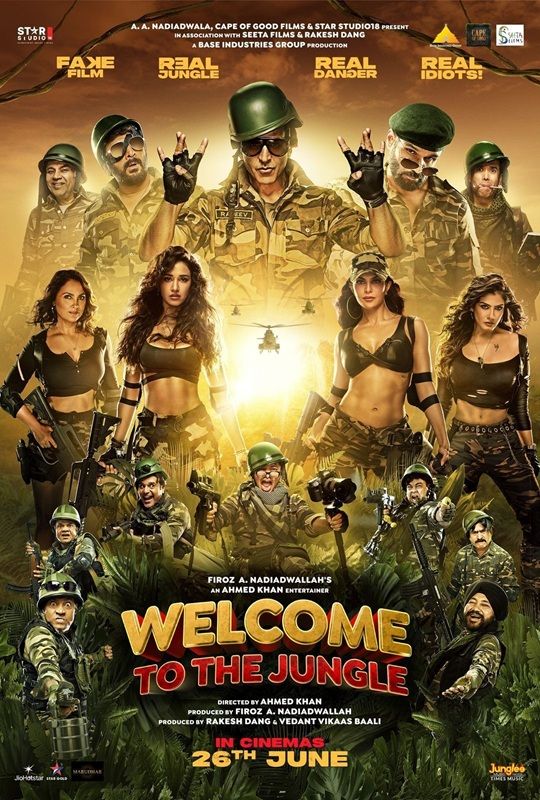
Back in the narrative, and the task remains to deliberately gather a team of misfits – a flop actor Rajiv (Akshay Kumar, but notice the name) who has been fending off Bhojpuri gigs to keep his fading stardom intact, a director duo by the names of Dev (Paresh Rawal) and Das (Rajpal Yadav) who reference Dhurandhar as their big-ticket ‘leap’, a visually impaired cameraman (Shreyas Talpade) who wouldn’t know whom to focus on, two qualified gangsters of the Uday-Majnu clan – Romeo (Arshad Warsi) and Yeda Anna (Suneil Shetty) of Awaara Paagal Deewana (2002) fame, Rajiv’s ex flame Nadia (Disha Patani), the nepo-kid co-producer turned actor Munni (Jacqualine Fernandez), a couple of TV stars and Bhojpuri stars, a Punjabi singer – and a script that caters around the Indian Military rescuing a village from Pakistani terrorists.
The proceedings are a little wobbly to begin with, wherein I found myself gasping at the intended humour, more than laughing out loud – even as the meta-humour felt slightly forced. For instance, the classic Majnu painting of a donkey on a horse is reversed as a horse on a donkey – something that had me facepalm. Or even the forced montage of a military training in a followup to the main film production that had me sinking. What works even between these moments is the meta-reference of Rajiv talking about money coming in his way of walking out of the film, or the nostalgic bait on Yeda Anna that actually works. Or even the heated yet clumsily funny dynamic between Anna and Rajiv – both fighting it out figuratively to deduce who the ‘real’ hero of the film is, a classic subtext on why multiple starcast films aren’t made today due to inflated egos. The portion involving the reel death of a character, only for that character refusing to die – is literally to die for.
The fun truly begins when the focus shifts to a remote village that remains the center of terrorism lead by Zatara (Jackie Shroff), even as the proceedings flip – and the film needs to complete in one-day while ensuring that it is a blockbuster. And this is the period when the drama is the most self-aware with its humour – be it the meta-monologue of a villager Zoya (Raveena Tandon) that would directly take a dig at her real-life affair with her co-star 20 years ago, or a mumbling old lady (Farida Jalal) that is further acknowledged by an indecipherable Urdu-speaking elderly man (Kiran Kumar), all of it being a nod to the villagers of Tees Maar Khan. You even get gems like Rajiv confessing that he isn’t a nationalist and has nothing to do with the country – a very self-aware subtext of the facade pulled off by so many stars today. Or a hilarious Dubey (Johnny Lever) suddenly losing his voice at a pivotal moment, to abruptly stall the flow of communication at tge most inappropriate point. This, while having the most outrageously brilliant interval block that hit it out of the park with a special ‘song’ in play.
I am unsure on the potential recognized by the crew with regards to the drama here – something that would have absolutely hit home, if certain elements were taken care of without losing sight of the proceedings. The concept of shooting the film guerilla style (a literal gorilla appears out of nowhere at its first mention) is somewhere lost in the buffonery of overtrying the punches. For instance, the gag of a Punjabi singer (Daler Mehndi) being shot only for him to sing one of his sad ‘aalaps’ of his song, would have worked even better if the film hadn’t lost sight of its central theme in the second hour. The whole idea of neutralizing the terrorists amidst a sea of buffonery wasn’t a bad ploy – but would have worked better with the context of shooting a film.
Some of the humour is pretty lame, even in the boundaries of a parody. For instance, two heroines employed for ‘glamour’ use subtle moans to distract male terrorists in order to ambush them. Or a random sequence involving a gorilla that felt like a random nod to the climax of Phir Hera Pheri (2006). Or a nostalgic throwback to a famous TV show before nullifying its relevance with a Jawan-coded introduction of a lisping elderly character. Or the entire arc of Zatara that felt pretty timid by the end of it. Or even the eye-sore of a finale that felt like a nod to Bajrangi Bhaijaan (2015) meeting Welcome (2007). What I missed for an additional 10 minute outro that would circle back to the main plot of the film being a blockbuster, a la Tees Maar Khan that featured a surprise cameo by the film critic Komal Nahta. That abrupt ending stripped the potential of a laughathon at the end. Had these issues been fine-tuned, the end result would have been a spoof for the ages! But nevertheless, the end result still felt like a vast improvement from my expectations from the film – something that was fun while it lasted.
The dialogues range from lame to actually funny, filled with multiple meta-references that are atleast entertaining to some extent. While the lines like ‘He Is Your Ex. But Y?’ don’t land, the rawness of the drama peaks in some moments of self-aware humour that scores against the run of play. The music and BGM are decent, but go well with the brainrot mood of the drama. The cinematography is a wild swing that inducing slapstick humour and falling back on physical comedy through the frames. Yes, the frames at times feel straight out of an adobe screensaver but it weirdly blends itself in meta-ness of the world (remember that this is a film within a film too).
The editing pattern leaves a lot to be desired, and one of the aspects that lowers the impact of the drama. Yes, I understand that this is a parody or a spoof or even a film within a film. But there still needed to be a better structure to the madness unfolding – as opposed to random mismatch of cuts that would christen the narrative. This is particularly evident in the second hour that felt like a video game on easy mode, something that significantly undoes the good work of the self-aware beats of the drama. Director Ahmed Khan may have probably outdone himself here. And while that doesn’t say much given his mediocre filmography, there are instances wherein the humour lands really well – even whilst being self-aware with its tone. The issue arises when the filmmaker chooses to overdo things while allowing his ambition to overpower the otherwise self-aware nature of the drama. But the end-result still isn’t bad, and good for some unhinged laughter.
The performances are pretty good given how all actors plays a spoofy versions of themselves. While the likes of Zakir Hussain and Brijendra Kala have little to do, Farida Jalal and Kiran Kumar are outrageously hilarious with their respective roles. Urvashi Rautela is decent, Hemant Pandey, Sudesh Berry, Jeetu Verma, Tusshar Kapoor, Aftab Shivdasani and Vindu Dara Singh are fairly alright in their respective roles. The much nostalgic (final) reunion of the trio Pankaj Dheer (in his final outing), Puneet Issar, and Feroze Khan was a sight to witness, wherein all actors manage to shine. Krushna Abhishek, Kiku Sharda, Daler Mehndi, Yashpal Sharma, and Mukesh Tiwari play spoofy versions of themselves to good effect. Raveena Tandon scores well with her restrained meta-humour while leaving a lasting impression.
Lara Dutta plays to the galleries with her tough demeanor, and she does a good job here. Shreyas Talpade is ticklish and does a fine job. The trio of Johnny Lever, Rajpal Yadav and Paresh Rawal are wonderful to witness here, and their natural flair for comedy will have you laughing at varied intervals in the narrative. Jackie Shroff is decent, although his arc felt pretty lame. Disha Patani and Jacqualine Fernandez are just there for the glamour factor (as mentioned by a couple of characters in the narrative), and they are decent here.
Arshad Warsi as Romeo has a superb flair for comedy, wherein he finds humour at some unexpected places. Suniel Shetty in an alternate version of Yeda Anna from Awaara Paagal Deewana nails his performance with his unhinged bout of comedy. But it is yet again Akshay Kumar who excels in a raw bout of comedy that has him unleashing his most brutal yet self-aware dose on himself, and others around him. He isn’t afraid of making a fool out of himself, often allowing his natural comedic traits to take over. He is fabulous here, re-establishing the fact that his comic timing might be the finest amongst his mainstream counterparts.
Welcome To The Jungle is so bad that it actually loops back around to being entertaining. It is pleasantly middling – the highest praise I can give a film I had zero expectations for. While the writing does stumble when it tries too hard, the movie thrives on a self-aware sense of humour that keeps the proceedings pretty watchable. Not gonna lie, it ain’t as bad as I feared it to be! It is brainrot done ‘almost’ right. Available in a theatre near you.


