

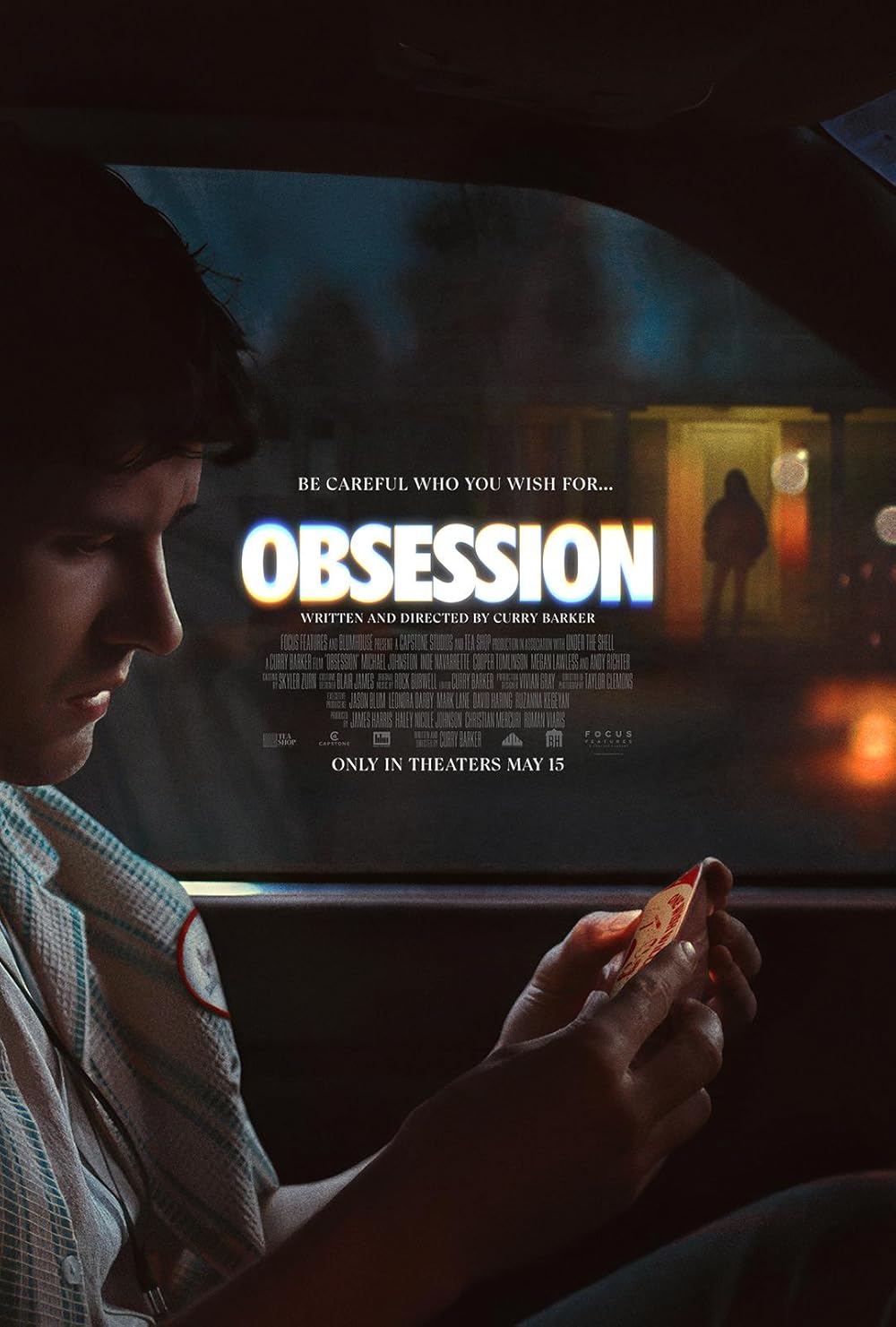
As a part of the cold open in the new English film Obsession, you are introduced to a fumbling protagonist Bear (Michael Johnston), even as he practices proposing to his childhood crush Nikki (Inde Navarrette). Bear almost resembles Karan (Tusshar Kapoor) from Mujhe Kucch Kehna Hai (2001), or similar variants of him onscreen who are overcome by fear of having to express their feelings for a girl that they love. There is a noticeable sense of awkwardness to his demeanor – be it his stuttering speech or his drooping shoulders, that instantly makes him ad oddball having the tag of a “nice guy”. It is interesting on how the protagonist remains a predecessor of the Toxic Alpha make (of the Toxic ‘Paglu’ Universe) who remains in his nascent phase of being consumed by his own solitude. So in the next scene wherein you witness his cat dying after accidently consuming the drug oxycodone – you realise a sense of loneliness engulfing his life, further re-establishing his idea of love towards Nikki – something that emerges more out of the idea of wanting someone to love around him (particularly after suffering a loss) without actually spending time and effort to build his relationship.
Written by Curry Barker, Obsession taps into a very specific streak of love that dangerously borders on the ruins of a relationship. The ‘one-sided love’ narrative is particularly true in males who aren’t exactly taught to express their deepest feelings – something that invariably makes them hollow and vulnerable from within. For Bear specifically, while he is ‘obsessed’ with Nikki, the latter isn’t particularly interested in him – even as you witness her turning to her friends Ian (Cooper Tomlinson) and Sarah (Megan Lawless) to drop her home as opposed to Bear. The protagonist though doesn’t wish to lose out on a specific chance – willing to buy her a gift as a replacement for an item that she lost recently. And while stumbling upon a ‘One Wish Willow’ – his life would eventually change…..for the worse!
The ‘One Wish Willow’ itself reminded me of the central conflict of The Substance (2024), wherein a drug would eventually go on to change the course of an individual. Here the logical aspect of it seems vague – even as ‘One Wish Willow’ represents a ‘programme’ or a ‘supernatural force’ probably to supersede the body of the assailant. So what seems like a harmless wish of ‘deep love’ and ‘the want to love him more than anyone else in the world’ – turns out to be the worst decision for Bear. The results are humourously immediate – a sudden want of Nikki to be in close proximity to Bear, lying her way around to get him in bed, and profusely addicted to him in terms of physicality. While these maybe a wet dream for any guy, the reality is far from rosy!
There is a subtext of consent that accompanies the narrative – with Bear’s wish completely stripping Nikki of her free will, thereby superseding the idea of love in its organic form. And with that, you also witness the idea of intimacy taking a backseat – in a scene wherein you suddenly witness Bear yelping in fear out of nowhere. There is a consistent mood of tension being created with the antics of the protagonist, who is suddenly at the receiving end of the obsessive overdrive of his partner. The aftertaste is horrific, disgusting and nauseating – even as the intensity of ‘obsession’ steadily increases throughout the narrative.
The characterization of Nikki remains a fascinating one – someone who is trapped in the realms of a psychological prison without having any control of her body or actions. This also includes ‘glitches’ of the real Nikki suddenly appearing against the run of play, only to be superseded by the ‘wish programme’ – making her an unpredictable entity. In a scene, you see her covered in bodily fluids and faeces while waiting at the same spot for Bear the whole day. In another, you see her pushing Sarah away during a game just so that she could be kissed by Bear. And in another, you see her boisterously intimidate Bear into taking her to his Boys’ Night Out. This, while creating an eerie environment of fear for the protagonist who is soon running out of options.
The horror elements incorporated aren’t really atmospheric, or relying too much on the ambience around. The nature remains sudden and ‘against the run of play’, as opposed to a steady buildup towards a particular incident. So when a character is suddenly bludgeoned to death, the scene in itself comes out of nowhere – without the filmmaking preparing you about the inevitable (wherein you almost would predict and question the antics of a character going in the dark for instance, invariably to their death). This made the drama unpredictable while christening it with a new template – something that was also used as a foreshadow for the final act.
The twisty nature of the proceedings also find a voice towards the end – often lacing the narrative witb bouts of black humour that nicely mixes the dynamic. And while being a little abrupt with the conclusion, the turn of events by itself amp up the intensity and gore in the narrative – something that kept me on the edge of my seat with my hands covered over my mouth. The twisted tragedy employed at the end felt poetic in every sense, especially if I were to trace back the core themes of the film leading up to a particular character being the antagonist (no spoilers here, go watch the film). And that summed up an interesting piece of writing that ticked all the boxes for a horror film while laying out a fresh template of storytelling along the way.
The dialogues deliberately range from corny to sprinkles of dark humour, with every line adding a different ‘bite’ and fresh dimension to the drama. The BGM adds to the unpredictability of the drama with sudden bouts of whiplash to hold your attention, even while perfectly maintaining an eerie ambience with its notes. The cinematography employs a tight aspect ratio of 1.50:1 – deliberately in order to create a prison-like environment for the two protagonists who are stuck in symbiotic loops of their own. This creates a sense of claustrophobia along with bouts of suddenness that often catch you unaware. The idea was particularly impressige given the modest budget of the film.
The editing pattern is an interesting case point – often employing long takes with sudden turns and mood shifts that create an air of unpredictability. This creates an eerie atmosphere of tension laced in a slow-burn narrative that truly elevates the impact of the drama. Director Curry Barker ably formulates a fresh approach in constructing a horror film. His idea isn’t tilted towards building an atmosphere but ringing in a sudden tonal shift in a specific scene, something that would instantly change its mood. As a result, he is successful in keeping the viewers guessing about his next move – often allowing his character’s actions to define the next passage of the narrative. This, without relying on any external gimmicks like a haunted house or rain to create an impact. It remained a commendable effort, instantly making him a fine new voice in the horror genre. The direction is excellent here!
The performances are wonderful by the members of the cast. Darin Toonder as Harry and Haley Fitzgerald as Viola have their moments to shine, particularly given their stoic but frothy body language that deliberately goes against the mood of the drama. Megan Lawless as Sarah and Cooper Tomlinson as Ian remain important cogs in the narrative, particularly with respect to their interpersonal dynamics that they wickedly share with the protagonists. And there is an oscillating jest and naivety that laces their terrific performances, wherein both are wonderful to witness.
Michael Johnston as Bear is excellent here in a character that has to account for a wide variety of emotions. He uses his expressions perfectly while labeling Bear both as a victim and an orchestrator of the events – so much so that you don’t fully detest him, but you also don’t fully sympathize with him. In that regard, this remained a rather balanced act.
Inde Navarrette as Nikki delivers probably one of the most unassuming and unpredictable performances of the year. Her act needed to account for frequent mood changes and sudden outbursts – even without losing out on her physical antics and eerie expressions. There is a sense of assurity in her demeanor, creating a sinister and eccentric vibe around her character, while also deftly touching upon the emotional core of the character. This remained a complex character played to perfection by Inde.
Featuring brilliant performances, Obsession is a snarly ode to toxicity and one-sided love wrapped in an unsettling horror thriller. It hits all the right notes, making it an excellent, deeply uncomfortable watch. Available in theatres in India from 29th May’26 and Highly Recommended!


