

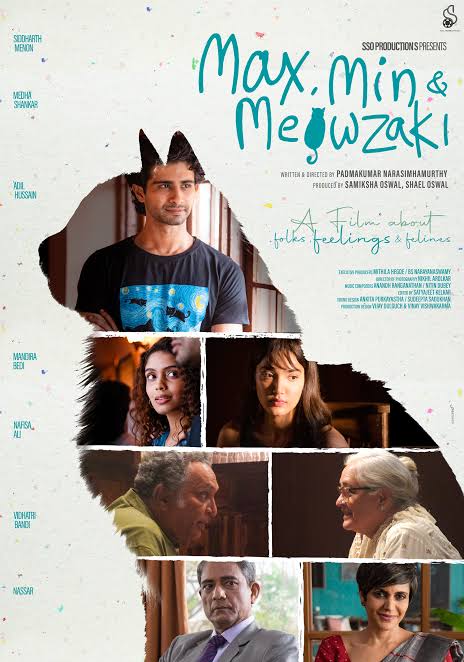
There is an early line in the Hindi film Max, Min & Meowzaki wherein a character claims that the films of veteran filmmaker Hayao Miyazaki don’t feel the same – to which the other character mentions on how they have outgrown its magic. This line encapsulates the spirit of the drama here that essentially wishes to focus on the dynamics between characters, wherein every relationship comes with an expiry date. So when you are first introduced to Max (Siddharth Menon), you see him on the verge of a breakup with Min (Medha Shankr) while having to hold onto the custody of his cat Meowzaki.
A fleeting flashback transports us into the happier times of the couple, wherein the cat itself remained a bridge of an emotional connect between the couple who thrive on the films of Hayao Mirazaki (hence, the name of the cat). And yet, the journey hasn’t been easy for the couple who are like chalk and cheese from the start – she loves cats, he is allergic to them, and his ability to use a nasal spray to counter the latter signifies on his idea of commitment to love. But ironically on the cusp of his breakup – all that is left with him is the one animal that he is allergic to, an allegory of having to deal with the grief and trauma of his past and present, all of which would formulate the fabric of his identity.
Written by Narasimhamurthy Padmakumar, the biggest strength of the film Max Min And Meowzaki offers an early nod to the recently released Hindi show Family Therapy (2025), particularly with respect to the character of Ramesh (Adil Hussain). And it is interesting on how his bout of trauma and grief connects and ironically distances himself from his son Max (whom he likes calling as Mahesh). Here the character of Ramesh resembles an onion – offers layers to him. You can sense with his interactions with his psychiatrist Dhaara (Mandira Bedi) that he has lived a life of an alpha-male – being a topper of his batch in IIT Madras, starting a business of his own, and wanting his son to assist him there. This dominance is all that he has learnt in life, but suddenly when his power center is compromised in the form of the passing away of his wife, and being distanced from his son – is when he is forced to opt for therapy.
One of the core dynamics of the drama is that between the frosty bond shared between Max and his father. In fact, Max is someone modelled on the lines of a man-child character from Wake Up Sid (2009) – having a mind of his own but never on the same page as his father. You can sense that his heart lies elsewhere, not wanting to handle his family business much to the annoyance of his father, while focusing on singing for ad jingles. And given that his family has had a history of classical Carnatic music, makes his father even more annoyed.
But the protagonist doesn’t wish to budge, ironically only compromising in the ‘confused’ matters of love that sees him trying to opt for rebound dates, but desperately running away from them. And it is interesting also on the reason why Min distances herself from him is because she doesn’t wish to stay with a man-child, instead choosing to stay with a matured ‘married’ man who would also help her fulfill her ambition. So essentially, Min is modelled on the lines of Aisha Banerjee from Wake Up Sid (2009), except that she mirrors the psyche of Max. This basically means that while she doesn’t want to stay with him, she still emotionally clings onto his persona while being protective about him. That also explains why she left Meowzaki with him despite being very close to the furry animal, because he didn’t want to break down following their breakup – something that coincided with his mother’s death.
One of the recurring themes of the drama remains the generational gap between the characters, something that defines their identity and actions. For instance when you are introduced to the grandfather of Max, Sridhar (Nassar) – you see him grappling with loneliness in his last leg of life, something that makes him seek for companionship with an elderly dementia-stricken lady Jennifer (Nafisa Ali). And you just witness the warmth of the bond that Sridhar shares with Max – being his buddy more than a patriarch, and fleetingly joking with him on how all the men of his family are now single – following the breakup of Max, and the demise of Max’s mother.
But ironically in a moving scene, you see Sridhar confessing on how he wasn’t a good father to Ramesh – being emotionally distant with him as a child. Interestingly, even Ramesh finds himself at similar crossroads – being emotionally distanced from his son whom he meets just on Sundays for breakfast, while being in disagreement with him on most aspects of life. The marginal political commentary prevalent that is even more relevant today, forms the fabric of their relationship too – with Max being the liberal Gen-Z who doesn’t wish to restrict his thoughts and ideologies beyond the regular inflammatory Whatsapp forwards unlike his father, who has formed an opinion based on the online University of Whatsapp. The generational gap is echoed through a searing political commentary that has finally formed a steady voice in the Capital, as I type.
It is interesting on how the core theme of the drama remains that of mental health and healing, as viewed through the POV of most characters. For instance, the only core memory that Jennifer holds onto is about her twin-brothers who aren’t around in the last leg of her life. Or perhaps in hindsight, she remains the luckiest one given how her dementia prevents her from holding onto any painful memories. For her granddaughter Carol (Vidhatri Bandi), it remains about escapism from pain – the pain of surviving a broken marriage, or losing her parents, or being involved in a relationship with a married man who hasn’t committed to their future. The escapism is in the form of baby-sitting her furry creatures that in turn brings her in contact with Max, another character coping with loss while turning towards bad dates and films of Miyazaki to heal. The same holds true for Ramesh and Sridhar as well – two similarly-shaped up characters who have guilt mixed with regret, only for realisation to kick in at a much later stage.
In many ways, the drama acts as a coming of age tale for all these characters – offering them perspectives of life, and allowing them space to heal. And all of these contribute to bittersweet moments that tingle and gently tug the strings of your heart. The screenplay in many ways felt like a bout of therapy, offering a reminder on the setbacks of life that don’t have a merit in the long run, and the art of letting go, while focusing on the smaller celebrations of life that in turn trigger a healing mechanism within each one of us. Just like the mystical films of Hayao Miyazaki that allow you to believe in the magic of life, despite its imperfections.
The dialogues are therapeutic and politically relevant, while offering a bout of healing along the journey of characters. The tone remains understated, even as the lines offer brewing bouts of conversations. If anything, there are instances of overexplaining things – particularly towards the end (note the dynamic between Max and Min), that remained a minor blip in the wake of spoonfeeding the viewers with information. The music and BGM beautifully account for a symphony of emotions that don’t overpower the narrative at any point, while serenely infusing the understated free spirit of the drama through notes of fusion towards the end.
The cinematography offers frames that are leisurely and soothing, often being painted with soft colours that have a calming influence on the drama. The frames also offer a quiet sense of resilience amongst the characters suffering from grief and trauma, that later transitions into hope. And this helps in keeping the viewers emotionally abreast with the characters, even whilst not fully getting too close to them. The editing pattern allows the conversations to linger on effectively in a virtual hyperlink format, while maintaining the emotional core from one scene to another. The only real stutter with the editing was in the final act that had mild moments of lag, something that stretched the drama in its final moments.
Director Narasimhamurthy Padmakumar has an understated approach to christen his world in a sea of grief, while allowing a layer of sensitivity in treating his characters, often through bouts of empathy that humanises each of them. The main keywords remain understated and soothing – something that accurately defines the drama. The direction remains brilliant as ever, maintaining a stranglehold on the proceedings that are christened with bittersweet emotions of grief, trauma, depression, and the art of moving on.
The performances are wonderful by the members of the cast. Sameksha Oswal as Yuki Gitanjali Rao as Vasudha offer quiet little bouts of sensitivity through their respective performances. Elisha Mayor has a solid screen presence, and she manages to impress as the rebound of Max. Nafisa Ali as Jennifer is quite affable while delivering an understated performance laced with positivity and grief. Her portrayal beautifully highlights how older adults handle loneliness by seeking pure companionship, joy, and emotional nourishment without ever appearing helpless. Nassar as Sridhar is brilliant as ever in a character that injects a sense of lightheartedness to the proceedings mixed with shades of regret. There is an incredible amount of warmth in his performance that will definitely strike a chord with you.
Medha Shankr as Min is typically a reimaged version of Ayesha Banerjee from Wake Up Sid, except that she continues to hinge on the emotional core with regards to Max. She could so easily have been showcased as a walking red-flag, but there are genuine emotions that cater to her character – something that she wonderfully pulls through in a pretty impactful act.
Mandira Bedi as Dhaara is a nod to the character of Neha Dhupia from the show Perfect Family, showing wonderful restraint and poise with regards to her performance that is graceful as ever. And the subtext with respect to her identity is deftly touched upon with sensitivity at the end.
Vidhatri Bandi as Carol is sincere and earnest in a character that is carrying a mountain of trauma within her, while seeking various forms of escapism. She uses her delightful expressions and body language to such good effect, wonderfully traversing the various shades of her character with a lot of ease. And in the process, the palpable emotions that she brings to the table are commendable to witness.
Adil Hussain as Ramesh masterfully creates an alternate dimension of masculinity, in a character who is essentially in transit of sorts. He represents someone who is conservative in nature, majorly owing to his past that was induced with his own share of grief and trauma. And his understated approach allows you to reflect on his perspective, without having to judge him – and later witnessing a masterful transition that is equally heartwarming to witness. He was incredible to witness here.
Siddharth Menon as Max has a palpable side of innocence to his character, that essentially may make him a man-child, but also offers a sensitive side to him which is affable. His key emotion remains that of trauma and grief – one involving the passing away of his mother and his breakup, and the idea of having to bear his emotionally unavailable father going forward. And so, he basically represents the youth of today who is messy, complicated but also sensitive (you see him questioning Min on why do people love the violent films of her boyfriend, even as he is a fan of Hayao Miyazaki). He brings such affability and sincerity through his expressions and body language, that you eventually begin to root for him. This was a coming of age act by a very talented performer who has aced his act here.
Max, Min And Meowzaki is a masterfully crafted, therapeutic symphony of emotions that tackles the heavy burdens of grief, trauma, and generational divides with remarkable effervescence. Structurally, the narrative unfolds with the healing intimacy of a therapy session. The drama is wonderfully woven, tender, and soft – offering a much-needed breath of fresh air in contemporary storytelling, and making it an absolute must-watch. Available in a theatre near you (from 24th July 2026 onwards), and Highly Recommended!


