

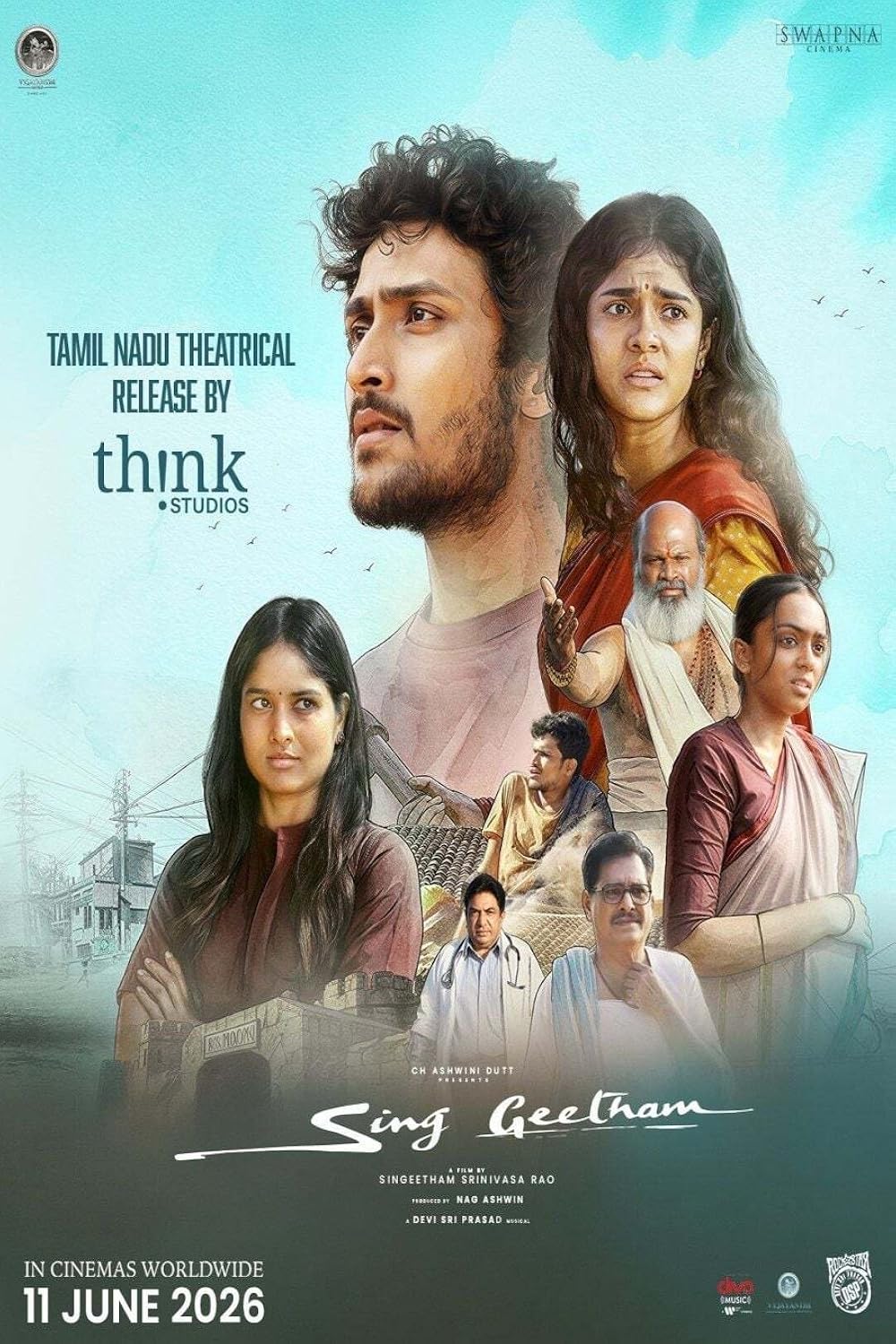
Although a little wobbly to begin with, the start of the Telugu film Sing Geetham showcases early signs of greed, even as you are introduced to the protagonist Prathap (Ayaan) who after serving his sentence in jail, quickly shifts focus to an isolated village that is witness to greed. In fact, it is this greed that also connects the protagonist and the setting – the latter having to deal with illegal mining at the hands of a corporator Renu (Shalini Kondepudi) and her father who have invariably razed every single piece of land, opting for another bout in order to clear their debt. However, the drama is quick to establish itself as an eco-fable – initially in the form of a beautiful tree, that remains the last ‘branch’ of hope for the villagers, even while introducing the viewers to its caretaker, a girl named Gowri (Ahilya Bamroo) who believes the tree to be the version of her late mother. In its truest sense, the drama here employs the standard telugu film template of good versus evil – one featuring the poor villagers that are pitted against the evil capitalists, while completely transforming the tale into a quirky musical ride that leaves you with a warm fuzzy feeling by the end of things.
Written by the 94 year ‘young’ writer Singeetham Srinivasa Rao, Sing Geetham can immediately be viewed as a companion piece to the prolific director’s iconic film Pushpaka Vimana (1987) – particularly given the contrasting themes employed in both films. While the latter was a silent comedy, Sing Geetham remains a musical comedy – almost designed to be a quirky revolution, without losing sight of the seeds of greed that defined the drama in the first place.
For instance, greed as an emotion is showcased to be contagious in many ways – percolating from the evil capitalists, to the protagonist Prathap and later on the villagers barring Gowri – even as the village is invariably witness to the razing of the last standing tree, with even the Gods silent in the land that had no hopes left. But in this land of fantasy – are the Gods actually silent? That is the question that the writing poses, even while exposing the viewers to a musical ride with a hint of quirk – even as the entire village is cursed to sing after the incident.
It is interesting on how the ‘singing’ becomes a pivotal device of driving the narrative forward, reserving a major chunk for itself – even as the ‘typical’ dialogues are only prevalent at the start and end of the drama. And the part of the drama that makes the narrative quirky is the characterization. Be it the village quack turned doctor (a reminiscent of the quack from Gram Chikitsalay) who prescribes medicine for fever in order to prevent villagers from singing. Or a priest that ‘charges’ money from all visitors of the temple. Or two identical twins who are shown to fighting with each other. Or even a pregnant woman who is about to bring a child into a village that is increasingly getting hopeless by the minute.
The writing is fresh, almost shepherding the narrative with unique bouts of quirks that keep the narrative afloat. Be it an instance of the villagers trying to figure out a way to stop the singing, or the characters suddenly spurting out truth bombs in the form of musical conversations, or even an instance of the characters invariably speaking s-l-o-w-l-y in gibberish, something that makes sense only later on in the film. Even an extended flashback is enough to reiterate the origin story of greed in the vicinity, while providing a searing commentary on the environment that also forms a connection with the ‘Gods’ in the story. The proceedings remain inventive and utterly affable, almost wanting to be like a wakeup call in many ways.
The one form of criticism that I had was with respect to the final act, wherein the drama gets a little too ambitious for its own shoes. The simplicity is traded for a more layered narrative, and while there is nothing wrong with that – the proceedings begin to stretch out, as opposed to being breezy and frothy whilst being poignant. The Indiana Jones style of finale does work in parts, but the conclusion could have been reached sooner than what was employed eventually. And yet, the messaging itself followed by the quirky outro is so palpably relevant that it invariably showcased seeds of poignancy without allowing the drama to get overbearing. The drama could so easily have been guilty of the latter, if the songs were replaced with words. It signals a screenplay that is really well written, while putting its message across with an inherent sense of charm and wit.
I don’t get a chance to mention this everyday – but the prevalence of the music over words, is what set the drama to be unique, while never allowing the proceedings to get preachy. The music by Devi Sri Prasad is excellent, using the sound design to such good effect and precision that in a scene, you are also witness to a crow crooning much like the villagers in the mix. The level of detailing is definitely in play, and it accounts for an immensely satisfying watch. The cinematography comprises of frames that capture the quirks of the setting with aplomb, without losing sight of the emotional hinge that ties its characters together. The oscillating balance of wide-angle shots and the mid-shots cater to this norm, while always allowing you space to invest in the characters.
The editing pattern could have been a little better – seemingly being minutely choppy to begin with, while not quite accounting for lags towards the end. But the faster cuts employed in the second act does allow the humour in the drama to land, while creating the much needed momentum for the drama.
Director Singeetham Srinivasa Rao has my heart, for showcasing the spirit and resilience of a teenager (ably supported by prolific filmmaker Nag Ashwin who acts as his assistant here). The end result is an environmental fable that is as endearing as it is revolutionary, as quirky as it is poignant, and as soulful as it is humourous. The characterization is top notch, ably supported by a fantasy world that had me invested throughout the narrative. The direction is stupendous by the 94 year old veteran director, even I as bow my head to the master. Brilliant is the word!
The performances are wonderful by the members of the cast. The starry cameo by Vijay Devarakonda at the end was a lot of fun to witness. Rahul Ravindran as Uday and Nivetha Pethuraj as Sailaja are superb in their performances despite a limited screen time, and both of them have their moments to shine. Srikuktha Macha is sincere and earnest with her act, often also inducing an emotional hinge in the narrative. Yogi Khatri as Gowri’s father, Sivannarayana Naripeddi as Super, Banerjee as Renu’s father and Mahesh Achanta as the compounder showcase specific quirks rather effectively, something that formulates the fabric of the drama. Agu Stanley Chiedozie as Swahili is fabulous to witness here as a greedy capitalist with frequent doses of humour to drive his character.
Shalini Kondepudi as Renu has a good screen presence, and she remains understated in showcasing the shades of grey with respect to her character, something which in turn makes her transformation more palatable. She does a fine job here. Ayaan as Prathap wonderfully grounds his character to the world – nicely oscillating between a carefree, greedy youth to someone enduring a personal loss. He is understated while managing to immensely impress. Ahilya Bamroo as Gowri (you may have previously seen her in I Want To Talk (2024)) is a serious talent to reckon with – dipping her performance with measured signs of quirk and assertiveness, while possessing a commanding presence on screen. There are various shades to her character, even as she uses her body language and expressions to wonderfully convey her sincerity. She was brilliant as ever here.
Despite a few minor narrative shortcomings, Sing Geetham stands out as a uniquely refreshing, immensely charming and deeply relevant fantasy musical. The film brilliantly uses the creative quirks and structures of music to highlight pressing contemporary issues like corporate greed, unchecked capitalism, and environmental destruction. Backed by a cast of splendid performances, this rare Telugu film successfully balances a whimsical tone with sharp social commentary. It is a delightful, heartfelt watch that genuinely resonates long after the credits roll. Available on Netflix.


