

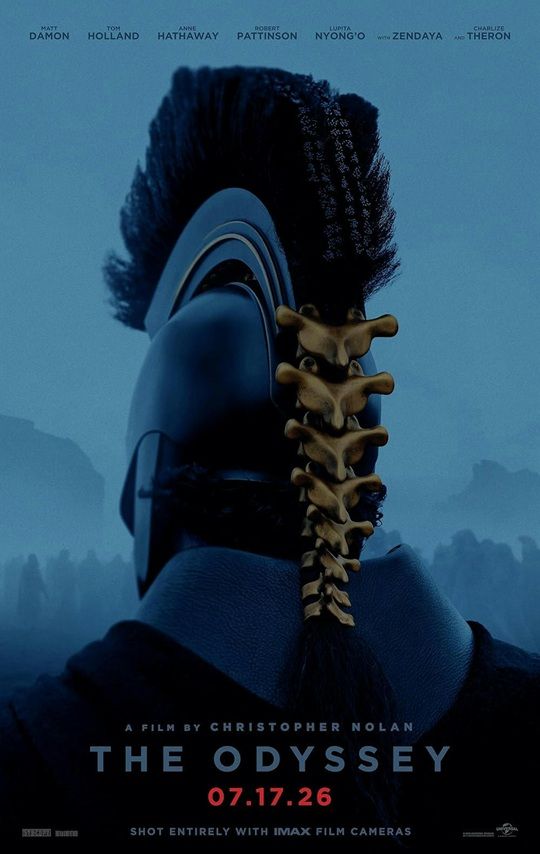
Almost immediately, the English film The Odyssey can be a companion piece to Christopher Nolan’s previous film, Oppenheimer (2023). In this, the ‘Trojan Horse’ is as much of a symbol of guilt to the protagonist Odysseus (Matt Damon), as much as the creation of the nuclear bomb by Oppenheimer. Interestingly, both these journeys of symbolism are only best understood in hindsight – even as the central object in question surmounts to betrayal too, depending on which side you choose to view it from. In that sense, the broader theme of the drama is that of redemption and realisation – two important cogs that drive the emotional core of the protagonist. In the same breath, the voyage through the torrid waters is a directly metaphor to life – a thematic struggling to be endured in order to reach the final destination (which for the protagonist remains his hometown, Ithaca). And along the way, the unpredictability of life is explored through the calmness and chaos of the seas and lands, in what remained a significant journey of transformation for the protagonist.
Adapted from Homer’s Greek Epic saga of the same name, and written by Christopher Nolan, one of the earliest themes explored in The Odyssey remains that of trauma – interestingly set over different timelines, in a narrative that is deliberately designed to be non-linear such that the drama doesn’t appear to be episodic. When you are introduced to Penelope (Anne Hathway) and Telemachus (Tom Holland) – it is grief, trauma and uncertainty that binds the two characters together. The layer of uncertainty erupts from the fate of Penelope’s husband and Telemachus’ father – Odysseus, who hasn’t returned years after the Trojan war has ended. This also extends to the idea of having to provide a new ruler to their land Ithaca – prompting Penelope to contemplate on finding a suitor for herself, an understated form of patriarchy that still finds its presence today.
It is interesting on how her character hides behind the endless weaving of the burial shroud – a metaphor not only of endurance and patience, but also of a character restricted in a cage of her own. This, while having to endure the rovering eyes of a shady suitor Antinous (Robert Pattinson), one of the many others interested in claiming his stakes to the thrown. In the same breath, Telemachus is also driven by a purpose of angst – trying to model his personality on his father that he hasn’t met, while severely lacking the leadership qualities of claiming the throne. Ironically, it is the protagonist that accounts for an emotional hinge in the narrative, almost tapping into flashes of his past journey that would pave way for the road ahead.
The linking factor remains that of trauma – even as you are acquainted with frequent bouts of flashback that severely point towards this trait that has plagued the memories of the character. And yet there is a line in its original source material that wishes to tell the story of a complicated man. One look at his past, and you know that Odysseus is indeed that person – ambitious, corrupted, unempathetic, and arrogant, all in the same breath.
While the trojan horse can be viewed as an imagery of betrayal, you notice the arrogance of the protagonist when he wishes to sway away from his fleet of ship. His idea remains to explore and conquer without accounting for basic moments of empathy for either his men, or the ones being plundered. And thus the burden of ending a civilization isn’t realised by him at the start, even as he voyages the dark seas in what formulates the dark side of homecoming – something that he would realise only years after he reaches his ultimate destination.
One of the other themes of the narrative remains a commentary between civilization and barbarism. And the same is inferenced through Zeus’ law that states on how a guest must be treated with empathy the same way as you are expected to be treated. But this very law is repeatedly breached by the protagonist – one through the trojan horse that was positioned to be a symbol of peace before the betrayal, or even plundering the home of Cyclops (Polymephus; also viewed as psychological barriers of war). The latter has parallels with the battle of Troy, or even through the passage involving the suitors at Penelope’s palace – wherein the ‘guests’ violate the Zeus’ law – by killing people and the livestock, and gobbling down food.
Ironically, the protagonist’s men get a taste of their own medicine when Polymephus begins to eat his own men in the similar manner in which they violated Troy. Or even in another instance involving a witch, that transforms Odyssseus’ gluttony-induced men to pig for showcasing barbarism. This, even there is a scene that reflects on the arrogance of the protagonist – unwilling to give his men a proper burial, while also invariably challenging Poseidon (God Of Water), while attacking Polymephus. But in the next instance with the witch, you see a softer approach that signals the growth of his character. But gluttony with regards to his men is not only linked with barbarism but also the lack of discipline – ironically being the cause of their downfall.
The themes with respect to acceptance go hand-in-hand with the psychological baggage carried by the protagonist. It is interesting on how the latter is tackled through specific objects of ego, frailty and trauma – the sirens that represent the validation of the past for the protagonist, or the blue lotus that accounts for a numbing form of comfort. Or even the consistent ‘invisible’ presence of Athena (Zendaya) – whose statue was beheaded by the protagonist and his army in Troy. And yet, the moments of healing and acceptance tilt tides towards his home – making the realisation beautifully simplistic and complex at the same time.
The final act is not only a commentary on redemption and reunion, but also that of closing the loop of the Zeus’ law that had been repeatedly violated. But along the way, sandwiched between the magnanimous finale involving an incredible face-off, the emotional core of the film lays its sight on the realisation of an individual whose act of betrayal has wiped off a generation. The realisation that mistakes are irredeemable, much like the people who have died, even as the glimmer of hope is a silver lining etched in history on how civilization form a way of growing again, despite falling prey to the same kind of mistakes in their bid for absolute power, greed and ambition. The screenplay forces us to introspect – have we learnt anything from history, even with how things stand today, and warring nations and corruption are at their worst? Maybe when vengeance subsides and ego deflates, history will be kinder to us.
The dialogues are individual mood pieces stitched together through scenes that tackles themes of ego, frailty, realisation and redemption. Yes, the idea remains on using a language that is palable with emotions, trading its authenticity of the original language with something that is easily perceived. The only point of criticism for me remained its clunky exposition towards the end – something that could easily have been detoured without the use of words. The music and BGM by Ludwig Goransson infuses the traditional beats through Greek instruments that adds layers of authenticity to the drama, while creating an immersive ambience. The notes exude of calmness and chaos, something that ably creates a sense of trance along the way. The astounding soundtrack comes to full life in the final face-off – with notes steadily increasing the tempo, before bringing it back to zero, signalling a roller coaster ride.
The cinematography by Hoyte van Hoytema is a visual masterpiece of the highest order. From inferencing moments of claustrophobia inside the trojan horse, to the scenic visuals of the endless sea that denotes uncertainty and hopelessness – the visuals are staggering. But in all of the chaos, the idea to ground itself in the emotional core of the characters, adds an instant set of gravitas to the drama while providing room to individually invest and reflect in the journeys of the characters. I couldn’t help but think what a travesty Dhamaal 4 (2026) remained last week – while insisting on shooting against a green screen, wherein the efforts of shooting the events at real locations here – instantly adds depth to the proceedings. When will Hindi Cinema discard mediocrity?
The editing pattern masterfully weaves and intercuts multiple timelines, without reducing the narrative to an episodic structure. The branches are nicely stitched together to culminate into a phenomenal face-off that is one of the best of the year. Director Christopher Nolan is once again in God-mode here, brilliantly telling a timeless tale while grounding the proceedings on the emotional core of his protagonist. You also see subversive shades of horror as an alternate dimension, that doesn’t stick out as a sore thumb but instead, weaves its significance in accordance to the themes of the drama. That definitely gave me an impression of a director being at the top of his game, while frequently willing to challenge himself, keeping his trademark identity intact. The direction was stupendous here, something that needs to be studied and savoured!
The performances are wonderful by the members of the cast. I liked how the female characters weren’t merely used as props, but remained symbols of fury, guilt, temptation and vengeance. Zendaya as Athena has an understated presence while ably doubling up as a symbol of guilt for the protagonist. Mia Goth as Melantho is a symbol of temptation and treachery, while having her moments to shine. Charlize Theron as Calypso symbolizes comfort and numbness, while delivering a well-restrained performance. Lupita Nyong’o as Helen and Clytemnestra is a symbol of vengeance and fury, unleashing her might wonderfully in a couple of scenes. Anne Hathway as Penelope is a symbol of guilt and perseverence, something that contributes to the emotional fabric of the drama, quite beautifully. Samantha Morton as Circe is fiercely good while putting forth a commendable act.
Himesh Patel as Eurylochus has a stunning screen presence, and he is incredible to witness here. John Leguizamo as Eumaeus is sincere and earnest in a character who is blind, while putting his best foot forward. Jon Bernthal as Menelaus acts as an intermediate mentor to Telemachus, and he remains impressive with his act. Robert Pattinson as Antinous wonderfully possesses a shady and vile trait that makes his character repulsive. And he was a treat to witness here. Tom Holland as Telemachus has a specific quality of naivety and innocence, something that he essays with perfection.
The show though belongs to Matt Damon who is phenomenal to witness as Odysseus. There are so many shades to his character that are imperative in accounting for his coming of age journey of redemption. The character arc is layered, and so is his performance – wherein he uses his body language and expressions to great effect in conveying the plight of emotions that his character is undergoing. He is brilliant as ever in a towering act.
The Odyssey serves as a profound allegory of life’s turbulent journey, masterfully tackling universal themes of guilt, redemption, and ultimate self-realisation. Wrapped in a cinematic magnum opus of the highest order, the narrative transforms personal struggle into a mythic epic. It is a big-screen spectacle that feels both magnanimous and timeless, balancing intimate human emotion with grand visual scale. Ultimately, it sums up an evocative drama that remains an absolute delight to witness, leaving a lasting imprint on the audience. Available in a theatre near you and Highly Highly Recommended!


