

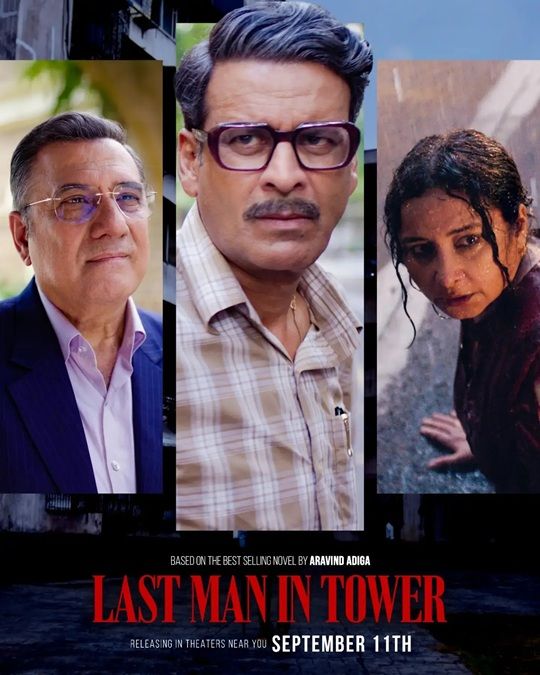
There is an early bout of secularism introduced in the new Hindi film Last Man In Tower that engulfs the narrative. Unlike some of the physical characters on display, the initial protagonist remains the crumbling colony in Mumbai called Vishram (that literally translates to ‘rest’), even as you are introduced to its shaky streak of characters in the garb of secularism – a boisterous Punjabi family with a differentially abled son, an old Christian couple, a single Muslim family, a restrained building secretary, a shady real estate agent, a young female who would often feature in the gossip circles of the society, and a retired teacher Yogesh (Manoj Bajpayee). In an early scene, you notice that there is an underlying streak of friction plaguing the families, but tolerance also remains a key ingredient. Think of members of the Gokuldham society from TMKOC minus the stereotypes.
And yet in the same breath, the central conflict induced in the form of a builder named Dharmen Shah (Boman Irani) has a powerful political subtext that plagues the society today. Not only does he offer lofty and empty promises of redevelopment in exchange for a hefty amount, much like most ministers at the moment – the idea also remains to divide people and their thoughts, for the only way to rule would be through heavy doses of capitalism and greed. For Shah (should I use Dharmen to avoid any ‘confusion’ in my review?), it is about extending a part of his greed to the common man in order to further make a fortune, tapping into the necessities of the common man and in the process, creating a situation for them to compromise on their morals.
Based on the novel of the same name by Aravind Adiga and written for the screen by Sooni Taraporevala, the title of the film Last Man In Tower instantly gives the illusion of an underdog story. The underdog in question is Yogesh, the protagonist who has his morals in check. In an early scene, you see him frowning at the idea of redevelopment – an indicator that instantly makes him the ‘rigid villain’ amongst the other members of the society. And this rigidity stems from his own sentimental value of his room – a sort of a personal space that he just doesn’t wish to trade.
In fact, the protagonist’s room remains an extension of his past – featuring a typewriter, a landline phone, a book with phone numbers, a sewing machine, a pile of newspapers, and a wall with a photo of his late wife. In the same breath, you see him distanced from his son Gaurav (Sukant Goel) – instantly making ‘Masterji’ an emblem of loneliness, wherein all his emotions are buried in his past, with the last standing wall being his own room in a society that is now up for grabs by the leeches of capitalism. One could call it selfishness, or even rigidity, but the heroic stand of a common man cannot be dismissed!
In many ways, the drama here can be a companion piece to Khosla Ka Ghosla (2006), wherein both the narratives are similar themes with regards to the land. But the difference clearly lies in the tone here, with the greyer hues being witness to a more bleak, realistic and pessimistic approach here. Even the protagonist could form a distant cousin to the elderly protagonists in Aligarh (2015) and Bhonsle (2018) – ironically both essayed by Manoj Bajpayee – wherein each of them remain the last men standing against the norms of the society. Ironically, the ‘society’ itself represented as an extension of the city forms a commentary of its own – wherein the cluttered land interfaces of the city is a direct ‘deconstructed’ take on capitalism in the name of progress. Both these elements form internal companion pieces too – with the crumbling elements of the society being a direct reflection of the surroundings of the protagonist, further puncturing his psyche with high doses of rigidity.
It is interesting on how the drama focuses on the concept of herd mentality too – a faint political subtext that forms an extension of this sentiment. And within this space, the commentary with regards to the basic necessities also ties up the loose ends. For instance, the character of Mrs Puri (Divya Dutta) doesn’t necessarily belong to a wealthy household, often also having to devote her time to her differently abled son. But that doesn’t stop her from dreaming big and willingly wishing to secure her family’s future with the hefty sum that she would get for her flat (along with a replacement flat in a high-rise in Mumbai). It does tell you enough about the deprived needs of the middle class who officially remain the worst affected tax-paying citizens of the country, while silently going about their duties and being only a step away from a disaster (financially or otherwise).
Hence, it is hardly a surprise that greed (for a lack of a better word) forms the foundation of characters like Mrs Puri – often transcending in bouts of desperation when the rigidity of the protagonist comes in their way of the ‘moolah’. Hence, the greyer streaks of the character involve her convincing some of the other tenants including the lady whom she despises – only for the latter to be vulnerable on this one aspect of insecurity. Money may follow my brother – but try telling that to a middle class person!
In the same breath, the writing here isn’t designed to be a fairytale that would suddenly adopt the David Vs Goliath template. There are instances of hope in the form of a cop, or a lawyer that the protagonist approaches following a series of threats and arm-twisting tactics, only for him to return empty handed. In a scene, you witness the cop advising the protagonist to take the money given that it was a great deal, or the lawyer who also strikes a deal for him despite the idea of having to fight in court. Even some of the invisible characters like a crime journalist or a social media manager remain superficial modes of hope that never fully transpire – either due to the power dynamic on offer, or an extension of the rigidity of the protagonist.
The one little gripe that I had with the screenplay was with regards to its final act, something that allowed the nihilistic finale to appear abrupt. The steady buildup was the need of the hour in order to get a glimpse into the simmering tensions of the characters, while also delving into the POV of the antagonist that did come across as a one-note character. These elements could have added layers to the narrative that would have blurred the boundaries of morality, before the final blow that would blend it with these same themes. But, this is just me nitpicking on a screenplay that was designed to be depressing while giving a glimpse into the future in its aftermath!
The dialogues by Juhi Chaturvedi are realistic and grounded while also having undercurrents of pessimism. There aren’t flashes doses of hope but an understated approach that the lines opt for, painting a harsh reality of the society that is hard to brush after the end credits roll. The BGM isn’t overpowering, instead allowing the drama to build on the foundation of silence – something that is both haunting and simmering with fear. The cinematography comprises of frames that christen the narrative with hues of grey – a direct thematic visual representation of the pessimistic nature of the drama. In that space, you are allowed to invest emotionally in the characters – none of whom are completely black or white. The synonymous nature of the frames that coincide with the personality of the characters is what formulates the drama here, making it a pondering watch.
The editing pattern holds the narrative by transferring the simmering set of emotions from one scene to another, something that kept me abreast with the crumbling psyche of the characters (much like the surroundings). If anything, the edit felt too sharp in the final act wherein a considerable buildup would have enhanced the shocking moment in the finale even more. But that is me nitpicking again!
Director Ben Rekhi patiently builds his world and his characters – stripping the thread of hope from each of the two facets of the drama. The approach is almost meditative that eerily normalizes the growing stacks of ‘progress’ that we see around us, almost holding up a mirror to showcase the underbelly of the human psyche, amidst a searing commentary on capitalism. The direction is assured to keep the tensions simmering and mounting through the narrative, slightly faltering in the final act, but still doing enough and more to leave a lasting impact!
The performances are wonderful to witness by the members of the cast. The likes of Amarjeet Singh as Ram Khare, Shrikant Yadav as Shanmugham, Ujjwal Chopra as Mr Puri, Darshan Jariwala as the lawyer, and Salim Siddiqui as Ibrahim their his moments to shine, and each of them ably contribute to the fabric of the society here – offering individual bouts of commentary too . Swaroopa Ghosh as Mrs Rego epitomizes a character who would possess the ability to think rationally at the start, before the mechanism of emotional manipulation would have the better of her. And she is wonderful to witness here. Uday Chandra and Madhuri Bhatia as Mr and Mrs Pinto follow a similar trope of ‘fear’ but of a different kind, and both of them are superb with their respective acts.
Tanisha Malti Mehta as Minakshi is epitomizes a female character whose name finds her way in the gossip circles of the group, invariably also accounting for a generation gap in the narrative. And she remains wonderfully understated with her act. Harish Khanna as Mr Kothari is well restrained while showcasing subtle bouts of manipulation through the narrative. The deliberate dose of hesitation displayed is enough to tell you a thing or two about his own conscience, but it is here that his manipulative streak gets the better of him. The subtle shifts in gear make his performance admirable in many ways.
Sarika Singh as Sonal is sincere and earnest with her performance, often finding herself at a crossroads between her husband and her father-in-law. And she taps into this space pretty efficiently. Sukant Goel as Gaurav is incredible to witness here as the son of the protagonist with potentially contrasting world views and moralities. His character is an even bigger reminder on how the protagonist still remains stuck in the past, although one can’t quite fault his morals along the way. Chandan Roy Sanyal as Mr Ajwani remains a plucky character who could easily be swayed and manipulated. And these traits are ably portrayed by him in a commendable performance that also borders on his vile persona.
Boman Irani as Dharmen Shah is wonderfully understated in his portrayal of a scheming and calculative builder with chilling doses of restraint. If anything from a writing POV, his character needed an additional dimension to fully blossom, as opposed to the one-tone approach that it sticks to. But even in this space, he was a treat to witness here. Divya Dutta as Mrs Puri has a very interesting arc to play with, the one that would not only blind her views on morality but also eventually push her into a chilling psychological zone with no way to return. In many ways, this remained a complex character with a variety of emotions that were both personal to her. And she used her body language and expressions to great effect, also offering you space to unwittingly empathize with her. She was brilliant as ever to witness here.
The show though belongs to the brilliance of Manoj Bajpayee who shines as Yogesh. His character is mounted on morality but also ambiguity simply given that the viewers after a point aren’t sure on what he is fighting for. The fight itself represents a rear guard action of an uncanny standoff that is reflective in the posture of his character through his slouch. And yet, the nuances and glances are enough to convey the emotional turmoil of a character who is subjected to atrocities from all quarters, something that is also reflected in his diminishing psyche, and through his dimishing doses of hope. This was towering act by one of the best in the business!
Despite an abrupt finale, Last Man In Tower stands as a realistic drama that delivers a searing commentary on capitalism, subverted by a gripping middle-class calamity. It is a deeply pondering watch—at once disturbing and pessimistic—that forces viewers to confront uncomfortable social truths. This narrative commentary is powerfully elevated by resounding performances that expose a crumbling worldview and mirror the fracturing nature of contemporary society. Ultimately, this bleak yet honest look at human greed grounds the story, delivering an intensely immersive and thought-provoking watching experience. Available in a theatre near you.


