

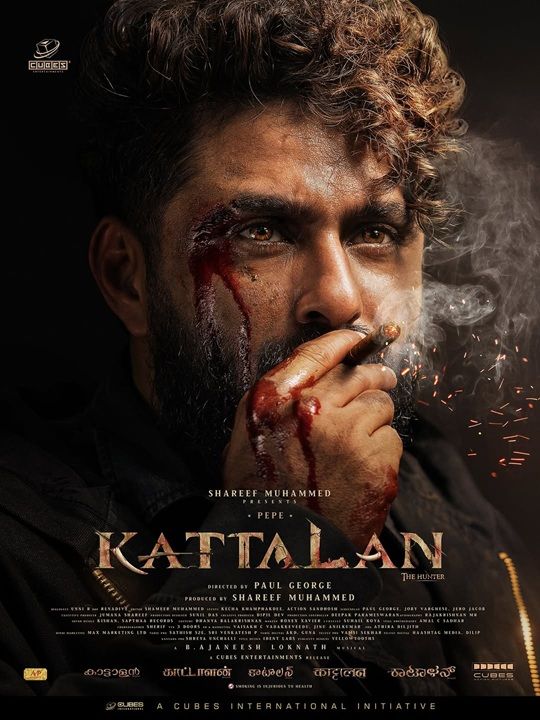
If I was blindfolded and made to sit in a theatre playing the new film Kattalan, then there would be a slim chance of me guessing that this movie belongs to the Malayalam Film Industry (to make matters worse, I watched its Hindi dubbed version). In other words, this is the most non-Malayalam film that you may see all year – almost having the soul of an over-the-top Telugu film that is filled with stylized slow-mos and an overwhelming score by Ravi Basrur. In fact at a point in the film, we were literally counting the seconds when the background score will be reduced to a silence – and that itself was an indicator on the kind of overdrive employed by the makers in constructing the drama here. So as opposed to the familiar shades of world building and characterization, the only shades you see are that of style – of excessive slow-mos amidst a blaring BGM, so much so that if I had to remove the slow-motion sequences from the film, this would have ended up being a 40 minute short film (on the higher side). And the idea of using Marco as a selling point for this unconnected universe, further established the fact that this film was just used as a cash cow – something that reflects tediously with its filmmaking technique.
Written by Joby Varghese, Paul George, Jero Jacob, and Unni R, the main issue with the Malayalam film Kattalan remains on how it is confused on what it wants to be – a gangster thriller involving two warlords? An underdog that eventually becomes The Chosen One – a concept that is the plotline of every other film these days, a good versus evil template involving the villagers and the warlords?, an invisible commentary on the illegal ivory smuggles doing the rounds? Or a forced attempt at creating a non-existent universe? Unfortunately, the answer is all of the above, and that is where the core issue lies – thereby making the drama derivarive and bland.
The premise is simple – a gangster mafia Maari (Sunil) takes over the illegal ivory activities of a village of Aanakkolli, after being asked help to save the villagers from murderous elephants. While he fulfills that promise, he now intends to not only murder the elephants for their tusks, but also any form of obstacles that are presented in the form of humans. His nemesis remains the cartel lord Eddie (Kabir Duhan Singh) and his brother Roby (Parth Tiwari) who work hand-in-glove with the top cop SP Nelson (Harishankar Narayanan), thereby setting up the premise of a potential bloodshed. But the Dhurandhar-esque plotpoint of introducing the protagonist Antony (Antony Varghese Pepe) is now becoming the new norm – a transporter brought in to side with one of the power hungry cartel lords, and slowly form a cult of his own. What in the derivative is this writing?
One of the issues that I had was with respect to the moral ambiguity around the killing of elephants. At no point is it condemned, while presenting the innocent animals as intimidating beasts. Remember RRR (2022) and how Bheem (Jr NTR) apologizes to the animals for using them as his baits? There is no such moment present here, instead stripping the drama of all emotions wherein even the protagonist (someone that we are supposed to root for) is also killing elephants – with the BGM signifying a victorious march.
The other issue that I had was with the characterization of the protagonist, who is heavily modelled on Pushpa. One thing that the latter excelled in was on how the world itself presented many obstacles during his rise to the top – something that is essentially reduced to only two to three characters here. And because the world isn’t established, you never get the high that one would expect from such a protagonist. In the same breath, let me get Marco in discussion too – a character that was driven with the purpose of revenge following his brother’s murder. But here, Antony has no real conflict that is internal to him – almost be a wannabe street smart character that makes him all the more predictable. So if he is beaten up in a scene, we almost immediately know on what is about to follow – thereby stripping the drama of any highs of commercial cinema.
The characterization of the antagonists also feel like concepts – using the technique of style over substance to make ends meet. So if a character is playing with a snake-in-the-box, it doesn’t make any contribution in establishing the character. If the core trait of the antagonists remains that of greed and revenge, the generic and flat nature of the writing negates even the most basic emotions. At one point I was wondering on how two characters who couldn’t see eye to eye with each other, suddenly join forces against the protagonist.
The writing keeps getting obnoxious by the minute, suddenly shifting locations and randomly introducing a gun-welding character out of nowhere. It almost seemed like an after-thought, even as the character in questions showcases their skillset in a specific sequence involving a car chase. Elsewhere, I remained unmoved even when the writing tries to integrate a range of emotions following a massacre. And to top it, the flat final act that felt so insipid that it left me scratching my head on whether this is a Malayalam Film after all. The only positives for me remained the twin end-credit scenes that may again have been baits of the universe, but successful in atleast intriguing me to the point of curiosity on where this universe is headed. Other than that, this remained a travesty of the highest order.
I wouldn’t be fully able to judge the dialogues here, given that the version that I watched was dubbed in Hindi. But nevertheless, the dialogues seemed straight out of a Telugu film that is dubbed in Hindi – with people screeching and yelling, while hilariously maintaining the style quotient of their characters. The music and BGM by Ravi Basrur is loud, louder and loudest – typically in his trademark style. But I would have excused it had the beats been enough to have me grooving to it. At a point, I was literally grimacing at the loud notes – and that was enough to indicate that any layer of emotions remained untapped. Also, I never thought that I would get to watch an ‘item number’ in a Malayalam film!
The cinematography can be judged on two accounts. I liked the idea of shooting in real locations with real elephants – something that added some depth to the drama. But to overstuff the narrative with frequent slow-motion shots with the idea of aura-farming was creative-suicide. The impact was instantly nullified. Even the editing pattern felt so choppy and so abrupt with its cuts, that I couldn’t care less about the emotions behind an important character dying. And a word about the action – it is a considerable downgrade from the brutal gory visuals that one would associate with Marco. Given that this remains a shared universe – the action itself was a letdown.
Director Paul George misses the mark in his debut outing. It is clear that George is fascinated by films like KGF (2019) or Pushpa (2021) – thereby creating a derivative world that diminishes everything that Marco (2024) stood for. He misses out on the world building and characterization but only focusing on style – something that is tried and tested in so many films in recent times. The narrative style is as flat as a pancake, and that sums up the direction here too.
The performances don’t really impress you, and much of it had to do with the kind of writing being employed. Dushara Vijayan as Lucy adds intensity to the action set-pieces but her character felt like an after-thought more than anything else. And beyond the action, I didn’t see enough to write anything on her performance. Raj Tirandasu as the young Maari is intimidating, but again has very little to showcase beyond that. Parth Tiwari is such a talented actor with a towering presence onscreen, and while he is good here – the writing never allows him to fully bloom. Harishankar Narayanan as SP Nelson is decent but again the writing wishes to employ multiple moments of aura-farming with regards to his character, even when it was not needed.
Kabir Duhan Singh as Eddie looks intimidating but the writing with regards to his character is so shallow that it never really elevates his act. Jagadish as Ali is the only actor who is sincere and earnest amidst the mess around him. Sunil Varma as Maari has just one trait to play with – greed! And that makes his character so one-dimensional. Antony Varghese Pepe as Antony doesn’t quite deliver an intimidating act. His expressions remain stoic, and that doesn’t really do justice to the emotional core that his character has to exhibit in a few scenes. Even his mannerisms and body language remain pretty flat, which is unlike anything that I have seen in his previous films.
Kattalan is pure style with negligible substance. The movie is so obsessed with slow-motion that the plot feels permanently frozen. Flat, emotionally hollow, and easily one of the weakest Malayalam films in years.<span;> Available in a theatre near you.


