

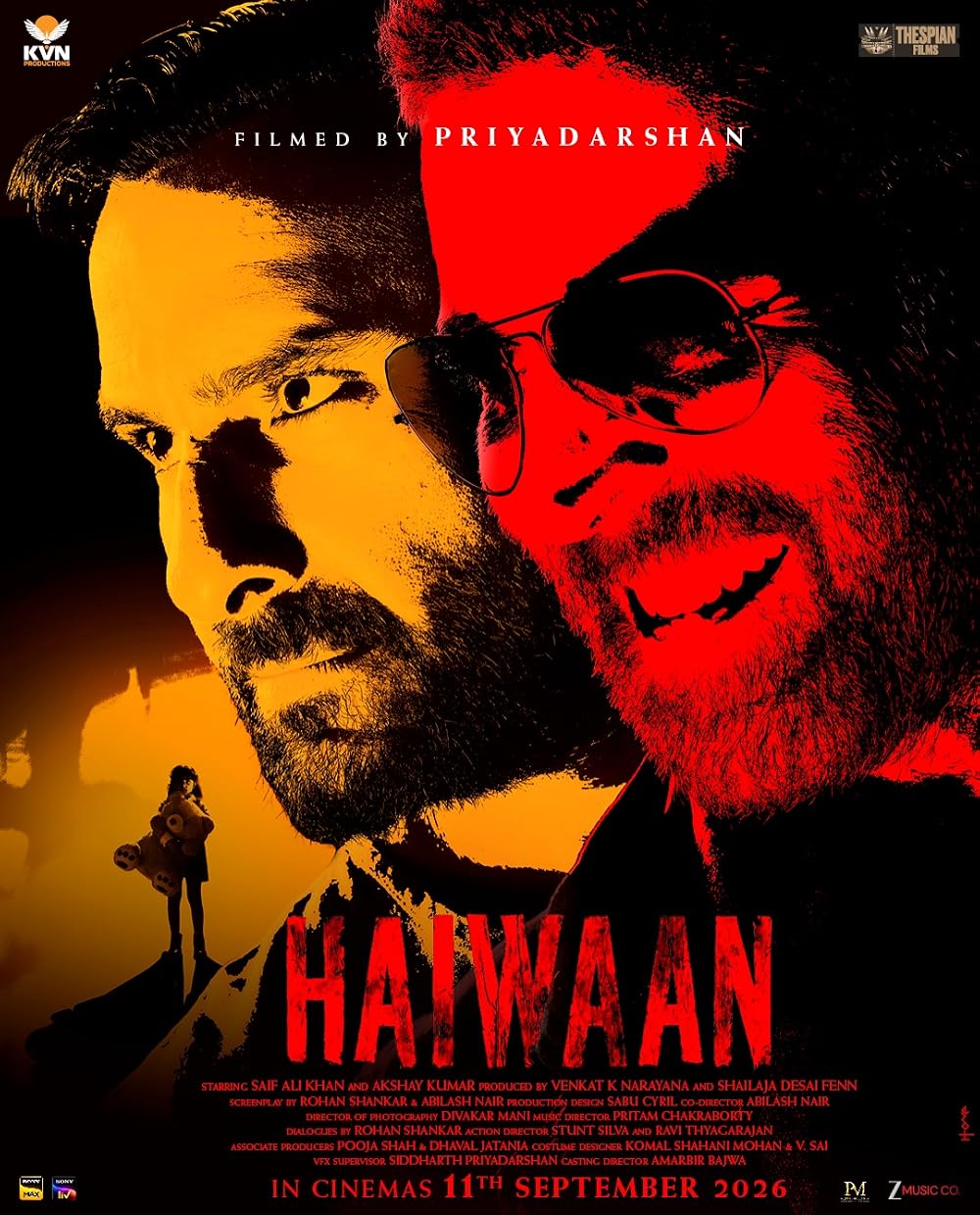
It really seems that the recent 80s AI theme on the internet has also extended its roots (unintentionally) on the silver screen. And if the latest Hindi film Haiwaan is anything to go by, barring the funky hairdoes and the vivacious clothes of the hinted theme of the 80s, the tone is straight out of yesteryear. A scene-to-scene remake of the original Malayalam film Oppam (2016) – which also raised bouts of skepticism in me, there is a dated tone to the start of Haiwaan, wherein you are introduced to the debt-ridden protagonist Shyam (Saif Ali Khan) who has to arrange a sum of money as a dowry for his sister to get married. Shyam is blind, but the most non-blind person you would ever meet – he sniffs his money-borrower with the smell of Sandelwood, he sings like a croaking-crow when no one is watching (no, others aren’t blind in the film), only to magically transform into a Shaan-esque voice in the middle of a scene. He even dances weirdly to the beats of music be it at a wedding or a ferry, almost signalling his happy-go-lucky era of being ‘blind’ – atleast he doesn’t have to put up with films like these!
Written by Priyadarshan, Abilash Nair, and Rohan Shankar, one of the issues with Haiwaan wasn’t its identity – that had its DNA similar to that of Oppam. Yes, the identity could be an issue given that its Hindi dubbed version is out for consumption on Youtube – but the problem here is bigger. It is with regards to the characterization of the protagonist that modelled on him being a superhero and the darling of the people around him. Think of him like Spider-Man (sans his blindness) that would allow him to sniff his prey just through his fingers. A pivotal plot-point later on in the film revealed on how he identified the perpetrator given how he had consumed pizza. Glad this wasn’t ‘that’ scene from Masti 4 (2026), or else even the viewers would have wanted extra tissue papers – even as Sherlock Holmes would be crying in the corner. My point is more serious though – there is a hint of invincibility that indirectly accounts for a bout of predictability.
The premise of Haiwaan is simple – Shyam works at a swanky residential building as a maintenance manager, almost being a go-to person for all chores and being a darling of the people from the tenants to the security guards. In fact, the writing specifically chooses to focus on his dynamic with a retired Chief Justice of the Supreme Court Pradhan (Boman Irani) – who would often take him to the hills that hold his buried secret about a victim-turned-stalker Parshuram (Akshay Kumar), who is discreetly after the latter’s life. In fact, there is another dynamic in play that would apparently ground the drama with a lot of emotions – that between the protagonist and Pradhan’s illegitimate daughter Nandini (Pahal Ashok Choudhary).
The writing remains largely unfocussed in the first hour – often digressing into societal tiffs between the members including a scandalous meeting between a couple that results in marriage, a random air-drop of a random character on the roof of a car driven by another character who is given far too much screen space, an initial police investigation underway headed by Inspector Varsha (Saiyami Kher) who is included in the bandwagon to simplify the case for the viewers and help connect the dots. The latter itself felt silly given how the screenplay itself was guilty of spoon-feeding the viewers with information including the reveal of the antagonist in the first scene.
There are a couple of sequences that felt mildly engaging – one specifically in the hallway between Shyam and Parshuram with the lights out, one of the rare level-playing fields for the two characters. But outside that, the investigation around the death of a character, itself felt silly – now headed by cops SI Ashok Shinde (Sharib Hashmi) and SP Rohit Vardhan (Rajesh Sharma), both of whom do no favours to the Mumbai police (infuriatingly so) and showing them as ‘silly’ with their ‘silly’ brand of humour, even as the entire second hour is restricted to a cat-and-mouse chase on loop.
In fact, the silliness of the drama can be determined through that one particular scene wherein the protagonist tied and bruised (and blind, remember?) decides to beat the cops to pulp, even as the writing is quick to remind the viewers that the protagonist also was a beefy wrestler. In between, the loopholes in the investigation are laughable – the cops suspecting the blind protagonist to be faking his disability and openly interrogating him around the actual suspect too. Even the subplot of a bag of cash gone missing felt like a discarded plot-point from another film!
The writing had to almost remind itself of recircling to the core dynamic between the father and daughter, something that would also coincide in a face-off between the protagonist and the antagonist. But in that moment, the silliness cuts through the supposed intellectual synergy that the drama wishes to identify itself as – even as a character laughably turns himself in a nun, with a foreshadow that reminds ita viewers that he was in a mental hospital. If I earned every penny for facepalming during the film, I would have been a millionaire! The screenplay can’t even be labelled as campy given how it just isn’t self-aware about its silliness. And when everything else is crumbling (including the petty performances), then these glaring flaws in the screenplay are imminently visible. Another ‘blinding’ mess indeed – this time without an identity of its own.
The dialogues have a Priyadarshan trademark engrained on them, with the incorporation of loud lines and louder gags that deviate from the tone of the drama. The themes of dowry and classism feel utterly forced here, rather than organically weaving itself in the narrative. The music is instantly forgettable, often posssessing a vibe of the 80s of its own with the song integration that pleasantly stalls the flow of the drama (relatively speaking). The BGM is blaring and loud (it felt screeching at an instance too), almost wanting to give an intimidating outlook to the viewers – and in its process, drowning every inch of emotions along the way. Even the sound design felt slightly underpar here, a key ingredient for the drama to work wonders.
The cinematography features frames that offer a shot-to-shot similarity with the original film. When even the shot compositions are same, this cannot be called an adaptation – this is a remake in the purest sense. And even then, the frames aren’t particularly engaging. As an example, you witness two characters interacting with each other on the top of a hill – even as the drone shot encircles and focuses on the lush greenery. It felt ridiculously sloppy in the moment when a major revelation was underway! And these slops are pivotal at vital moments in the narrative, including a sloppy and unintentionally funny finale that felt straight out of the 80s even with the frames on offer.
The editing pattern is clumsy, never quite being coherent with its style, and never quite being engaging with the dynamics between the characters. The vicious deviation to some of the other characters in the narrative who have literally no ‘real’ role to play, was an alarming trait – even as the edit felt like a collection of random scenes stitched together. It is slightly better in the second hour, but the engagement just isn’t there.
Director Priyadarshan yet again misses the mark here, trying to recreate one of his already mediocre products. And you can feel the staleness in his execution – something that not only flattens the drama, but also reduces the characters to mere stereotypes. Even the humour feels forced and silly, whilst the thrilling aspects of the drama are non-existential. And when the emotions also don’t land – you just know that the prolific filmmaker is well past his prime. The direction is pretty listless and lacklustre here.
The performances aren’t quite on point too, by the members of the cast. Talented actors like Bhavna Pani as Zeba and Donny Kapoor as Mrs Gulati just aren’t given enough meat to display their talent. The likes of Zeeshan Ali as Joy, Yamini Joshi as Shraddha, Kiran Dange as Manya, Manoj Joshi as Pandurang, Suchitra Pillai as the Principal (she played the same character in the original too; and an unexpected reunion with the now-blinded Sam from Dil Chahta Hai (2001)) and Abeer Meherish as Nagesh are fair with respect to their acts.
Rajpal Yadav as Chandu is natural to the core, but the writing again doesn’t allow his character to fully bloom. Boman Irani as Judge Pradhan is decent, but the emotional core with regards to guilt is missing from his armoury here. Asrani ji in his final outing onscreen as Security Guard Hussain lands a few punches rather seamlessly, and here I am tipping my hat for infinite memories from his immaculate filmography that would remain rent free in my heart. Pahal Ashok Choudhary as Nandini is also decent, even though the emotional core of her character isn’t established here.
Rajesh Sharma and Sharib Hashmi are such wonderfully gifted performers, both the writing reduces them to annoying characters who had me increasingly facepalming while witnessing their acts. You know that the writing is silly when they treat two gifted performers as mere caricatures, something that instantly lowered the impact of the drama. Shriya Pilgaonkar as Naina felt woefully miscast here, and her performance also didn’t exactly leave a lasting impression. Saiyami Kher as Varsha also felt immensely bland with any emotions on offer, something that was synonymous with her facial expressions that felt stoic.
Akshay Kumar as Parshuram is way over-the-top with his performance here. The stereotypes were hard to ignore in sequences of his laughter, something that felt hammy every single time. The sinister energy just wasn’t there to intimidate me at any given point – if anything, the writing ensured that his character remained a caricature in the final act. The idea was to use minimalism here to elevate the fear in the minds of the viewers, which sadly wasn’t the case here.
If the writing doesn’t offer any arcs to the characters then much of the responsibility rests on the shoulders of the actors to deliver just with their craft. This is where I would admire someone like Mohanlal who made a similar sloppy outing in the form of Oppam, watchable! But I can’t say the same thing about Saif Ali Khan who was far too inconsistent as Shyam. In fact, I did feel that he was a little lost here – never quite landing the emotions that were required from him to elevate the drama. His body language felt odd – drooping in certain sequences, but beefy and dominating in others. It is ‘Saif’ to say that he is a far better actor than what I witnessed here!
Haiwaan emerges as a painfully sloppy, shot-by-shot remake of the Malayalam thriller Oppam, mutating a middling premise into a blindingly messy, eye-straining disaster. The film is completely derailed by insipid writing and wildly inconsistent performances that aggressively tip the high-stakes drama into pure, unadulterated silliness. It is a rare, agonizing instance where there is absolutely “No Khiladi, Sab Anari,” delivering an experience so thoroughly confusing that my only reaction was a bewildered “Hein?” rather than a thrilled “Waa(n).”Available in a theatre near you.


