

The word ‘propaganda’ is often used for films that are largely political while offering a heavily-biased narrative towards one favouring faction of stakeholders. But oddly, the P-word also extends to a few films having a heavily-biased family dynamic. Take Baghban (2002) for example – in a scene, you see the character of the father using a typewriter in the middle of the night, typing away to glory – only to be interrupted by his son who politely asks him to stop. But the gaslighting BGM wants you to sympathize with the father, and vent your anger towards the son.
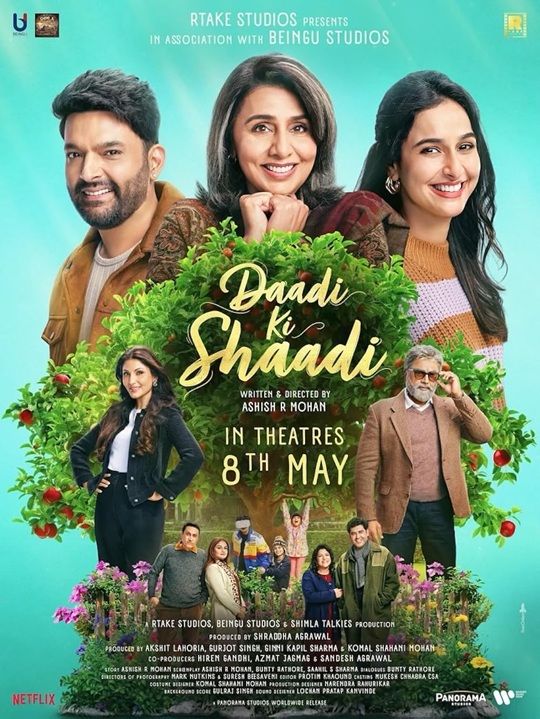
The generic theme of the new Hindi film Daadi Ki Shaadi is built on this foundation – that young adults must take care of their lonely parents. Don’t get me wrong – I am all for this sentiment, and I do feel that it is the right thing to do. But the film uses such gaslighting techniques with a heavily-biased headache-inducing narrative featuring a ‘poor and lonely’ character, that it is increasingly hard to sympathize with anyone in the narrative. The delusion of a small town drama wherein the subtext ranges from being regressive to being supposedly family-loving and progressive, is as dated and horrible as the recently released film Ginny Wedss Sunny 2 (2026). But what is worse is the collective belief of the filmmakers who still pass off a regressive messaging as progressive anecdotes in a narrative that can best be termed as ‘proper-ganda’.
Written by Ashish R Mohan, Bunty Rathore, and Saahil S Sharma, the thing that immediately stands out for all the wrong reasons in Daadi Ki Shaadi is the over-the-top high pitch tone that deafens any remote chances of finding humour. It is like a wannabe standup comic literally shouting his joke in your ears – and yes, the joke is unfunny but the screams gets inside your head and take the form of a headache. If you are still reading, Tony (Kapil Sharma) remains the biggest red-flag of a character who is about to get engaged to Kanu (Sadia Khateeb). And I say a red-flag with some flair – given how he passes off his stalking chops as a ‘one-sided’ love story in college, playing a part in expelling his ‘competitor’ from college for falling in love with his sweetheart.
In a passing montage, I was reminded of Ali (Uday Chopra) from Dhoom (2003) who desperately wants to get married and have children – except that his innocence is traded with a stalker’s syndrome featuring a guy who masquerades himself as Ali but in reality is Rahul from Darr (1993). Am I making him sound really bad? Thankfully, the film isn’t about him – even as a marriage mishap prompts him to save his engagement and go on a trip to Shimla with his in-laws – to woo his lady-love and prevent the marriage of Kanu’s Daadi. The questions on a background check can wait, can’t it? This, even as the streak of toxicity is reserved for the Daadi aka Vimla (Neetu Singh) who is a loner.
Vimla remains a character who loves to paint herself like a victim. For instance, she blames the ‘Facelook’ typo for her marriage confusion, almost playing along to keep her family with her for a few days. An issue that could have been resolved in seconds, while being backed by communication – is shown to spiral into an unredeemable territory wherein I had no sympathies as such for Vimla – firstly for lying to her children, but more importantly also raising such annoying humans who just don’t understand the pitch of the drama.
You know that this is a screenplay written by men, when a male character always shuts down his daughter from interrupting or asking questions – all in the name of seniority. And no one really seems to take objection to it – until the final reels wherein the writing takes an even bigger backward step with a female character. But more importantly, the gaslighting game is on – even as Vimla lies about her marriage, lies about her man, and plays every trick in the book to guilt-trip her children into staying with her. Just make them sit down and speak to them, would you? You don’t need to sell off their childhood souvenirs, or cook up a fake story about blackmail, and gambling and debt, and whatever the nonsense written in the script.
In between, the love story is an eye-sore too – wherein I didn’t get the core conflict between Tony and Kanu. In one scene, Kanu wished to settle in New Zealand with her dream job – but unsure on what transpired in between to make her change her mind (even after a monologue). Tony ain’t a heartthrob either while switching his loyalties midway in the film, also occasionally finding a girl to flirt with. If in 2026, the subtext of Kanu’s character remains of being committed to him in her mind while saying no – it again is a red-flag. But more than that, a regressive and toxic love story that is shelled by the utter chaos of Daadi and her newfound fake love story.
The emotions needed to be crystal clear in order to evoke the right sentiments – of really not having an issue even if Daadi would choose her life-partner in her 70s. But instead, what is served to you is a high-pitched headache-inducing comedy with tonnes of melodrama featuring a conflict involving the will, a loud counterplan to teach Daadi’s children a lesson, an unfamiliar love story that is hard convincing, and a never ending monologue at the end to drill in the message – just in case, you may have missed it. So when a character exclaimed on ‘why didn’t she tell us directly instead of making us go through this?’ – the line was met with a wave of giggles in laughter in my auditorium. Guess, others had the same question as I did!
The dialogues are atrocious with the sense of humour – high-pitched, headache inducing and immensely frustrating to witness. The music isn’t bad but it hardly contributes to the emotional core of the drama. The BGM felt like a ticking timer of a bomb about to explode – and unsure, if that was my brain giving me a warning. If every loud scene is accompanied by a constant ‘toing’ or a score that double-underlines the sentiment, then I would prefer the timer in my head to go off!
The cinematography gave me an impression that I was watching a soap opera. With weird camera angles from low shots to extremely tight reaction shots, the frames reeked off the melodrama one would associate in a daily soap. Also, the colour correction felt immensely tacky – reducing the depth of the drama despite being shot in a real location.
The editing pattern is as choppy as a reel, with every edit switching the POVs of characters mouthing the dialogue. It felt so isolated after a point that I had given up on my processing abilities – trying to focus but snipped off from my brain that refused to cooperate. Director Ashish R Mohan returning on celluloid after more than a decade, makes for a horrendous outing. Not only are the proceedings flat, they are also loud and torturous while being devoid of any emotions along the way. The characters have no identity, the world has no rules, and as a result, I almost ran out of my braincells. The direction is pretty bad, and my facial paralysis was witness to that.
The performances are pretty middling by the members of the cast. The likes of Flora Champa, Swarna Pandey, Yograj Singh and Nikhat Hegde ate decent, but the writing and particularly the pitch, drowns every little counter that the actors have to offer. Tejaswini Kolhapure and Aditi Mittal are used as side fragments in a drama that wishes to position itself as ‘progressive’. Jitender Hooda hams his way through the narrative, umsuccessfully trying to tap into bouts of humour. R Sarathkumar is a fine actor but you can make out that he is struggling with his lines in Hindi – some of which felt like dubbing issues too (and notice how the POV shifts every time he speaks, just so that the focus isn’t on him). Riddhima Kapoor Sahni in her feature film debut struggles here. While her dialogue delivery is fine, she lacks expressions that were crucial in conveying the emotional plight of her character.
The only moments of spark are retrieved from Deepak Dutta who makes the silliness of his character slightly bearable. Sadia Khateeb is such a fine actor, but the writing lets down her character bigtime here. As Kanu, she remains confused on what she wants in life – and that reflects in her inconsistent performance too. Neetu Singh as Vimla approaches her character like a concept. This basically means the cliched writing wishes to portray her as a victim, which isn’t progressive in the first place – with a thought that the same would presumably extend to all grandmas across the globe. There is no identity to her character apart from portraying herself to be a loner. Kapil Sharma as Tony is suprisingly dull in this film – never quite appearing inspired to lift a dated narrative with his trademark brand of humour. His performance mostly fell flat, and that remained a pity given his prowess as an actor that is highly underrated – generally speaking.
Daadi Ki Shaadi is a dated attempt at Baghban, and yet another entrant in the Headache Cinematic Universe, making it a painfully dull watch through and through. Oh Braincells, My Braincells! Available in a theatre near you.


