
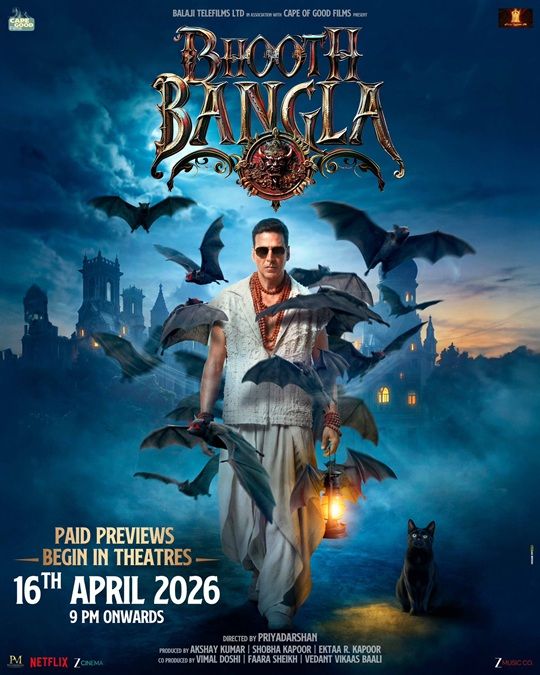
It isn’t everyday that I step out of a theatre with my face paralyzed – simply an attribution of the kind of trauma my mind was subjected to. And unfortunately, the new Hindi film Bhooth Bangla joins that elite list of films that had my face ‘stuck on a time loop’ of sorts. The iconic duo of Akshay Kumar and Priyadarshan have always been at the top of their game during their previous collaborations – Hera Pheri (2000), Garam Masala (2005), Khatta Meetha (2009), or even the first Bhool Bhulaiyaa (2008). It is said that the draft of Bhooth Bangla was supposed to be a spiritual (lol, ironic) sequel to Bhool Bhulaiyaa, until the franchise deviated towards a different route. All I can say is that in that regard, Bhoot Bangla remains a massive degrade from Bhool Bhulaiyaa that literally talked about the psychological condition of the protagonist whilst presenting it with traces of folklore horror. In that sense (and like the next two installments of Bhool Bhulaiyaa), Bhooth Bangla just talks about ghosts in a haunted mansion stemming from a folklore that was passed down from generations. The subtext remains on how we have evolved as a society – the folklore isn’t the issue here, the over-reliance on beliefs is, something that is a representation of the times we live in that reduces the subject of ‘Science’ as a backbencher.
Written by Priyadarshan, Rohan Shankar, Aakash Kaushik and Abhilash Nair, Bhooth Bangla has a simple premise that would initially remind you of the OG Jaani Dushman (1979) – a haunted town, a palpable folklore, the disappearance of the newly-wed brides, a haunted mansion, an age-old temple, a mystery running deep inside the veins of the villagers, and some typical trademark chaotic moments that you would associate from a Priyadarshan film. But I couldn’t help but think that the entire proceedings remained a derivative of plenty of other Priyadarshan films that were integral to my childhood. Ahh well, damn the nostalgia!
When you are first introduced to Arjun (Akshay Kumar) and his family comprising of his sister Meera (Mithila Palkar), and his ‘vedic’ father Dr Vasudev (Jisshu Sengupta), the occasion remains Meera’s wedding. The turn of events bring Arjun to Mangalpur – a sleepy town drowned in a sea of fear featuring a ‘Bhooth Bangla’ that is known to house a haunted secret – while accompanying a terrifying folklore about a rakshas Vasudhar who would hunt his preys at night and in the vicinity of the dark. Instead of dwelling deeper into the folklore, the focus inexplicably remains on the comedy which is loud and outdated, something that refused to twitch my facial muscle even once. And one reason for that remains its over-dependence on nostalgia with its loud ‘signature’ comedic tone that never lands.
Be it Arjun’s loud exchanges with Shantaram (late Asrani) that brought crickets as reactions, or even his exchanges with the wedding planner Jagdish (Paresh Rawal) – a much awaited Raju-Baabu Bhaiya reunion that never really had felt superficial previously. The exchanges may take you back in time with references from Hera Pheri or even rhythmic ones of Garam Masala (2005), but a realistic comparison would tell you on how the proceedings here are designed as a nostalgia-bait to milk the popularity of the scenes. The same goes for the inference of Sundar (Rajpal Yadav) – a character that is deliberately written to bring in the flavour of Chup Chup Ke (2006) with a ‘lotaa’ gag that just doesn’t have the same impact. Each gag made me relive the Paresh Rawal meme – ‘Main Sun Chuka Hun Yaar’, that much more. Also, the bouts of adult comedy thrown in the mix made for an even weirder integration given how the filmmaker had implied that his target audience is kids too. For instance how do you justify these scenes – a character being injured by a jet spraying hose of water in his a*s, or another character giving a kinky impression of smacking the backside of a woman.
The proceedings unfold at a snail’s pace in the first hour, almost focusing on individual gags to drive the narrative as opposed to taking the story ahead with the folklore. Thrown in the mix is also a half-hearted love story featuring Priya (Wamiqa Gabbi) whose subplot involves searching for her missing sister – something that is conveniently sidelined and evaporated in the wake of some mindless romantic exchanges with Arjun. It made me think on what the purpose of the film was – even as I inexplicably began to miss Kartik Aaryan in the film. Clearly, my mind had given up, but we weren’t even halfway done already.
There is definitely a streak of improvement at the start of the second hour, when the focus shifts towards the actual folklore horror in the film – even as the stakes in the drama are raised with an early death in a sequence that remained the sole bright point in the otherwise ‘dark’ film. The issue remained with the writing that did not look to fully utilize its eccentric characters beyond the gags, neither did it fully want to commit to the argument presented between the existence of the supernatural versus the reality. Remember how Bhool Bhulaiyaa (a remake of the brilliant Malayalam film Manichitrathazhu (1993)), questioned the psyche of the protagonist in order to drive home this argument? It felt so intellectually stimulating and satisfying to draw a comparison that was backed by Science while also respecting some ancient beliefs and customs. If this balance is wobbly, the impact will never be there – something that we see in its flashback sequence.
The flashback sequence just doesn’t exude of the bite of Bhool Bhulaiyaa, simply because it all but felt manufactured and ultra-convenient. The element of mystery did not hold because you did get a glimpse of it in the interval block that was integrated for its shock value, while having to compromise on its mystery that would unfold later on. In fact, the backstory is completely stripped off any emotions or even twists and turns that one would ideally expect – in order to elevate the impact of the drama leading into a significant payoff. But all I got in return was my mind sinking further in darkness.
The final act has got to be one of the most atrocious acts of the year, almost leaning its heritage on the film Stree 2 (2023), while absolutely unfolding like a video game on the easiest available mode. Where were the twists and turns? Where was the magic of the folklore with respect to some specific objects referenced in the film? How did the protagonist become a superhero suddenly after goofing around for most of the film? And not to mention the kind of convenience that was served in the platter here. Oh and last one – why were the stakes in the final act just so low? I was speechless and in a paralyzed state stepping out of the film while trying to seek for its answers for a film labelled as a horror comedy. Probably the word ‘Facepalm’ was missing before each of the two genres mentioned.
The dialogues range from silly to loud and cringy, trying desperately hard to make you laugh. The nostalgic streaks seem forceful while catering to the same formula of the past, something that only brought crickets as reactions. The music is instantly forgettable even as a song randomly appears in the middle of a narrative to further contribute to the travesty. The BGM is fairly decent in comparison, atleast trying ably to haunt the feeble proceedings with a score that is enough to create an atmosphere of horror.
The cinematography is poor and I can’t emphasize it enough. You can’t create elements of horror with weird camera angles that will keep your actors out of focus from the frames. The indecisiveness between maintaining stable mid-shots and trying to create a creepy atmosphere was immensely visible here, something that flattened the fairly decent production design along the way. The frames also felt dated to the extent of making the proceedings look soapy – almost like a Ramsay film from the 80s, which wasn’t the original intention here.
The editing pattern features multiple jump cuts that don’t really allow you to stay in the moment, while quickly moving on to the next sequence. This ‘reel’ style of editing is particularly hampering in two genres – horror and comedy, both which require you to immerse yourself in the proceedings. And unfortunately, the editing style never had me settled because of the fast cuts.
Director Priyadarshan misses the mark here, and it makes me realise on how Sreenivasan and Neeraj Vora played such important parts in writing and staging the chaotic comedies that he is known for. Here neither the comedy lands, nor is the horror encapsulating, and the filmmaker falters with the world building and characterization too. The issue remains in the treatment that often hinges on baits of nostalgia, that invariably makes this a derivative drama in many ways. Taking nothing away from his prolific journey, I can’t help but think that ‘Peak Priyadarshan’ is a sacred part of my childhood, while the direction here remains a pale shadow of that era.
The performances are pretty ‘hammy’ and ludricrous by the members of the cast. Tabu is absolutely wasted here in a role that had no real meat for her to exploit. It surprises me on why did she even opt for such a role in the first place? Probably, it was for the nostalgia too but was this trip necessary? The late Asrani in probably his final appearance onscreen is decent here as Shantaram, and his presence did trigger a tingling bittersweet feeling within me (his disappearance later on in the film may have been due to him passing away; Farewell Legend). Bhavna Pani as Ragini has little to do, but she still has a fairly good screen presence.
The likes of Manoj Joshi as Govind Maharaj and Rajesh Sharma as Dushand Acharya are decent, although slightly dramatic with their respective parts. In comparison, Zakir Hussain as Vashishta Guruji is well restrained and sincere, although he has hardly much to do here. Jisshu Sengupta plays the father of Akshay Kumar (yes, there is a reason given but still…) – let that sink in for a bit – and as Dr Vasudev Acharya, he is decent but always playing second fiddle to the protagonist.
Wamiqa Gabbi as Priya is well just there, and I am still trying to figure out why? Oh and same goes for Mithila Parkar who plays the…..hold it…..sister of Akshay Kumar. She is decent but her role is hardly fruitful, only being a damsel in distress to her brother at the end. It pains me to see talented actors like Paresh Rawal and Rajpal Yadav desperately trying to make the comedy work here, through their antics and subtle pauses. But there is little that prolific actors can actually do when the written material itself is unfunny and poor.
Akshay Kumar as Arjun hams his way through the comedy here. Yes, he is blessed with such a fine piece of comic timing that occasionally, he will make you smile. But you have got to question yourself – is this enough? Is this all that you expect from an Akshay Kumar performance? Where are the emotions in play? Why is the pitch consistently high? I have seen far better performances in the comedy zone here by him, and this isn’t one of them. And he really needs to pick his scripts correctly, without considering the ‘gimmicks’ as active acting opportunities.
Bhooth Bangla deserves a Facepalm D’or award for the worst horror comedy film of the year. In contrast, my ‘marked-as-safe’ braincells deserve a lifetime achievement award for having to bear the brunt of travesties like this, week after week. If the bar of entertainment is going to be this low, then I hope Hera Pheri 3 is never made! Damn the nostalgia! Available in a theatre near you.


