
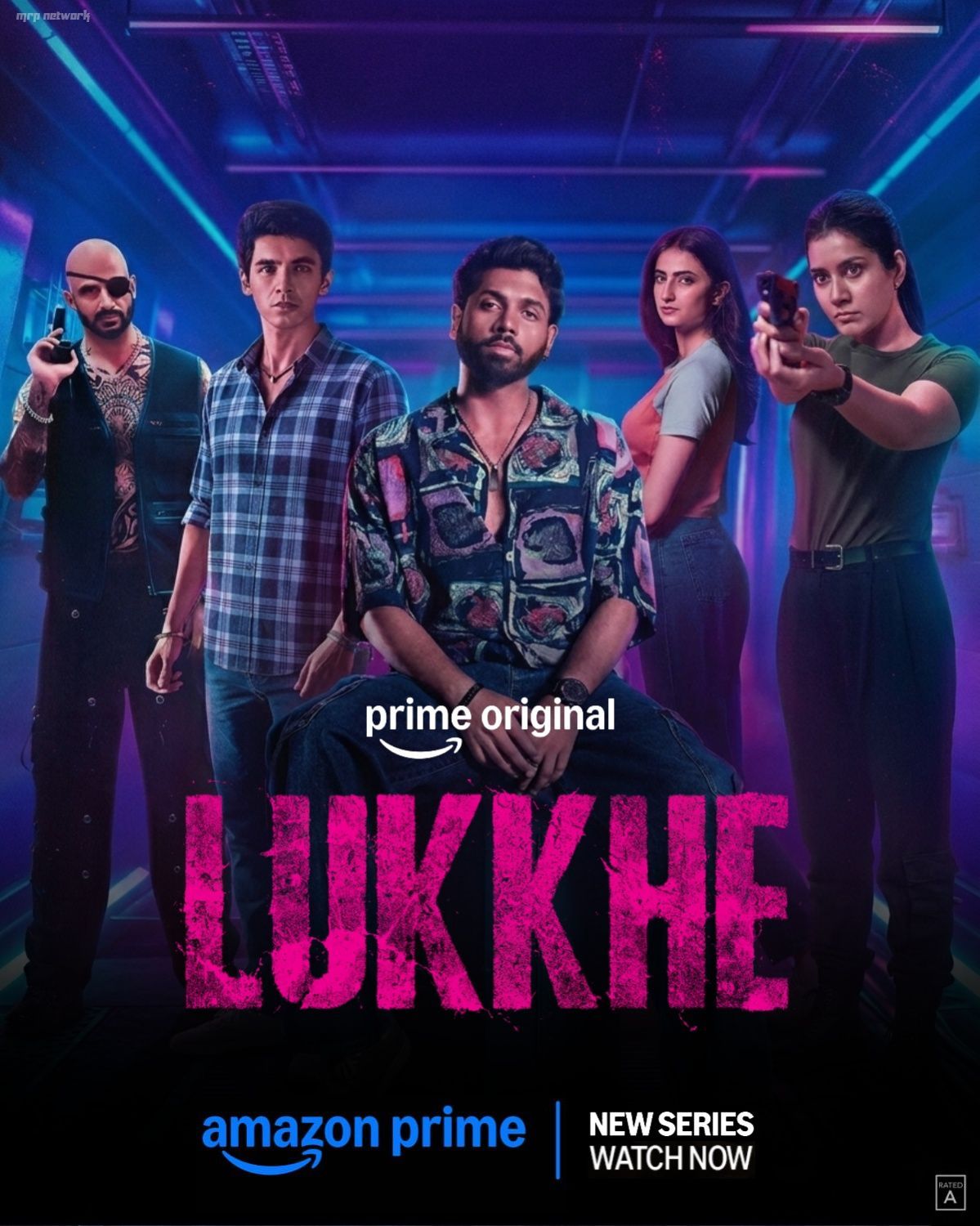
The premise of the new Hindi show Lukkhe is a cross between films like Dhurandhar (2025), Udta Punjab (2016), and the show Chamak (2023). The stakes are set in the drama at the start – an emerging hockey player Lucky (Lakshvir Saran) enrolls in a rehabilitation center for drugs following an accident that met with a tragedy, only briefly to get his life back on track after falling for his buddy Sanober (Palak Tiwari). Yes, he is carrying a trauma of losing his friend due to his midnight mishap with drugs, but life is seemingly giving him a second chance in the form of love. But just then, he is asked to infiltrate a drugs racket by top-cop Gurbaani (Raashii Khanna) in a classic Dhurandhar-esque plot-point – with the kingpin of the drugs gang being Sanober’s foster brother, rapper MC Badnaam (King), his girlfriend Paddy (Kritika Bharadwaj), and his bestie Jazzy (Nakul Roshan Sahdev) – even as Udta Punjab and Chamak give each other a high-five. And if you look closely, Lucky is Hamza Ali Mazari to MC Badnaam’s Rehman Dakait and Jazzy’s Uzair Baloch, with Gurbaani’s Ajay Sanyal keeping a watch. And that remained one of the issues of the show – its derivative storyline didn’t quite exude of a personality of its own.
Written by Debojit Das Purkayastha, Hardik Kaushal and Divay Chakshu Sharma, and Agrim Joshi, the first season of Lukkhe works fairly well with the conflicts of the some characters, but is equally frustrating with a few others. For instance, the purpose of the protagonist willing to infiltrate the gang is immensely justified because of a tragic accident involving his friend at the start of the show. For Lucky, it is traumatic and a way of redeeming himself – in a way that he could face the family of the deceased, while slowing putting his guilt to sleep.
For Gurbaani who appears to be tough and fiery while being a central alpha female fighting the patriarchal system of the society, the reason is a little more personal, having been witness to twin tragedies in her household – something that justifies her fight against drugs, even whilst viewing Lucky as her younger brother. But, I wish I could say the same thing about some of the other characters.
The character of Sanober is loosely sketched to the point that you would actually question her rationale behind living in a fool’s paradise. Whilst music remains her calling, she is unaware of her brother’s antics who is in turn involved in distributing a drug called ‘demon’. It made me question on how was she kept in the dark all along when her foster brother MC Badnaam wasn’t really intending to be the ‘good guy’ anyway.
On the other hand, the broad strokes implied on MC Badnaam exposes the underbelly of Punjab and its music industry, but it never always tends to give him an identity. For instance, his ‘beef’ with fellow rapper and his competitor OG (Shivankit Parihar) stems from a twisted equation of power with a dash of an assault that connects their rivalry. But in the same breath, the justification to run a drugs cartel is only equated with power and popularity that felt one-dimensional. If I were to connect this to Chamak, the individuality of Kaala (Paramvir Cheema) lay in the fact that he was searching for a truth about his father, that eventually took him on a journey of drugs and music. In a sharp contrast, OG had a better conflict in play – almost being a victim of generational trauma and masculinity at a very young age, that justified his treacherous behavior in the present.
You can see that the writing does cause some intense moments successfully – often using these very moments as cliffhangers in every episode (or even to start the episode). Be it a shootout in the parking lot resulting in a blood bath, or another shootout at a video-game parlour, or even a flashback involving a death to kickstart an episode. What these moments do is immediately spring your dwindling interests back in the show at crucial junctures. But the issue remains on how generic the writing is in a lead up to these cliffhangers.
It is easy to make out that the writing runs thin – almost prompting a catalyst to take the story ahead. Be it two random sharp-shooters being introduced out of nowhere, or a female drugs mafia randomly appearing suddenly in an episode – the tracks weaken the cohesive structure of the narrative. As a result, even the core conflict is compromised. The writing never fully commits to a love story in the midst of an exposition, the infiltration angle gets muddled with shifting loyalties so much so that I couldn’t judge the character of Lucky anymore. Even the ‘beef’ between MC Badnaam and OG never fully realises its potential – leading up to a predictable but largely underwhelming finale that didn’t land on scale or impact. And that honestly, was the story of the entire show – showed promise but never really landed with a thumping impact.
The dialogues add a fiery spunk to the proceedings, while also adding authenticity to the drama with lines that are spoken in Punjabi. Atleast, it did enough with respect to the setting of the drama. The music remains the strongest aspect of the show, so much so that the songs definitely carry the narrative ahead while showcasing the angst of the characters on show. Likewise, the BGM tries to elevate the emotional core of the narrative despite not always being supported by the writing. The cinematography ably uses hues of pink and grey to depict the edginess of the setting. But I really wished for a little more steadiness with respect to the emotions of the characters – something that was sporadically present in scenes of angst or regret with a couple of characters like OG and Gurbaani.
The editing pattern affects the cohesiveness of the drama, simply because the editing doesn’t traverse on the same track after establishing a conflict. For instance, if a track between OG and MC Badnaam establishes a conflict, the proceedings suddenly shift to the one involving Lucky while circling on the OG-Badnaam conflict later on. As a result, the impact is lowered in the narrative.
Director Himank Gaur doesn’t do a bad job here, but the issue that I had with the direction remained on how the drama didn’t always peak between two cliffhangers. The world building was decent, but the characterization remained a mixed bag – with as the established conflicts often fizzle out in the wake of bouts of sensationalism. The direction really shows spark in a few sequences – be it the blood bath at the parking lot, or even a shootout in a small meat shop. But the scale is found wanting in a finale that felt tepid. In other words, the direction remained a mixed bag.
The performances are decent by the members of the cast. The likes of Gaurav Bisht as Karan and Pankaj Sharma as Bhalla have their moments to shine. Akarsh Khurrana as the patriarchal boss of Gurbani is pretty good here, and he puts up a competent act. Lavvina Taandon as Zubeida and Ayesha Raza Mishra are excellent performers who play their parts well, despite the writing lowering the impact of their performances. Yograj Singh as Walia is restraint but intimidating with his demeanor, and he does a commendable job. Nakul Roshan Sahdev as Jazzy and Kritika Bharadwaj as Paddy manage to hold onto their own, while managing to impress with their performances.
Palak Tiwari as Sanober is underpar with her act, not quite tapping into her trauma and insecurities with flair, while also being subdued with her emotional core – both towards Lucky and MC Badnaam. Raashi Khanna as Gurbani has got to be one of my favourite characters of the show, given how her character uses her outer tough exterior to hide the vulnerable and palpable emotional side of her character. She uses her fiery expressions and body languagr to great effect, while delivering an excellent act. Shivankit Parihar as OG is a revelation here, using an ultra-aggressive approach to tap into the vulnerabilities of his character. The idea of plagiarism is associated with his character too, and coupled with his childhood trauma – there was enough meat in his character for a performer like Shivankit to shine. And he was a treat to witness here.
Lakshvir Saran as Lucky is competent enough to hold onto his emotional transformative arc, despite the writing trying hard to confuse his loyalties along the way. There is a sense of sincerity and earnestness in his performance that makes for a satisfactory impact. King, however remains an interesting case here. Make no mistake – he is a great rapper, and absolutely at ease when you see him perform onstage here. And he definitely shines in a couple of moments of madness involving his twin kills along the way. But, he really needs to work on his expressions that feel dull. Even his dialogue delivery is flat to the point that the emotional turmoil of the character is lost in translation. All of these points ensure that the performance by King is a mixed bag!
The first season of Lukkhe is a lacklustre blend of rap, dr*gs, and revenge that doesn’t quite hit the right note. The proceedings remain largely mediocre, thereby resulting in a forgettable watch. Available on Amazon Prime.


