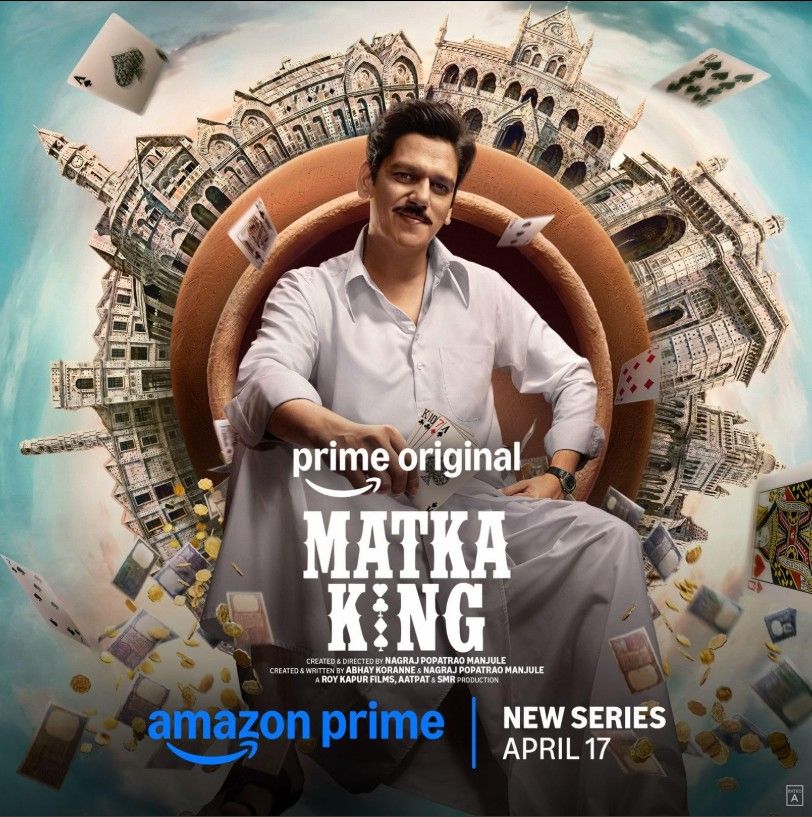

There is an early streak of Johnny Gaddaar (2007) with the cold open of the new Hindi show Matka King streaming on Amazon Prime. In the scene, you witness two characters placing a bet on the eventual fate of a ‘nearly-dead’ body in front of them. The period remains 1975 when India is in the middle of the emergency, even as you are tactfully sucked into the world of Brij Bhatti (Vijay Varma) while meticulously tracing his rise and fall as the Matka King. The issue straight up with Matka King is that there will be direct comparisons made to Harshad Mehta from the iconic show Scam 1992 (2020). It often seems like both Harshad Mehta and Brij Bhatti are a part of the same division of a class in school – seated beside each other during their exams. And one of them is known to copy the answers of another, even while trying hard to create his own identity with subtle tweaks here and there. But the subtities don’t really change the broader meaning of the answers, particularly when the trajectory remains the same. So when the template is same, it boils down to the specifics – and in that race, Harshad Mehta takes an unassailable lead over the Matka King.
Written by Nagraj Manjule and Abhay Koranne and inspired by the life of Ratan Khatri, there is an infectious energy at the start of Matka King that draws you into its world. The era remains the early 60s wherein a nation is freshly grappling with the power dynamics in play, particularly with the offshoots of power that have sprouted in the city of Mumbai. In the mix is Brij, a cotton trader who has been humbling working under a trading king-pin Laljibhai (Gulshan Grover). It remains a very specific game of oppression and identity that laces his conflict, even while secretly harbouring ambitions of minting money. And at the center of the drama is a gambling prologue, a silent character in the mix that would be a driving catalyst in the protagonist’s life. There is conviction in the writing at this point, so much so that my mind wasn’t deviating to some obvious questions – how did a cotton trader develop his love for numbers and probability? And how was he introduced to the game of gambling that would invariably go onto form his own identity?
There is a spark in the drama even while introducing characters along the way – Brij’s wife Barkha (Sai Tamhankar) who has reduced her life duties to taking care of his household chores initially, or Brij’s left hand Dagdu (Siddharth Jadhav) who remains the voice of the show, or Brij’s brother Lachu (Bhupendra Jadawat) whose loyalties would be tested with his kin, or Brij’s Parsi girlfriend Gulrukh (Kritika Kamra) who would become an object of ambition and desire for the protagonist. And yet, the issue lies in how each of these tracks progress eventually, something that remains formulaic and cliched to the core.
Some of the best moments of the show are at the start, with the writing focusing on establishing Brij as the Matka King through a variety of games that seem interesting and snappy. The subtext also remains a seed of anti-establishment that sees Brij lock horns with a local politician Bapat (Kishore Kadam), an honest cop Eknath (Bharat Jadhav), and an honest reporter TP D’Souza (Girish Kulkarni). The game of cat and mouse is fairly engaging to begin with, but it soon becomes repetitive in nature – almost offering nothing novel other than presenting the protagonist as God.
For instance in a scene, you witness a fidgety protagonist requesting the pilot to land the aircraft by 9 PM, just so that he could announce the draws for the evening, only for the pilot to be his fan and obliging. A police station sequence involving the draw taken from a cop’s buckle also follows a similar trope. The issue isn’t about these stray incidents per se, but how both these incidents are repetitive in tone and structure – setting up a mini obstacle, only to cop out with a convenient resolution without any layers. And that is the story of the show too – playing it safe and how!
Much of the issue that I had with the character arcs and the progress of individual character tracks, boiled down to the core personality of the protagonist. Yes, on the surface one could judge that this was an anti-establishment setup of the protagonist versus the world – with the former being an epitome of honesty and integrity. In a scene, you even see him supporting his mill workers against the likes of a local gangster, a builder and the system favouring capitalism. But herein also lies the issue – the writing perceives the protagonist with the same lens, treating him as a larger-than-life personality as opposed to adding chinks of vulnerability and shades of grey to his persona.
This reflects in his interpersonal relationships too – his infidelity isn’t viewed as a serious-enough issue to seek for confrontation, his relationship souring with Dagdu weaves a plot to give him an upper hand (you see him standing in that scene too as opposed to Dagdu who is on the floor), his rocky relationship with his brother Lachu that begins with a specific subplot of money laundering only to later switch to a different conflict.
Only a few subplots work here – like the arcs of Eknath and D’Souza, both honest men in an otherwise corrupt world having to wage frustrating consequences. Or a side plot involving Brij investing money as a film producer in a film titled ‘Bharat Ka Beta’ featuring a minority superstar – that showcased fleeting moments of politics in play. I guess in times like today, the algorithm can only be tweaked this much to question the authorities – even from the past governments. In every other case, the idea remained to play it safe under a formulaic narrative that slowly began drowning in a sea of mediocrity and convenience. It ended up being routine, very routine!
The dialogues seem borrowed from the idea of a 70s Bollywood film, as opposed to sounding authentic to that era. Take any gangster film from the 70s, and you will find a shadow of that film on this show. The BGM also faces a similar bout of criticism, sounding like a derivative of the 70s more than a twisted take on the 70s. Remember the iconic soundtrack of Scam 1992 by Achint Thakkar? That magic is missing. The cinematography and production design fair relatively better – with frames that depict the spirit of the late 60s and early 70s rather accurately. An notable talking point remains the lack of emotions, rather highs that the frames miss out on – something that adds to the mediocrity of the characters, and the momentary impact that is fleeting. The costumes given to the characters, particularly the protagonist is plain white – a trait that aspires to coincide with the writing. The only time you see shades of grey is right at the end, when the protagonist with streaks of dust chooses to surrender to the cops. A little arc worth noting there, through the costumes.
The editing pattern is long and winding given how there is considerable lag in the second and third acts of the show. And given that the proceedings are repetitive, the eight-episode show does get a little long and winding. I started my review with how there is a reference to Johnny Gaddaar which was a nod to Sriram Raghavan. In the same breath, there is a nod to Hansal Mehta and his filmmaking in Scam 1992 too. But I didn’t see the distinct voice of director Nagraj Manjule here, a name synonymous with iconic films like Fandry and Sairat. In fact, his voice is buried within a narrative that chooses to be generic – not quite focusing on the politics or powerful interpersonal relationships while only giving an impression of wanting to white-wash the image of the protagonist. No, this was a miss in every sense!
The performances are decent by the members of the cast. Vineet Kumar Singh shines in an extended cameo as a Bombay gangster. Istayak Arif Khan as Jinu Master is effective while having his moments to shine. Cyrus Sahukar as Maqsood is decent in an interesting character that didn’t fully bloom in terms of the writing. Simran Ashwini as Vasudha has a good screen presence and does a good job, although her character is used merely as a catalyst for a specific subplot. Bharat Jadhav is such a legend, and his portrayal of SP Eknath is nuanced and sensitive, formulating one of my personal favourite characters of the show. Girish Kulkarni as TP D’Souza was a clear case of anti-casting, and he is impressive as ever in a rather earnest act. Likewise, Jamie Lever as Sulbha is a revelation too – in probably her first role that isn’t in a comic zone.
Sai Tamhankar as Barkha has a certain poise to her character that makes her performance filled with grace. She is sincere here and purs forth a commendable act. Kishore Kadam as the vily politician Bapat is understated and scheming, but the writing doesn’t fully allow his character to bloom. Gulshan Grover as Laljibhai is supremely effective with his body language and demeanor, a trait that is reminiscent of his ‘bad man’ era.
Kritika Kamra as Gulrukh is visibly uncomfortable with her mannerisms, almost being cautious of her Parsi accent in every scene. Her accent is passable (yep, coming from a Parsi) but the aftermath is visible in her stiff body language, something that hampers her act to an extent. Siddharth Jadhav as Dagdu is outstanding to witness here, often accounting for a range of emotions with a lot of flair. Bhupendra Jadawat as Lachu is incredible as well, papering over the cracks of his characterization with a commendable act that always keeps you guessing with regards to his loyalty.
Vijay Varma as Brij Bhatti aka Matka King is sincere with his act, but his performance was majorly restricted due to the mounting of his character. The character in itself turned out to be vanilla – given how the filmmaking did not focus on the flaws without glorifying it. That was reflective in his performance that was good, yes – but also boxed without scope for variations. This isn’t to do with Vijay but more with respect to the brief given to him, that makes him perform accordingly.
The first season of Matka King is a formulaic gambling drama that crash-lands in a sea of mediocrity and convenience. It isn’t quite novel, offering nothing you haven’t watched previously – which makes the drama a fairly safe watch. But that is exactly the issue that I had with the show. <span;>Available on Amazon Prime.