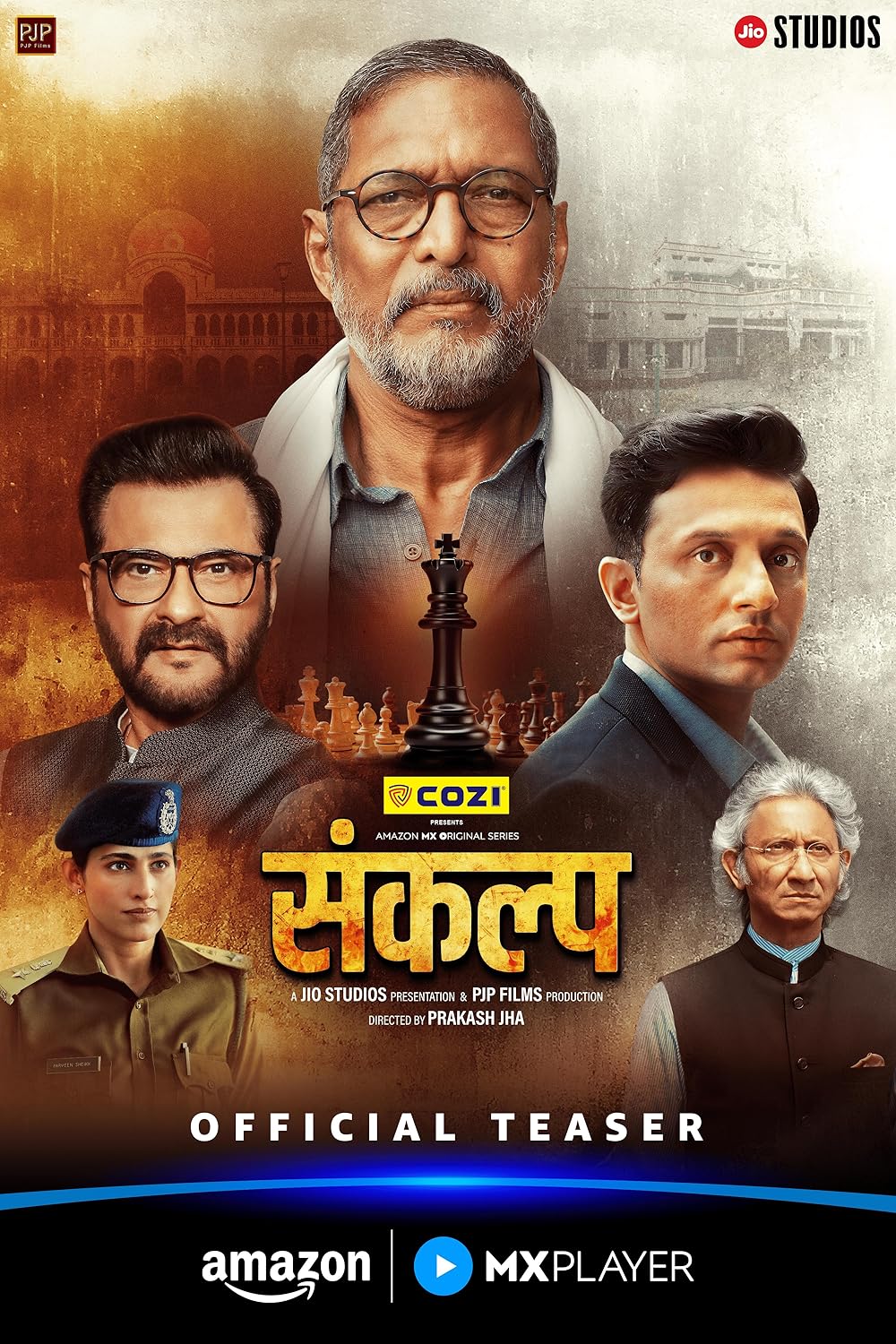

When you are first introduced to Kanhaiyalal aka Ma’at Sahab (Nana Patekar) in the first season of Sankalp, you instantly get the vibe of The Godfather – so to say, a modern day Robinhood who is essentially operates like a gangster whilst helping the poor out. In an early scene, you see he and his men forcibly ‘buying’ a child for his education under the pretext that the child’s parents need to move away from them in exchange for the money being provided to them. And therein lies the other side of Ma’at Sahab’s personality – he can be viewed as an educator and a strategist with a sure-shot technique to crack the UPSC exam. In other words, Ma’at Sahab can be termed as a hybrid crossover between Narayan Shankar (Amitabh Bachchan) from Mohabbatein (2000) and Vito Corleone (Marlon Brando) from The Godfather (1972). And yet, the purpose of the protagonist in maintaining the ‘Parampara, Pratishtha and Anushaasan’ of his Gurukul remains a mystery – even as the POV of the story shifts towards the nemesis amidst the other characters in the setup.
Written by Reshu Nath and Prasad Kadam, the first season of Sankalp can best be viewed as a socio-political drama set against the backdrop of a revenge plot that forms the crux of the narrative here. The fabric of the drama reminded me of the shows Bindiya Ke Bahubali and to an extent Maharani, given the political context in play. This is particularly true with respect to the political duo of Prashant (Sanjay Kapoor) and Waqar (Neeraj Kabi) who are menacing nemesis of Ma’at Sahab. In an early scene, you see them conversing about optics that would help them win an upcoming election – a discussion that constantly had me conflicted with two real-life figures in the political landscape of the country who mustn’t be named. Either way, you know that there is a demarcated line etched between these two factions given how Ma’at Sahab keenly listens to the election speeches of Prashant and Waqar. And a definite past lurks around the corner.
One of the interesting aspects of the drama remains its characterization, something that is directly linked to the real motives of the protagonist. So when you are introduced to the likes of Aditya (Mohammed Zeeshan Ayyub), Parveen (Kubbra Sait) and Vasudev (Saurabh Goyal), all of them occupy top positions of the police force. But more importantly, these characters add to the concept of revenge inflicted by the protagonist given how he has planted them at key roles to keep an eye and later destroy his enemies. It is an enthralling concept wherein each of these characters act as moles – a nod to Scorsese’s The Departed (2006) – something that adds layers to the narrative.
One of the driving forces of the narrative remains the shifting dynamics between the characters. This is particularly true for the dynamic between Aditya and his mentor Ma’at Sahab that undergoes a roller coaster of emotions. From almost being a devotee to a particular shootout incident that deftly shuffles the foundation to a constant conflict of oscillating as a mole to a traitor, Aditya’s journey remains the one filled with turmoil and internalization. And honestly, he remains the joker in the pack – a character that remains unpredictable not because of his intent but more so due to the fact that his truth is blended in a sea of lies from both parties. In the same breath, a flashback involving the the protagonist and his two nemesis also provides a clearer picture about the larger conflict in play. And yet, you also feel that the drama is slightly overstuffed with its subplots.
Each of the subplots operate in isolation here, whilst forming an assist to the larger conflict in play. And yet, I couldn’t help but think on how a couple of the subplots didn’t exactly elevate the impact of the drama whilst going around in circles. So there is a subplot involving an ATM robbery, a kidnapping case of a little girl, a melodramatic subplot involving a character’s family, and a faint whiff of student politics in play that either ought to have been quicker, or completely edited out. The reason is simple – in trying to justify every arc of the character, the writers lose focus of the larger goal at hand which was that of revenge.
And while the traces of revenge are definitely in play with byproducts of deceit and one-upmanship, the subplots sandwiched between these events had me momentarily disconnected. As a result, I was also not emotionally invested in the journey of a couple of characters that felt crucial with the kind of fate that they are eventually met with. On a side note, even the politics in play felt surface-level without really delving deeper into the underbelly of power.
There is also a very specific subplot involving the death of a character that felt rather unnecessary, and even defied logic if I were to think of it with an open mind. The reason felt more of a collateral damage given the killer belonged to the same side – making the event an episode of counterstrike wherein the friendly fire setting is enabled with any accountability. Even by the end of the show, I was scratching my head as to why that subplot was intended on the show. It definitely didn’t raise the stakes in the game, and had no real implications atleast with the events of the first season.
That said, the writing does fall back on track during its final act that did raise the stakes to some extent here. The entire kidnapping subplot yet again highlighted the might of power that did pose a threat to the protagonist and his clan. More so, it offered an internalized conflict with respect to a character by connecting his past in the form of a revelation, that would go onto change the dynamic of his present. And the same would hold true from the opposite POV in the wake of a tragedy that forms an outro for the show, and a setup for the next season. So overall, there are fairly engaging moments that are placed in a drama, although the stakes remains consistently mid for most parts of the narrative.
The dialogues by Chandan Kumar are earthy and add a sense of authenticity to the drama, although I couldn’t help but think on how the lines were used as a medium for spoonfeeding information. The subtext could have been written a little better as opposed to endless conversations planted in a handful scenes. The BGM is decent but the use of the background score remains an issue here. And this is specifically with respect to a handful of twists in the narrative that aren’t necessarily elevated by the background score, whilst flattening the impact of them. Even from an emotional standpoint, the BGM is found slightly wanting – be it an emotional face-off between two central characters that doesn’t always strike a chord, or a death of a character that also doesn’t fully hit home.
The cinematography comprises of frames that are effective in keeping you connected with the dynamics of the characters (even if it isn’t always emotional with its intent). The use of a muted colour grading compliments the sombre mood of the drama, even as the decision to shoot at real locations adds depth to the proceedings along with a streak of authenticity. Even some of the action set-pieces choreographed by Sham Kaushal towards the end are effective, with some lovely aerial and tracking shots that indicate a POV of a particular character.
The editing pattern is decent but the length of the show remains a suspect. So if you look intricately, there are moments of lag sprinkled throughout the narrative in the form of subplots that don’t always raise the stakes in the narrative. Hence, the show required a crisper edit to then elevate the impact of the proceedings. Director Prakash Jha understands the world and the genre really well. Socio-political dramas are his bread and butter, and in that regard, he definitely scores with his intriguing world building and characterization. The minor issue remained on the micro level wherein he isn’t quite able to elevate some pivotal moments in the narrative – instead opting for a restrained outlook that flattens the impact. But having said that, the shifty traits of his characters is ably maintained in a fairly engaging narrative wherein the prolific filmmaker does score.
The performances are pretty good by the members of the cast, and the casting director Shruti Mahajan needs to be applauded for handpicking a bunch of fine actors here. Akanksha Pandey and Kanchan Awasthi have their moments to shine here. The likes of Ritik Ghanshani, Akshat Chauhan, Tejas Raut and Shailja Chaturvedi as younger versions of Prashant, Waqar, Kanhaiyalal and Suhasini are superb to witness here. Tushar Pandey as Sattu, Sheen Das as Jayati, Abhishake Jha as Deepak and Ashish Mathur as Jaideep are competent while putting forth solid performances. Shreya Awastthi as Kairi uses her body language and expressions to great use to convey the pain with respect to her character separating from her child.
Gita Guha as Liluatiya may have been a slightly underwritten character, but her spectacular presence and theatrics adds layers of intrigue and emotional gravitas to her performance. Jitendra Rai as Tarkeshwar is commendable to witness here in a job well done. Danish Iqbal as Majumdar does a fair job here although the Bengali accent that he utters was slightly faulty (unsure if the brief was to use his accent as a subtle means of extracting humour). Tanmay Ranjan as Neeraj and Nitin Parashar as Musa remain understated with their acts, and to pretty good effect. Roop Durgapal as Madhuri has a good screen presence, and she does a fairly decent job here.
Bhagwan Tiwari as Sankarshan and Meghna Malik as Suhasini are natural to the core, and both act as perfect foils for the protagonist. Saurabh Goyal as Vasudev and Kranti Prrakash Jha as Kasturi are characters on opposite sides of the spectrum of law, but essentially a part of the same team. And both remain well restrained with their acts here. Kubbra Sait is probably the only character who has a faint emotional undertone to her character, and she does well in tapping into that space. Needless to say that she is a fine performer, and she puts forth a commendable act here.
Sanjay Kapoor as Prashant has a wobbly start here – often uttering the words ‘What the f*** is going on’ in almost his every other line. But slowly but surely, he settles into his character and puts forth a decent act. In comparison, Neeraj Kabi as Waqar is subtly chilling and intimidating, using his calm demeanor and body language to his advantage. He showcases so much restraint and yet, the menace remains a subtext in his incredible performance.
Mohammed Zeeshan Ayyub is such a phenomenal actor, and as Aditya, he showcases his vulnerability with a lot of flair. He isn’t your usual superhero cop, but more of a character that is striving in wanting to know the truth while constantly being in a conflict with himself. This remained a complex character, and he performed it with utmost ease and brilliance. Nana Patekar as Ma’at Sahab is brilliant to the core. It is interesting on how his younger self (essayed by Tejas Raut) is shown to be impulsive. In a sharp contrast, he remains calm and understated in a character riddled with patience even in the most chaotic situations. A veteran of his craft, he uses his flawless expressions and eyes to convey his emotions that are buried beneath a layer of revenge. And this remained a powerful act in every sense of the word.
The first season of Sankalp is a decently gritty socio-political drama that is elevated by solid performances. Yes, the length of the show remains an issue, but the drama still boasts of some fairly engaging moments that do make for a satisfactory watch. Available on Amazon MX Player.