

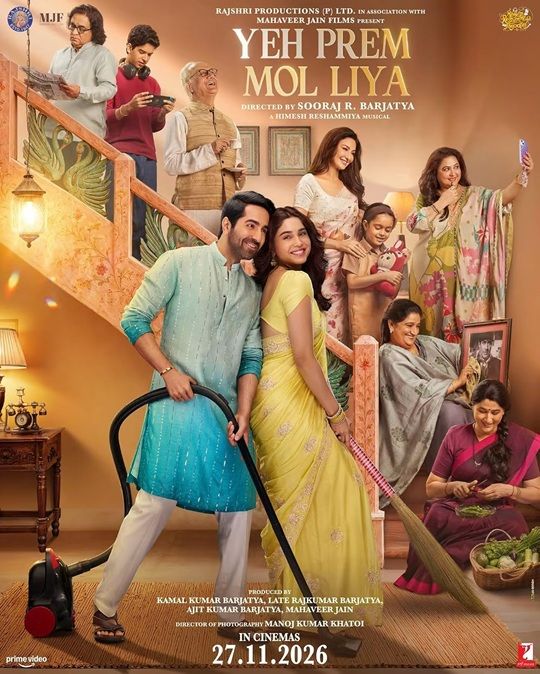
At some point in the new Hindi film Yeh Prem Mol Liya, there is a reference to a 55-inch television and a PS-5. These objects don’t just symbolize a streak of change, but a hint of desperation to portray the film as progressive within the cage of regression. This is true with regards to the characterization of the two protagonists, Prem (Ayushmann Khurrana) and Purva (Sharvari) too. The latter is shown to be a journalist, having no qualms in stopping a local train by stepping on the track – imitating a protest, just so that the farmers could get on the train (I wonder why though? There is a local train every 5 minutes, really).
The former is a struggling musician migrated from Bihar, trying his hand at making it big in the bad bad world of Bollywood – even whilst renting a small space in Mumbai that resembles a bungalow. Even the producer that he meets for his big break is a righteous man who chooses to walk away when someone bad mouths his profession, rather than confronting him in a crude tone. In all these elements, you notice a standard Rajshri touch of their perennial ‘goodness’, wrapped in a medicine labelled that of change, except that the creative liberties of progression are restricted to a film based on mythology.
Written by Sooraj Barjatya, Yeh Prem Mol Liya nudges you to suspend your disbelief from the start, even while portraying itself as a wholesome family drama with traces of romance. The latter in particular feels straight out of a fairytale of sorts, with a brewing love angle sprouting against the backdrop of an early 2000s-coded music number. You witness the conviction in the writing even as the focus remains on Prem drawing his inspiration for his song by simply staring at Purva in his local train journey spread across days in a 15 minute montage sequence. It is beautiful, and the shy boy in me was gushing at the events – even though a similar situation in another film could easily pass off as stalking. I guess the lens does matter after all!
There is something sweet and something tragic about its protagonists that had me drawn into their journeys – be it the silent stares of Prem subverting the focused demeanor of Purva, even as they stumble upon each other everyday. She is a SoBo girl living in a mansion in Walkeshwar overlooking the Marine Drive – except that her life hasn’t revolved around slow sunrises and sunsets across the Arabian Sea. Her focus centers around her matriarchal family comprising of two grandmothers, one aunt, one cousin and her kid, each of whom are dealing with either health issues or issues centered around grief.
On the other hand, a struggling musician seated within Prem is forced to look elsewhere given his ultra-bickering and patriarchal father, who remains a perennial pessimist in an otherwise hopeful setup comprising of Prem’s grandfather, his mother and his brother. It is a match made in heaven but laced in a tragic inevitability that transforms into bouts of longing. The characterization does the heavylifting here, treated with utmost sincerity that pours onto a scene christened with (extra) sweetness – even as the protagonist proposes marriage to his beloved in a scene by ensuring on how he isn’t toxic or a stalker – two key virtues of heroism on celluloid today. We believe you, Prem – the Rajshri-stamped name is enough.
The writing is genuinely well-intended, although dipped in a sauce of disbelief with its core conflict in hand – even as the protagonist proposes of shifting to Purva’s place as members of a one big joint family, simply because the latter cannot leave her family. There are inferences of wanting to smash the patriarchy, even whilst willing to give an identity to the suppressed gender by willingly portraying a family that would ‘share the load’. My complaint though remained with its stereotypes – the women would still be in the kitchen, often cutting vegetables, while the men would take care of the finances of the household. It is a specific case of how progression is also limited to the realms of relationships and households, as opposed to operating in full liberty.
There is a layer of warmth in the initial friction imposed between family members of the to-be bride and the groom – ranging from a bickering stance on the astrological space of the rooms (specifically in the direction in which the doors open), or a resistive stance on being referred to as ‘maa’ and ‘papa’, particularly when the girl chooses not to change her surname, or a genuine warmth erupting from an in-house competition of completing chores, and the one to finish first would get to operate the newly purchased TV first. There is something definitive about the ‘Rocky Aur Rani’ template that does work in the family setup.
The major issue that I had was in the positioning of the social issue, that did change the tone of the drama from a frothy, fictional romance to a full-blown melodrama. It is interesting how this drama worked the best (even with its wild swings) when love played a significant character. But when that ‘love’ was married off to a ‘social commentary’ – it took the shape of melodrama that had me increasingly staring at my watch. The events preceding the shift also have traces of the same laced with a secondary theme of ‘second chances’ – including an alcoholic character being given a second chance to marry another daughter from the household, or a wild swing in the form of a sub-plot involving Purva persuading a reluctant movie producer about giving her husband a second-chance inside a men’s toilet!
The writing in a Rajshri film has always followed a strict template of a family reunion subverting a blossoming romance in the mix, only for the tone to shift in the final act. It can be in the form of a death (Hum Aapke Hain Koun), or a fire incident crucial to the plot (Vivaah), with Yeh Prem Mol Liya following the suit in the form of a variant of the former event. A specific incident involving a staircase is imminently designed to evoke a sense of nostalgia with a similar tragedy, only this time to derail the events of the film.
The drama that ensues is not only preachy but a full-blown lecture on ‘ghar’ being the appropriate term for a house instead of ‘Maikaa’ and ‘Sasural’ – in a dynamic that pits the son against his family in a court of law. The court case in itself is laughable simply because the poor judge has to listen to an entire flashback of over two hours, only for a series of events that could easily be described in a line or two (he heard the songs too?). But more than that, the subtext of patriarchy being smashed is only communicated through long monologues and simpler resolutions including a take on the values of a man being passed down from his mother, that don’t exactly cross the realms of progression in a patriarchal setup, with the ‘man’ always hijacking and reminding the values of a woman (why doesn’t she have a voice of her own again?). By the end of it, I wasn’t fully convinced on its progressive stance despite its right intention – and that is the main issue that I had with the screenplay that blows hot and cold within the realms of a married household.
The dialogues offer a well-intended, soft-landing of the themes that wish to be addressed – almost a trademark of Rajshri dipped in extra doses of sweetness. But in the same breath, the monologues get way too preachy after a point (with characters pausing after every two words to give every bit some weightage) – almost as if the writing isn’t convinced of its subtly heartfelt moves, intending to drill home the point that it is trying to make. And therein lies the issue too. The music by Himesh Reshammiya is melodious, and instantly reminiscent of the early 2000s – an era where Himesh himself was prone to delivering certified bangers. In fact, the early suspension of disbelief could also be credited to some tunes that instantly make their way to your heart – allowing you to feel the freshness of love all over again. The BGM follows a similar suit, doing enough to evoke each scene with the necessary dose of emotions in the mix.
The cinematography comprises of wide-angle shots that account for the spacious mansion of Purva to play a character in the film, being witness to the bustling synergy of the existing characters in the mix. The framing also accounts for an emotional core that is imminent through the close-ups of the characters. The grandeur of the landscape is explored ably through the frames that do the job as desired! The editing pattern is leisurely, a trait that literally had me squirming in my seat towards the final 40 minutes – that featured one monologue after another. The lags were for everyone to notice in a screenplay that nearly ran into 3 hours!
Director Sooraj Barjatya shines brightest in the intimate, early-2000s-coded romantic beats and the bustling warmth of large family ensembles, where his earnestness makes you willingly suspend disbelief. However, his signature reliance on old-school melodrama and heavy pauses weighs down the narrative when it shifts toward social commentary. While his intent to champion progressive household dynamics is clear, his staging struggles to break free from the traditional Rajshri template, allowing preachy lectures to overpower the film’s genuine emotional core. And that is where the conflict lay in my thoughts – are pure intentions enough to deliver a progressive tale? The direction remained a mixed bag here.
The performances are wonderful by the members of the cast. Shruti Seth, Krish Rao as Rohit, and Ashnoor Kuckreja as Rasgulli deliver earnest, natural turns that keep the bustling household feeling authentic. Adding welcome texture to the sprawling family dynamic are Surbhi Tiwari as the embittered aunt and Shaad Randhawa as the recovering ex-brother-in-law. Meanwhile, Saumya Tandon as Bua lends quiet dignity and tenderness to Purva’s widowed aunt navigating grief and a second chance at happiness.
Rajesh Kumar and Girish Kulkarni lend solid, grounded support in brief yet memorable turns, bringing their trademark naturalism to the film’s sprawling ensemble. Even within limited screen time, both actors register effectively, adding credibility and lived-in texture to the world around Prem and Purva. Seema Pahwa as Daadi and Supriya Pathak as Nani inject delightful comic relief and lived-in affection into Purva’s Walkeshwar mansion, balancing lighthearted banter with genuine emotional pathos.
Swanand Kirkire as Ved Mishra delivers an impactful turn as Prem’s rigid, pessimistic father, convincingly portraying the patriarchal resistance that drives the central conflict, even if his dramatic shift feels slightly abrupt. Yes, if the character does come across as annoying then that is due to the writing that pushes the characterization in realms of extremism, even when the drama doesn’t warrant it. Balancing his stern, bickering demeanor is Geeta Agrawal Sharma as Prem’s peacemaking mother, who brings quiet grace and maternal warmth to the household. Together, they effectively anchor the ideological divide within Prem’s family – showing the contrast between inherited patriarchy and the gentle values passed down to their son. Anupam Kher as Dadaji brings effortless authority and soulful warmth to Prem’s supportive grandfather, serving as the moral anchor of the household.
Sharvari brings an easy grace and quiet resilience to Purva, effectively balancing the poise of a modern working journalist with the emotional weight of anchoring a fragile, all-women household. Her effortless chemistry with her co-star gives the early romantic beats their fairytale charm, while her understated vulnerability shines through in the domestic friction scenes. Though the screenplay occasionally sidelines her voice during the preachy climax, Sharvari still manages to hold her own.
Ayushmann Khurrana as Prem scores well in the first hour, slipping effortlessly into the quintessential Rajshri mold with an old-world sincerity that sells the romantic beats—from drawing musical inspiration on his daily commute to earnestly assuring Purva that he isn’t a stalker. However, once social commentary takes over in the second hour, his mannerisms no longer feel entirely natural, turning noticeably theatrical as he delivers long-winded, preachy monologues. While his familiar everyman charm keeps the character likable, his measured pauses and overly earnest posturing in the final act feel engineered rather than organic. He was decent overall, but his performance did feel largely curated to suit the mould of Prem.
Despite earnest performances, Yeh Prem Mol Liya left me conflicted with its simplistic attempt to dismantle patriarchal stereotypes while staying safely within the conventional confines of marriage and relationships. Its intentions are pure, yet the melodramatic staging turns meaningful social commentary into a preachy, meandering lecture rather than an impactful, grounded story. While I wholeheartedly endorse the ideas it champions, one question lingered throughout – are pure intentions enough to make a film worthwhile? For me, the answer is a reluctant no. Available in a theatre near you.


