

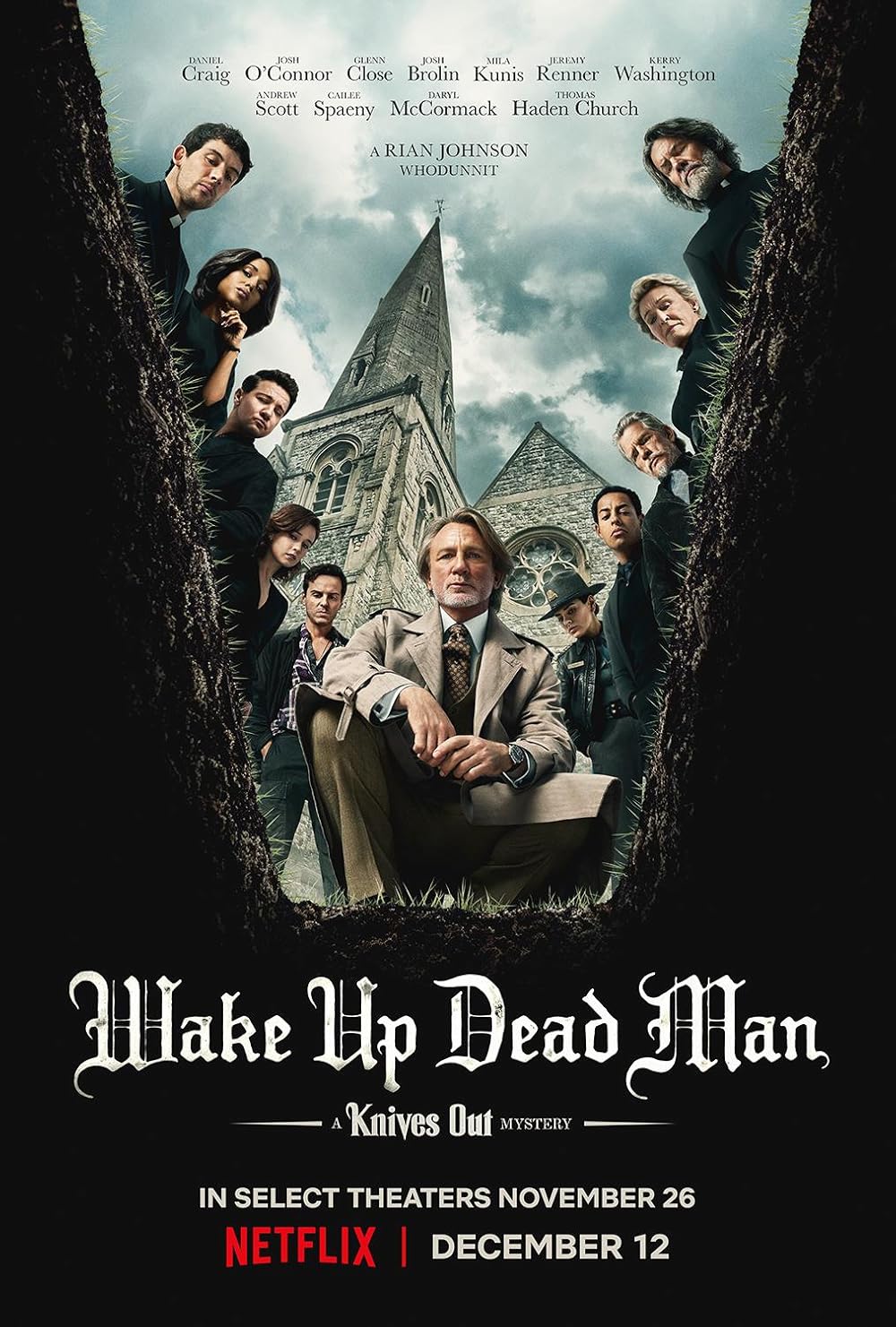
The encroachment of the Knives Out franchise into the gothic religious territory isn’t a coincidence – it is a reflection of the times that we live in. Going from a classic mystery in Knives Out (2019) to a more frivolous vacation whodunnit of the rich in Glass Onion (2022) to entering the dark Southern alleys of Gothic cinema in Wake Up Dead Man: A Knives Out Mystery (aka Knives Out 3), the franchise has a natural upgradation in terms of its content but a serious retrospection on the us versus them narrative that has been a talking point even closer to home even with a ‘harmless’ film like Dhurandhar. Such are the times of duality that we live in – something that is also reflective as broader themes in the narrative here. To begin with, we are introduced to Father Jud (Josh O’Connor), a boxer turned priest who is tasked to assist Our Lady Of Perpetual Fortitude – a rural parish led by Monsignor Jefferson Wicks (Josh Brolin).
It must be noted that Jud has led a dual life already – one that of a boxer who has knowingly committed a murder in the ring, something that he claims was stemming out of hatred that made him turn towards God for love and resurrection. As a result, the core personality of the now Father Jud remains timid and restrained while wishing to show empathy towards the people around him (with the blow to an arrogant deacon being an exception as well as an extention of his duality). The journey from fisted hands to open arms is the path that Jud has been treading on, until the next theme of duality remains his encounter with Wicks – a seemingly religious but powerful entity known to spread rage in a game of absolute power.
Written by the ever-so-talented Rian Johnson, the gaze that Wake Up Dead Man wishes to redirect is as much of a whydunnit as a whodunnit while subverting the concept of religion, faith and practicality in between. As an extention of the same, the characters hold a lot of importance in the mix based on the themes in play here. For instance when you are introduced to Wicks, you see his shadow pouring in on the cross – almost an indication of a God-like figure that could replace the Christ on the cross. His rage is specifically redirected to newbies of his church, leaving behind only a flock of people who would stand by his teachings that are driven by hate-speeches in a bid for absolute power. He represents the fascist take on religion by using it as a medium of hate and not love – a single sentence that can be equated to many world leaders today as well as the God-man that they have been supporting.
Given that this remains a whodunnit, many characters form the fabric of storytelling here – the devout servant of the church Martha (Glenn Close), a disabled former cellist Simone (Cailee Spaeny), an author wanting to sensationize his new novel Lee (Andrew Scott), a town doctor Dr Nat (Jeremy Renner) taking a liking for alcohol after the death of a loved one, a tightly wound lawyer Vera (Kerry Washington) tasked with having to take care of her half-brother and failed politician Cy (Daryl McCormack), and the sincere groundskeeper Samson (Thomas Haden Church). These might seem like regular characters but if you dig deeper into its subtext, every character is flawed and living a life of duality, with the themes of greed, hope, sensationism, alcoholism and faith being pivotal byproducts of every personality. And these materialistic traits further compromise of our society given how people are being killed in the name of religion across the globe at the behest of men like Wicks who enjoy absolute power (in the name of religion).
And given that this is a whodunnit too, you are also reacquainted with Benoit Blanc (Daniel Craig), the stellar private investigator who joins the setup after the inclusion of murder. It must be noted that his teamwork with Father Jud isn’t a coincidence either but a subversive take on the dilemma between faith and practicality – with each trait being symbolic of the two characters. The contrasting tones are for everyone to see as well – the tone continues to remain serious, sedate and empathetic when the limelight is on Father Jud, while the tone branches into a quirky dark comedy with Blanc enjoying most of the punchlines.
The Biblical references in the drama cannot be denied as well, particularly with the inference of the murder that transpires on a Good Friday with a gothic twist in the tale being on Easter Sunday, presumably with the resurrection of the dead body (a direct reference to the dead and resurrection of Lord Jesus Christ) – almost touching upon the concept of a ‘miracle’. There are inferences to religion too – given how a pizzeria is named Il Diavolo which literally translates to the ‘devil’, so much so that even devil-bound lamps double up as Chekof’s gun in the narrative. Or even the inference to ‘Road To Damascus’ literally translating into enlightenment or a change of heart (in the Bible, it signalled a sudden conversion into Christianity), that seamlessly establishes itself in the narrative. Or even the Eve’s Apple that represents temptation, an integral cog in the narrative too.
The writing remains complex and a little convoluted particularly given that the drama intends to be a closed door mystery, a nod to the novel The Hollow Man. And while the characters jostle for clues and hints, the subversive themes continues its gala run in subtly exposing the simmering corruption in the church – almost in the form of a revelation that adds clarity to the proceedings. If I were to look at the trajectory of the drama, it would resemble a flawed person who may have committed crimes throughout his life but later seeks for forgiveness in front of the Lord. It is interesting how every character is dealing with this sentiment of guilt – the guilt of having to resort to materialistic pleasures that makes everyone a suspect.
The stakes in the drama are raised even as the bodies begin to pile up but what really impressed me about the writing was the risk-prone final act – that began with theatrics and drama with revelations underway but soon paused the proceedings for an alternative revelation. This could have gone horribly wrong, particularly with the pause in momentum at the end. But the precision with which the drama circles back to the revelation – almost in the form of a confession to the priest, not only landed perfectly but also went perfectly with the theme of the drama that found its home in forgiveness. That remained the arc that found its completion in a brilliantly penned screenplay that absolutely hits it out of the park.
The dialogues perfectly encapsulate the contrasting personalities of the two protagonists Blanc and Jud, while ranging from religiously sedate and inflammatory to something quirky and fun. The BGM perfectly elevates the gothic themes of the drama, creating a chilling ambience of mystery and deceit that will potentially keep you on tenterhooks. The cinematography also captures the themes of religion and practicality perfectly. While the introductory scene of Wicks extending his shadow on the cross tells you a story, even Blanc’s introduction by the fireplace tells you a thing or two of the fiery ‘impossible’ investigation that would unfold through the film. The costumes exhibit a sense of duality as well. For instance, you spot Wicks in whites and Jud in a black robe, two contrasting shades to their personality but more in line with how the world perceives them to be.
The editing pattern allows the drama to simmer that much longer in order to extract flavours with respect to the dualities in display. Come to think of it, the narrative style employed is a complex one too, with multiple threads that needed a seamless connection – something ably put together by the editor. Director Rian Johnson has got to be one of the finest contemporary filmmakers doing the rounds lately, and this film may well be the big bold move of his filmography. Not only was the subject matter complex, but also some pivotal scenes that needed precision for them to have a lasting impact (for instance the two-fold finale). But Rian uses his characters to perfection while creating a world that not only is scary but also a reflection of the times that we live in today. The direction remained brilliant while never losing sight of the recurring themes in the wake of a whodunnit, something that elevated the drama to new heights!
The performances are wonderful by the members of the cast. Annie Hamilton as Grace is terrific while leaving a lasting impression despite a limited screentime. Cecilia Blair is phenomenal as the young child whose performance is stoic and capable of giving you chills at the end. James Faulkner as Rev. Prentice and Jeffrey Wright as Bishop Lamgstrom have their moments to shine. Mila Kunis as Chief Geraldine is sincere and earnest while being a perfect example of an anti-casting. There is a sense of calmness mixed with an impulsive streak to her character that she taps into beautifully. Thomas Haden Church as Samson is superbly understated while representing a follower without analyzing the subtext of a personality. Daryl McCormack as Cy is wonderful to witness as a character representing absolute power and greed. Kerry Washington as Vera is understated in a character that remained a touch underwritten.
Jeremy Renner as Dr Nat is exceptional to the core even while utilizing a minimalistic approach towards his character. Glenn Close as Martha is absolutely brilliant as a character blinded in faith, wherein she uses her wonderfully expressive eyes and a dignified posture to drive home the point of her character. Josh Brolin as Wicks is an extremely flawed character that remains an extention of many real life personalities that you may know. He is driven by rage and the hunger for power that will prick your fury at many junctures in the narrative. And he was superb to witness here.
Both Daniel Craig as Benoit Blanc and Josh O’Connor as Jud represent to drastically different personalities. One is practical, the other is God-fearing. One is quirky, the other empathetic. One is playful, the other driven by sorrow. And together, they form a fire and ice combo that is hard to shrug off. Both are such exceptional actors who feed off energy and deliver such brilliant acts. This remains particularly true for Josh who had to shoulder the mantle of the first act mostly by himself, even as the drama unfolds through his gaze. Daniel adds the much needed fizz to the drama with his entry, thereby collectively putting forth phenomenal performances.
Wake Up Dead Man: A Knives Out Mystery is a deeply complex commentary on religion and practicality packaged in a brilliant genre-bending whodunnit that makes for a phenomenal watch. And much of the subtext with respect to faith in today’s world stems from its title – Yes, we are the dead men…..but hopefully we will wake up soon before it is too late. Available on Netflix and Highly Highly Recommended!


