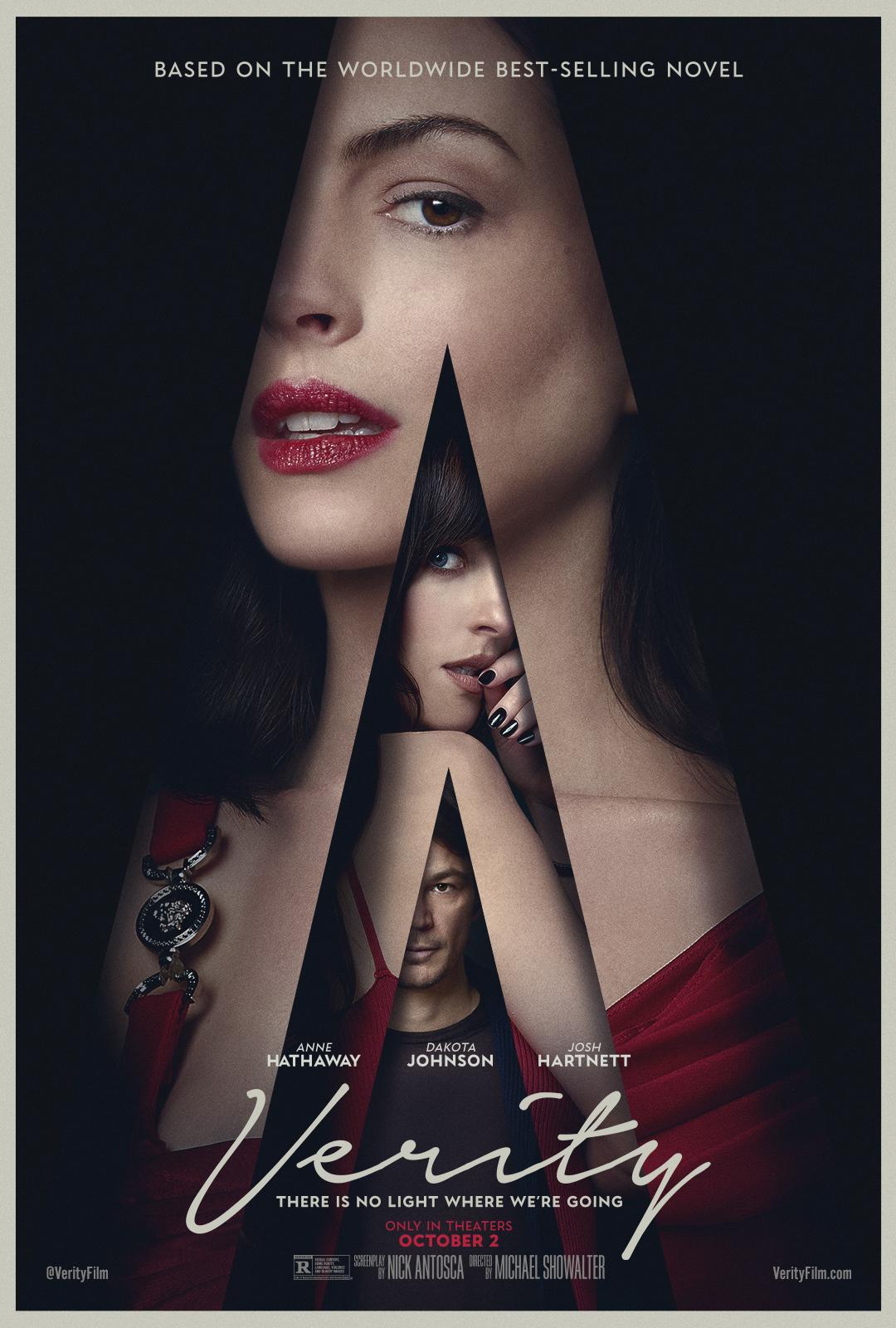
In an alternate universe, the new English film Verity could have been a superhero origin story – typically traversing a good-vs-evil template through its drama. But an early indicator of the writing aspires to tap into its grey shades, through the protagonist Lowen (Dakota Johnson) – an underrated writer having an affinity to cook up twisted tales. It is also interesting on how the parallels are drawn between the protagonist and Verity (Anne Hathway), an established crime novelist who is known to pen her chronicles through the POV of the antagonist. Her novels are controversial, dark, and disturbing – almost reflecting a fractured psyche of an individual deeply immersed in an unwinding labyrinth, tactfully penning every move of hers as poetry in pose. So when Lowen is approached to finish a writing assignment of Verity – a three book deal for ghost writing her notes, it isn’t just due to her writing abilities. In fact, the theory remains on how Lowen matches her fractured psyche with Verity, having subconciously inculcated a habit of matching her pessimistic and erotic style, while possessing the intellect of a twisted person in what is observed to be a replica of Verity. In other words, Lowen is Verity from a different timeline and age demographic.
Based on the novel of the same name by Colleen Hoover, there is an underlying streak of grief that binds the characters at the start of the film Verity. For instance, Lowen is suffering from a personal loss of her mother, even as her writing career hasn’t exactly flourished. And in a blood splattering moment, she crosses paths with Jeremy (Josh Harnett) – the supposedly hapless husband of Verity, grieving due to the loss of his child, while also having to take care of his crippled and incapacitated wife.
The writing taps on an interesting dynamic between the protagonist and Jeremy, something that coincides with the increasingly fractured psyche of the protagonist. My minor criticism extended to the setting of a wooden home built beside a frozen lake that didn’t hold the atmospheric angle that was crucial to the drama. The setting although secluded, wasn’t intimidating enough to weave a blanket of tension reminiscent of a film like Gone Girl (2014). The claustrophobic alleys had played a pivotal part in elevated the fractured psyches of the characters there, something that didn’t feel like an extension of the same. And whilst the house itself was a metaphor for emotional and psychological isolation following the tragic instances, the spacious atmosphere felt compromised. In that sense, the brewing dynamic had to do a lot of the heavy lifting, coupled with the decaying mindset of the protagonist.
I like the thought of the reality and morality of the protagonist progressively blurring over the course of the proceedings. This, including her uncanny obsession for Verity’s past – a tactful reconstruction of her early life with Jeremy, her tryst with motherhood, and her twisted stance on her children. The picture remains skewed trudging on themes of narcissism followed by postpartum, with sinister streaks infused in the narrative that are worth a million nightmares. In fact, this sinister streak felt like a psychological glimpse into the disturbed mindset of a psychotic evil girl who is twisted in her demeanor. And in the same breath, these stray events contributed to a more meaningful psychological horror on the part of the protagonist who seemingly begins to imagine ‘things’ around her.
Unfortunately, these instances often coincide with a rather dragging and unnecessary dimension of erotica – something that reminded me of a film like Basic Instinct (1992), with the protagonist tracing the iconic character of Catherine (Sharon Stone). But I have used the word ‘unnecessary’ here because it definitely strayed away from the tense psychological dimension that the writing was dwelling in. One could argue that this angle of erotica was equally twisted and psychological – but it definitely resulted in pacing issues, whilst dipping the flow of the drama. And not to mention, a tonal mismatch of sorts from the main drama.
I couldn’t help but reminisce over this triangular dynamic that have once upon a time been a staple of Vikram Bhatt films – like Inteha (2003), or even a brief flirting tryst with a film like Kasoor (2001) which in hindsight were fairly popular B-films that had effectively served a heady concoction of thrills and erotica. In fact, the dynamic also reminded me of the recently released English film The Housemaid (2025), that had painted each of the three characters with a hue of grey while tapping into a similar dynamic. Instead when the eventual idea was of building around an air of ambiguity – one of the lesser explored dynamics remained that of Jeremy with his son Crew, something that would have gone a further way in justifying a wild swing for the character towards the end.
The events of the final act increasingly reminded me of Gone Girl (2014), wherein the final twist was used in hindsight to justify the actions of the characters through the film. This, while ably creating a moralistic blur that would force you to think about the drama and its characters, long after the end credits rolled. But here, I did feel that the finale twist was left a little too late in the narrative – an issue that I had previously encountered with the dud Toxic (2026). I see what the writing was aiming for, creating a villainous ambiguity around a particular character while trying to hide the villainous traits of the others, in the wake of a deliberate crime being orchestrated. But because the complex dynamics weren’t strong enough, and the swings were too wild to even care for – the streak of ambiguity itself felt diluted.
Yes, I was in the middle of discussions around the open ending, but a force did hold me back – something that didn’t quite add up or feel convincing in that regard. In that sense, the screenplay was a mixed bag – showcases some interesting instances of horror including a terrific jump scare, but doing little to rest its balance on the plank of ambiguity, something that was wobbly. The concept truth vs deception may have been interesting on paper, but it didn’t quite land seamlessly on celluloid.
The dialogues flirt with bouts of edgy, psychological horror and nuggets of erotica, and they make for a fairly good impact. In fact, the portions involving the reconstruction the notes of a particular character, resembled flipping through the pages of a novel, almost like a deliciously dark aroma of a brewing calamity that nicely blended with the mood of the drama. If only, the writing didn’t have distractions, something that compounded through a chatty s*xual tension brewing between two characters. The BGM ably uses silence to create a solid impact with regards to the psychological horror element of the drama. In fact, silence plays a bigger part in brewing psychological tensions between the characters, rather than the setting itself.
The cinematography comprises of frames that struggle with the location in question – unable to fully create a sense of tension that was pivotal for the brewing drama here. The frames didn’t always get up and closer to the characters for me to be fully immersed into their fractured psyche. The editing pattern ranges from bouts of brilliance to unending pacing issues in the second act. From a scene composition perspective, I like a steady buildup of tension in a particular scene leading upto a terrific jump scare (one for the ages, if I may say so myself). This scene worked because the cuts were too jarring or prevalent. But in the same breath, there are some severe lags in the second hour leading to bouts of erotica that could have easily been implied through clever shots and cuts. This would have also resulted in a tighter runtime, that may have been less meandering and more intriguing.
Director Michael Showalter successfully taps into the story’s intense psychological undercurrents, but he falls short of doing full justice to the written material. He proves adept at cultivating an atmosphere of mounting dread and capturing the world’s eerie suspense. However, this focus comes at the expense of the narrative’s emotional core, as his direction never quite focuses on developing the intricate dynamics between the characters. By prioritizing psychological tension and erotica over these vital, slow-burn relationships, the film leaves its most compelling human conflicts feeling underdeveloped and prevents the adaptation from achieving its full potential. As a result, the end goal of ambiguity is never fully realised, making his outing a bit of a mixed bag.
The performances remain a mixed bag too, by the members of the cast. The likes of Arina Dvorovenko as Anna, Ismael Cruz Cordova as Corey, Sienna Kulovitz as Harper, and Brady Wagner as Crew are pretty impressive in their bits, and each of them have their moments to shine.
Anne Hathaway delivers a masterclass in calculated menace as Verity. She completely locks into the pulse of her performance, ensuring that every frame she inhabits feels intensely calculated. Even when her character is seemingly incapacitated, she leverages a chilling, hyper-controlled body language that sends shivers down the spine. It is through these micro-expressions and unsettling physical choices that gave me terrifying glimpse into her deeply twisted psyche, making her an inherently magnetic yet horrifying presence on screen.
Josh Hartnett does his best with the material as Jeremy Crawford, but his natural charm works against the script’s final demands. He effectively projects a warm, dedicated, good-guy persona through the majority of the runtime, making him an easy anchor for the audience’s empathy. However, this earnest framing fails to justify the massive, jarring character flip at the very end of the film. Rather than a failure of his acting capabilities, this narrative disconnect is entirely a byproduct of the writing, which unearnedly forces a psychological pivot that his previously established wholesome character logic cannot support.
Dakota Johnson fails to anchor the psychological gravity required for her role as Lowen Ashleigh. The inherently twisted virtue that defines her character’s moral descent is majorly missing from her portrayal. Instead, Johnson appears to merely go through the motions, delivering lines without allowing any genuine psychological edge to sharpen her persona (unlike say Rosamund Pike in Gone Girl (2014)). Because she avoids tapping into the deeply rooted paranoia and obsession of the narrative, often resorting to dead pan expressions amidst a wave of erotica, her performance feels empty rather than edgy, leaving a vacuum where the tension should be taut.
Verity stands as a decent psychological thriller that ultimately remains a mixed-bag drama, never fully realising the profound potential of its source material. While the narrative fairly excels within its psychological parameters – occasionally pivoting into effective traces of horror, it fails to meaningfully tap into the complex dynamics between its core characters. Instead, the story places an unnecessary emphasis on erotica, a misstep that drastically reduces the impact of its final ambiguity. Because the tension is continuously undercut by these tonal distractions, the piece ultimately delivers a middling, conflicted experience: a perfectly watchable but decidedly underpar thriller that leaves its most compelling narrative promises unfulfilled. Available in a theatre near you from 2nd October ‘2026.


