
I still remember a little toy phone that I had, something that formed a brief but distinct memory from my childhood. I would make imaginary calls with it, allowing my imagination to run wild – whilst also providing my comforting moments with my friends back in the day. But as I grew up, I grew out of that little toy – upgrading that toy to a real phone, and later to a smartphone – all of which did bring my world closer, but ironically lost its charm of simplicity. The Toy Story franchise has followed a similar trajectory with a bunch of toys increasingly undergoing an existential crisis, firstly with the kids with whom they once formed a integral connection with their childhood, to now having to compete with actual tech devices, in order to gather the attention of the kids that they really love. The glitch in its idea is the lack of heart in the devices, that ironically forms a major bout of criticism for the fifth installment of the franchise Toy Story 5. You can sense that the peak reached was around the third part, and with technology advancing – I felt that the heartfelt nature of the drama that was once its USP, has suddenly gone missing here!
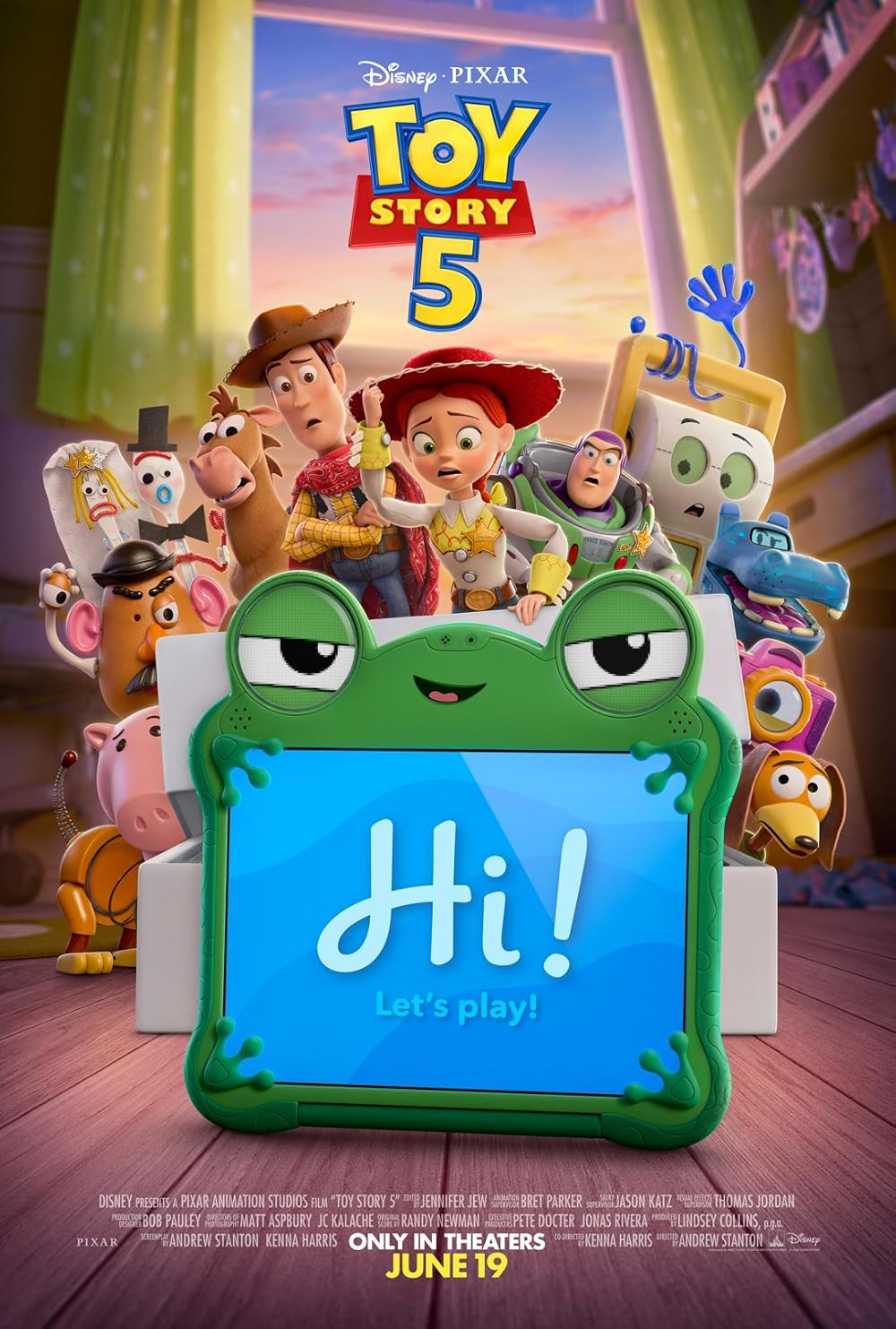
Written by Andrew Stanton and Kenna Harris, the premise of Toy Story 5 is both interesting and relevant in the times that we live in today. It starts off with the character of the toy Jessie (Joan Cusack) and Buzz Lightyear (Tim Allen) who are still a part of the little girl Bonnie’s (Scarlett Spears) life from the last film. And the persona of the latter drives the narrative here – a nine year old being the last kid standing who loves playing with toys, even as peers in her school and neighbourhood have advanced to tech devices. You feel a sense of loneliness on the part of the little kid, that invariably coincides with the existential crisis of the toys that would soon be lost in oblivion in the garb of a new tech device Lilypad (Greta Lee) – something that would hijack their worlds.
The drama scores the most when the focus remains on Jessie, a specific toy who had previously encountered her bouts of rejection, something that had made her question her own abilities. Hence when she wishes to fix the loneliness of Bonnie by accompanying her to a sleepover, the emotions were palpable and focused on a bunch of characters whose future would remain uncertain.
But my primary issue with the narrative remained on how overstuffed it felt, particularly with the subplots in play – the reintroduction of the now-balding Woody (Tom Hanks) who would arrive in order to provide his services to Jessie (following a miscommunication), or Buzz’s newfound ‘random’ feelings for Jessie that would invariably have him competing with Woody, or an army of Buzz Lightyear’s who believe they are tasked with countering humans in a plot that felt out of a totally different film. What that does is counter the simplicity of the narrative that initially had heart with a purpose, even while fizzling out on both after a point.
The issue extends to the journey embarked by Jessie, something that needed a simpler trajectory as opposed to a convoluted one – even as she soon finds herself at the farm of another kid Blaze (Mykal-Michelle Harris), a child that loves toys similar to Bonnie. The subtext remains that of manipulating the trajectory of the screenplay while steering away from the core conflict, and treating it as a parallel plotline as opposed to the central conflict – in a clear case of what felt like the writers overtrying to keep the narrative relevant. Even the introduction of a new tech device Smarty Pants (Conan O’Brien) felt like an a plotpoint to establish a middle ground between the toys and the tech world that never was the starting point of the narrative. It is ironic on how Smarty Pants faces an existential crisis of its own that is similar to that of Jessie, but both aren’t tapped into well enough to feel a sense of empathy for them – a feeling that I had got in Toy Story 2 and 3.
There are a bunch of heartfelt moments sprinkled in the narrative – be it Jessie discovering on how the kid that used to play with her, has in turn named her kid after her, a beautifully emotional moment that comes out of nowhere, and in isolation. Or a bittersweet moment between Bonnie and Blaze, wherein the former refuses to collect her toys after being ridiculed online by her friends – a clear subtext on how social media is overhauling the simplicity of our lives. But these moments work only in isolation as opposed to creative a cohesive emotional thread.
My biggest gripe with the narrative structure remained on how the nostalgic baits in the form of Woody and Buzz were literally reduced to background characters, almost nullifying the point of relevance that was an integral conflict of these characters. And add to that a muddled finale that not only failed to fully resonate with me emotionally, but also skewed the original messaging of the film. I would have been fine with this messaging, had its seeds been sown at regular intervals in the narrative. To be fair, the seeds were there through the ‘tech toy’ characters – but none of them had enough screentime to fully resonate with them. In other words, the screenplay here feels like your comfort food that has now on the verge of being stale, even while serving as a stark reminder that my childhood is long past me.
The dialogues are grounded to its themes, but a little too mechanical as opposed to providing sustaining heartfelt bouts along the way. The music and BGM try hard to evoke a deeper set of emotions than what is on offer, and to be fair, they are successful in parts. But I wished that the writing was sharper for it to have an even bigger impact. The animation by Pixar is absolutely top-notch, much like most of their previous ventures – with the only exception that forms both an irony and a meta-commentary on technology. The animation (and technology) still need to be backed by emotions that are heartfelt and palpable, as opposed to being hollow and mechanical which form their basic trait.
The editing pattern doesn’t always cope up with the muddled nature of the writing, often resulting in the drama being overstuffed. The convoluted nature of the drama comprising of multiple tracks (some unwanted too) in the second act, also makes the proceedings slightly stretched while lagging at many places, enough to disconnect viewers momentarily. And all of it boiled down to its core issue – the writing wasn’t simplistic.
Director Andrew Stanton isn’t fully able to commit to the relevance of his subject matter, even while scattering his vision into multiple subplots that over-complicate an otherwise simple tale of tech vs toys. He does create a few heartfelt moments against the run of play, but largely relies on nostalgia through the characters to drive the narrative. That for me didn’t fully land the way it was anticipated, resulting in the direction being decent but nothing beyond that.
The voiceovers are mostly good by the members of the cast. Scarlet Spears as Bonnie and Mykal-Michelle Harris as Blaze have their moments to shine, while accounting for a good enough emotional core of their characters through their voiceover. Conan O’Brien as Smarty Pants is fairly good although there is a streak of annoyance through his voiceover in a few instances (something that needed to be more earnest otherwise). Craig Robinson as Atlas and Shelby Rabara as Snappy are decent while accounting for a few moments of fun.
Tom Hanks as Woody and Tim Allen as Lightyear Buzz are competent, and both of them manage to impress. Greta Lee as Lilypad has a sinister undertone to her character, which she voices to perfection – although her transformation felt sudden and abrupt after a point. Joan Cusack as Jessie brings flair and emotions to her voiceover, while acting as the soul of the drama. She was brilliant, and a treat to witness here – particularly while accounting for subtle shifts in her characteristics while retaining the leadership core.
Toy Story 5 tries to lean on nostalgia while facing its own identity crisis. This creates a crowded story that starts well but quickly loses its way. The emotional moments feel incomplete, serving as a blunt reminder that childhood is long gone. Even as modern technology replaces the simple toys of my past, I still find myself wishing my old childhood ‘toy’ friends well. Sadly, even the best things change over a period of time, just like the franchise here. Available in a theatre near you.


