
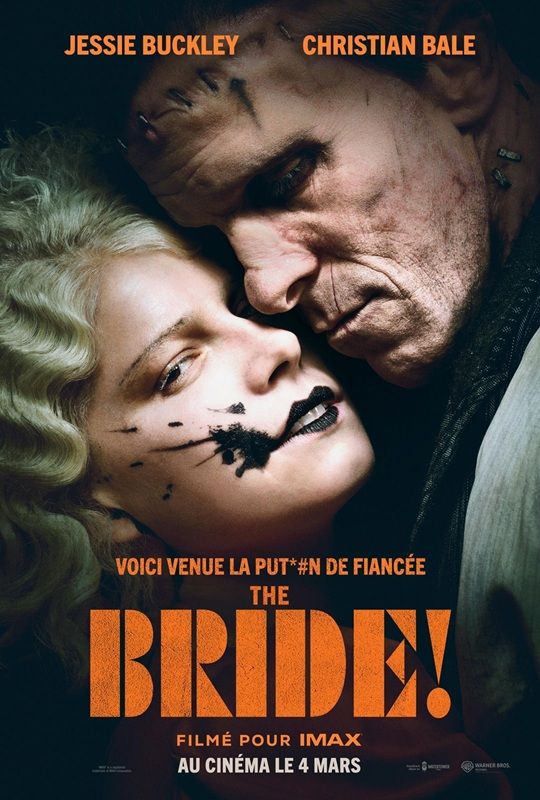
The opening act of the new English film The Bride is enough to tell you about the self-indulgent traces of the drama ahead. In an early scene, you are introduced to its protagonist Ida (Jessie Buckley) – a beautiful young woman caught in the midst of the gangsters. You see early signs of patriarchy thriving too, even as Ida is fine as long as she is s*xualized – but the minute she opens her mouth to expose the activities of the gangsters, she is bundled off to her coffin. For me, this was the spirit of the drama which could have been the fundamental backbone of the drama. But this is where the self-indulgence creeps in with the introduction of Mary Shelley (also Jessie Buckley) – the writer of the 1818 novel Frankenstein who is reimagined to be in her aftermath – whilst holding onto a secret ambition of wanting to tell an alternate tale. The character is known to frequently break the fourth wall while doubling up as a spirit inhabiting young women in order for them to speak their minds out. The margin remains narrow and the writing often tows this line of incoherence – even as this character randomly begins appearing at multiple instances in the drama.
Inspired by the 1935 film Bride Of Frankenstein and written by Maggie Gyllenhaal, the issue with The Bride remains a very specific case of an identity crisis. It wishes to be a horror film, a neo-noir drama, a gothic romance, a thematically musical drama, and an eccentric piece of hot mess – all at once. And therein lies the issue of incoherence – it doesn’t know what it must give importance to. In a way, it remains a batter whose strength lies in artistic shots but is pushed to play some rather wild slogs along the way. As a result, the slogs feel empty and seldom does the ball cross the boundary line.
The initial premise does offer a steady hand with regards to the larger context in hand, even as you are acquainted to Frankenstein (Christian Bale), a monsterous figure living a life of solitude for over a hundred years until he requests Dr Euphronius (Annette Bening) to create a companion for him. And so begins a journey to revive a dead woman from her grave – in this case, Ida – while awakening her to no memory. In other words, even the start of the love story between Frank and Ida begins with a lie – with the former lying to her about a supposed accident that she was a part of.
In many ways, the character of Ida reminded me of Bella (Emma Stone) from Poor Things (2023) – a character slowly finding her feet against the backdrop of patriarchy that were to exist around her. In a scene, you see her getting into a scuffle with a couple of men, only to be rescued by Frank who kills them while unleashing a series of madness that follows. The subtext remains of how the only way to counter patriarchy is to rise above it – in a way that makes you stand out from the society. In other words, unleashing your madness is the only way out – a nod to anarchy and the philosophy of the Joker from The Dark Knight (2008). And I wished that the writing stuck to this angle which was the most interesting strand in the storyline.
There is a little scene involving Frank who remains a cinephile, often visiting the cinemas to get a glimpse of his favourite actor Ronnie Reed (Jake Gyllenhaal). But such is the nature of the world around him, that he is probably judged by his roughened appearance, prompting him to cover his face. In a way, both Frank and Ida are victims of the society – but oddly, it is their madness that drowns some part of the film. As they say, there must be method to the madness.
In a random scene after committing some murders and being followed by a detective Jake (Peter Sarsgaard) and his assistant Malloy (Penelope Cruz), both the protagonists Frank and Ida find themselves at a party of the high society – a space that amplifies their trait of being misfits, often leading to even Ronnie (who is present at the party), dismissing them from his sight. This event is inexplicably followed by a dance of madness that marks a sudden tonal shift without changing the ‘visual language’ of the drama.
It is a wild slog that felt so forced that it derailed the drama besides making it appear cartoonish. It reminded me of Joker: Folie a Deux (2024) – wherein the psychological drama was intercut as a musical. But where the latter scored was in completely committing to the gamble, wherein the emotions of the characters weren’t isolated at any point. Perhaps history would be kinder to that film, even as I may die whilst being in the minority of folks who loved that film.
And this is where the issue lays. The drama here doesn’t fully commit to the intrinsic layers in the narrative, with respect to the vulnerability of the characters. There is no real room for longing and softness, even as the whole drama is mounted and hijacked on a shock value of madness. It increasingly reminded me of a similar shocking portrayal of romance in the form of Wuthering Heights (2026) that felt one-dimensional without going deeper in a game of identity-crisis. The fate of The Bride! is no different – it refuses to offer a commentary on the original anecdote of patriarchy whilst also not justifying the gangster drama and the love story in the vicinity. And why did the drama deserve detectived again?
There are only momentary moments of emotions that peep through the narrative. Be it Frank being on the cusp of revealing the truth to Ida before being wrongfully interrupted, or a beautiful moment of longing that ends with a tragedy. Somewhere between these sequences, there is also a moment that I would describe as the core of the drama – even as Ida wishes to identify herself as ‘The Bride’, being devoid of the boundaries of relationships and willing to lead a life of her own.
But alas! The final act again goes back to its iffy nature – again not knowing what it wishes to stand for. Is it a tragedy masked as science fiction? Is it an opening ending signifying an array of hope without the promise of memories? Is it a revolution caused by Ida invariably bringing like-minded and suppressed women together for a common cause of madness and anarchy? Is it a horror story continuing through the lens of Mary Shelly who continues to transcend the human and spirit world? Is it all the above? The ambition doesn’t fully justify the events here.
The dialogues aren’t pondering enough to evoke a wave of emotions, even whilst resorting to a gimmick that doesn’t have a pay-off. So in the opening sequence when a character opens with ‘Knock Knock’ – it instantly felt odd and something that immediately stuck out like a sore thumb. The BGM compliments the madness of the narrative in isolation, doing its bit in enhancing the impact of various scenes. The cinematography creates a stylized version of Chicago and New York from the 1930s pretty intricately, with the use of the lighting that ably creates a gothic ambience.
<span;>This is a nod to the incredible production design which immediately enhances the viewing experience, making the events grander. Even the editing pattern in a few scenes is pretty crisp while encapsulating the eccentricity of the characters. But….BUT…the incoherence lies in the fact that none of these individual pieces of brilliance come together in the narrative. For instance, the depressing frames of the final act is as confused as the identity of the drama; the shift in the production design doesn’t coincide with the subversive intercutting editing style that introduces a musical set piece out of nowhere. If only, there was some coherence behind the piece of art.
Director Maggie Gyllenhaal firstly must be applauded for trying to present a tried and tested concept (remember we had a Frankenstein movie like four months back?) with bouts of flair! And also her bold approach to opt for some rather wild swings in the narrative. Sadly, the craft behind these slogs doesn’t add up – an area where the filmmaker’s ambition precedes her execution. Her ideas may have sounded great on paper but they don’t always land here, even as her approach remains guilty of being self-indulgent. The subversive slicing of an existing genre felt like tonal distractions more than anything else, even as the ultimate messaging of the film was lost. And that blame sadly ends up with the director.
The performances are pretty decent by the members of the cast. Zlatko Buric as Lupino, John Magaro as Clyde and Matthew Maher as James leave an impact despite a limited screentime. Jake Gyllenhaal as Ronnie felt like an after-thought of a character. But despite that he leaves a mark here. Peter Sarsgaard as Wiles and Penelope Cruz as Malloy are decent but their characters felt so sketchy that their purpose was defeated in the screenplay. Annette Bening as Dr Euphronius is sincere but probably needed added doses of eccentricity to stand out.
Christian Bale as Frank is terrific to witness here, often providing bouts of vulnerability that stood out for most parts of the runtime. Jessie Buckley is such a fine actor who was beautifully aching in a film like Hamnet (2026). And here as Ida and Mary, she exudes of the right amounts of eccentricity that drive her character. It was heartening to see an actor completely surrender to the vision of the filmmaker, and endure some of the wildest slogs with grace and earnestness. She seldom misses a beat here in another towering act that unfortunately comes in a drama laced with incoherence.
The Bride boasts of daring wild slogs of incoherence wrapped in a beautiful mess of a drama that ends up being a hit-and-miss watch. It is watchable, but I can’t help but think that it is self-indulgent too. There was a poignant tale of feminism buried somewhere that didn’t quite see the light of day here. Available in a theatre near you.


