

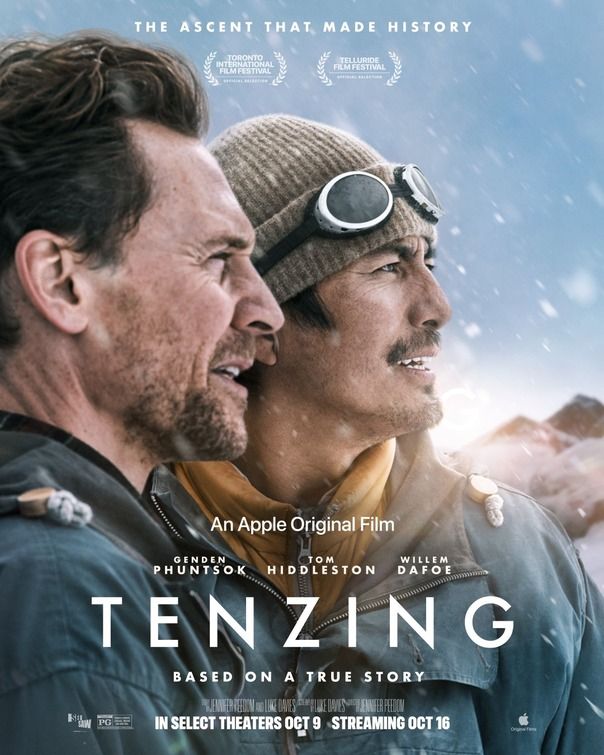
As they say, home is where the heart is. And we get an early glimpse of the same in the new English film Tenzing, with the introduction of the young protagonist. In an early scene, you notice his calling, a rare phenomena of a beautiful meditative feeling that would purpose to anyone’s life, during his accidental meeting his the famous mountaineer George Mallory in 1920. Ironically, his calling appeared in front of him, not like a mountain that wished to be conquered, but instead a mother on whose lap he wished to attain peace and tranquility. It remained a pivotal moment given his meditative outlook at a young age, referring to Mount Everest as the goddess Chomolungma – a sacred place of insurmountable heights. The moment itself felt like a surreal one, fuelling his dream with an impulsive question of wanting to tag along, automatically adding purpose to his life, invariably and subsconciously also signing up for greatness – the one that would be christened not only in golden letters, but also leading a giant step for mankind in general, for generations to come.
Written by Jennifer Peedom and Luke Davies, the non-linear narrative employed in the film Tenzing is a metaphor in many ways – simply because it draws a parallel between the final summit of Mount Everest while comparing it with another virtual Everest of obstacles in the life of the protagonist. In the past timeline, there is a definite hierarchal bias that the young protagonist (Tenzin Dalha) has to deal with – often being regarded as an outsider of sorts. The same indifference is first felt as his little version (Samdrup Dorje Lama), even as he is left behind by his parents in a setting that remains alien to him. The in-built resilience that Tenzing in the current timeline (Genden Phuntsok) endures, is a system accumulation of years of perseverance subjected to his own identity. In that sense, the protagonist had embarked on the journey of the Everest metaphorically, years before he actually set foot on its summit!
The writing addresses this perennial discrimination of being an outsider, even when the protagonist has developed feelings for a local girl Dawa (Thinley Lhamo), a character belonging to a higher caste. The inherest perseverance is for everyone to witness – even as the protagonist is shown to pursue his love (pun-intended), without abandoning her due to the very differences that could set them apart. This feeling also extends to his dream of getting a chance to set foot on the tallest mountain range of the world – for which he is even shown to persevere with learning the English language that is unfamiliar to him; or even having to compete with the members of the Sherpa tribe who are ethinically considered as the shepherding clan, as opposed to the Bhotia tribe that he is a part of. The alienation is real, but so is his stubbornness to succeed.
The proceedings tap into the theme of rewriting the imperial narrative that has also made it to our history textbooks. If I were to google ‘the first man to climb Mount Everest’, the result would be ‘Sir Edmund Hillary’ along with ‘Sherpa Tenzing Norgay’. The order of the names spelt out isn’t incidental, but an unsaid way of Western supremacy, often regarding the protagonist in question as a mere ‘helper’. The writing here inverts that narrative by treating the protagonist as an equal partner in the setup. But the road is far from being a cakewalk!
In the current timeline, the writing is quick to establish the protagonist as the only non-white participant in the historic climb – the one that is marred by discrimination in every sense of the word. While the Brits headed by John Hunt (Willem Dafoe) look down upon him, even the members of the ‘helping’ Sherpa tribe treat him as a outsider, often being envious of the opportunity granted to him. Hence the protagonist often acts as a bridge of communication between the two stakeholding clans, shepherding the interests of the group and showcasing some exemplary leadership qualities.
The proceedings also highlight the differing cultural ideologies between the Brits and the protagonist. Whilst the former look at climbing the summit as a race in order to establish their supremacy across the world, it remains an intimate and meditative journey for the protagonist – treating the mountain range as the Goddess of nature, without whose approval the climb would never be successful. In a pivotal scene, you notice a ‘worshipping’ ritual being carried out, reluctantly being participated by the Brits – a crucial moment of meditative tranquility that woule define the fabric of the drama with respect to the success in hindsight.
Whilst the characterization of some characters like Dawa or Jill (Caitriona Balfe) remains contrived and a touch underwritten, the prime focus lies between the warm dynamic shared between the protagonist and Sir Edmund Hillary (Tom Hiddleston) – one that is laced with mutual respect and an unlikely camaraderie of two equals who would go onto make history. The events unfold like a thriller set against a ticking timer set against the backdrop of the wrath of nature – even as the duo are instrumental in sharing intimate conversations on their shared fear, and a mutual goal of overcoming their psychological barriers that are laced with anxiety and grief.
Despite being slightly cliched with certain sub-plots that act as familiar tropes of the genre, I liked how the writing chooses to circle back to some of the key obstacles in the life of the protagonist, a way of highlighting on how his journey remained personal and intimate – carrying a mountain of grief and loss laced with an issue related to identity, while imparting a meditative and spiritual outlook to the ultimate feat. The purity of the moment ran deeper with these unsaid emotions, that hovered over the magnanimity of the accomplishment itself – leaving you with a pious and sacred feeling that was hard to shrug off. And that summed up the screenplay for me which was beautifully penned despite scattered moments of convenience, while having several moments to shine.
The dialogues are understated while christening the narrative with spiritual and meditative anecdotes that add a heartwarming simplicity to the drama. The BGM is soothing, never really overpowering the narrative or trying to manipulate the emotional beats of the moments – while gently aiding the emotional and meditative core of the proceedings with a calming presence.
Shot entirely on location with zero AI or VFX used for its gripping mountaineering scenes, Tenzing achieves a breathtaking authenticity that adds profound physical depth to the proceedings. The cinematography utilizes digital shortcuts, grounding the gruelling high-altitude ascents in raw, tangible reality. Beyond the visceral struggle, the composed frames meticulously reflect the spiritual and meditative nature of the protagonist. These serene, expansive visuals lend a sense of deep piousness to his journey, transforming a perilous climb into a sacred pilgrimage.
The editing pattern seamlessly blends the two timelines here, weaving the protagonist’s monumental 1953 Everest ascent with formative fragments of his past. Rather than relying on jarring transitions, the cuts function as emotional and psychological bridges, linking the grueling physical demands of the peak to the lifelong preparation of his spirit. There are occasional lags in the narrative, but those don’t overtly distract you in anyway.
Director Jennifer Peedom approaches the subject matter with a clear focus on real human emotion, skipping standard Hollywood drama for a deeply authentic story. Using her years of experience filming in the Himalayas, she shifts the spotlight to show the historic 1953 Everest climb from the Sherpa perspective. She perfectly balances the scary, real dangers of the high peaks with a close look at the climbers’ inner strength and willpower laced with a meditative outlook and nuggets of spirituality. Her direction honors the local culture and spirit, making this an engaging and spiritual saga that gently tugs the strings of your heart.
The performances are wonderful to witness by the members of the cast. Johnny Flynn as George Mallory has his moment to shine. Samdrup Dorje Lama as the little Tenzing is utterly endearing, infusing his scenes with a pure sense of wonder and childhood innocence that highlights the early roots of a lifelong dream. Tenzin Dalha as young Tenzing does a brilliant job capturing the fierce spark of youthful ambition and restless drive, laying a wonderful psychological foundation for the legendary figure he would become. There are traces of resilience that encompass his character, something that grounds his character in reality.
Caitríona Balfe as Jill Henderson shines with exceptional emotional clarity, providing a crucial and deeply empathetic presence that helps enrich the personal and historical stakes of the expedition. This, despite her character being a touch underwritten. Thinley Lhamo as Dawa adds warmth and quiet fortitude, while delivering a wonderful performance that beautifully portrays the profound support, encouragement, and emotional foundation central to Tenzing’s journey.
Tenzin Jigmey as Pasang brings an authentic, reliable energy to the ensemble, effortlessly carrying forth a mini character arc ranging from indifference and envy, to the one involving a warm camaraderie at the end. Willem Dafoe as John Hunt brings an commanding, grounded gravitas to the role of the expedition leader, blending intense authoritative focus with a palpable sense of awe and responsibility toward the mountain and his crew. Tom Hiddleston as Sir Edmund Hillary brings a wonderfully generous spirit and physical grit to the screen, while delivering a finely attuned performance that highlights his character’s determination and his genuine bond of mutual respect with the protagonist.
Genden Phuntsok as Tenzing Norgay delivers a deeply moving and soulful performance. He anchors the film with a powerful sense of quiet strength and dignity, capturing Norgay’s profound spiritual relationship with the mountain beautifully. He was brilliant and a treat to witness here, using a range of emotions to showcase his meditative outlook to the drama.
Tenzing is a meditative, deeply moving, and spiritual account of Tenzing Norgay’s historic quest to become one of the first people to summit Mount Everest alongside Sir Edmund Hillary. Driven by powerful performances, the drama effectively overcomes standard genre clichés to deliver a poignant exploration of discrimination, perseverance, and resilience. Overall, it stands as a subtly captivating, inspiring, and soothing watch that will gently tug the strings of your heart. Available on Apple TV.


