
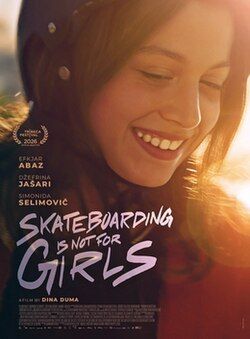
Almost immediately as a part of its cold open in the film Skateboarding Is Not For Girls, you notice a young teenage girl skateboarding through the alleys of North Macedonia. The drama is swift to establish its metaphor that extends to the title – a sport dominated by males with only fewer females opting for it. In fact in the drama, the protagonist Adela (Efkjar Abaz) is the only one, bold enough to take up skateboarding that invariably acts as her tool for freedom and a form of expression, curving through the pavements of patriarchy prevalent in the society. She isn’t afraid to speak her mind in class – having to qualms to call her father names, given that he has abandoned her family, left them in a financial crunch and settled in another country with another women. It must also be noted on the specific age demographic that Adela is representative of – often being only a silent observer of the atrocities around her, unafraid to voice her opinion, while eventually having to bow down to patriarchy unless the generational chain is broken. Hence, her skateboard acts as modern tool along with the use of social media to express her freedom, and in the process, try and liberate her sister (and mother) from the generational trauma passed down in the near future.
Written by Dina Duma, Lidija Mojsovska, Teona Strugar Mitevska, there is a shade of Shape Of Momo (2026) in Skateboarding Is Not For Girls, particularly with respect to the characterization in play. So much like the character of the mother in the former but in a much younger demographic, you are introduced to Esma (Simonida Selimovikj) who has to take care of her two teenage daughters – Adela and Zara (Dzefrina Jashari). In fact, the core conflict with respect to her character remains a deep financial crisis, given that she isn’t quite able to cope with her the inflating prices of daily necessities. In an early scene, you see her even struggling with her house rent, her electricity bills, and her internet bills, while barely earning enough for Adela to study in school.
The character of Esma remains a fascinating one given that she has often being a silent victim of patriarchy, even as her husband has left her and settled elsewhere, while literally leaving her suppressed with the idea of fending for her. In a way, the character has been at the receiving end of generational trauma to the point that the same would soon be transferred to her children. Another point to be examined is that she is a Romani, a virtual outsider living in North Macedonia, that makes life that much more harder, particularly with regards to her financial crunch. In a scene, you see her contemplating selling her car – until there is a proposal to marry off her daughter Zara after presenting her in a bridal market that to known to put young girls up for sale (for the purpose of marriage), in exchange for money.
The character of Zara also remains an interesting case study. Her ideology is often sandwiched between her mother and her sister, given her age demographic. She has streaks of rebellion like her sister, something that is prevalent in her opening shot wherein she is shown to kiss a guy that she loves. But in the same breath, she is accustomed to the struggles of her mother who isn’t able to make ends meet. Her natural progression from a teenager to a matured woman has probably come at an early age – more out of compulsion and ‘fate’ rather than her choice. Hence, you don’t see her opposing the idea of getting married – despite showing her reservations beautifully in a scene wherein her mother wishes to buy ornaments for her. Likewise in another scene, you see her reluctantly making a promise to her sister on how she will continue to live together.
The streaks of patriarchy are often sprinkled in the narrative through various instances in the narrative – a young boy narrating his experience of a summer holiday even as Adela has nothing to share, a character passing off her dead husband’s gold tooth only for her to worry about him cursing her from heaven, a character narrating a superstitious technique of giving birth to a boy, a character yelling at a bride-to-be after she spills tea on her expensive carpet even as the guy and his father look on.
Or even a deliberate societal perception of a character who quietly reveals that she isn’t a virgin, prompting a thought of even surgically reversing the same, whilst an elderly character asks her to cut her thighs in order to prove it to her soon-to-be husband. The latter remained a viscious generational chain of suppression with a nod to patriarchy. In that sense, the ending is pretty hopeful given how the idea remains that of breaking the chain of patriarchy, as opposed to continuing it. This, while maintaining its realistic tone with regards to the poverty of the characters in play. The screenplay is subtly charming, painfully heartbreaking and searingly hopeful – all in the same breath.
The dialogues are conversational while maintaining a heavy subtext of oppression and patriarchy, both of which prompt the actions and pave way for the drama ahead. The BGM uses silence to great effect, often allowing the viewers to interpret the psyche of the characters in the moment, as opposed to nudging them into thinking in a specific direction. And yet, there is an air of helplessness that is accurately tapped into too, creating a haunting ambience of uncertainty that laces the narrative.
The cinematography comprises of frames that keep you emotionally invested in the characters, while hovering an observant eye to the proceedings through the gaze of young Adela. In a way, the frames remain an examination of silent everyday atrocities endured by women, through the gaze of a character who would possible have to be accustomed to it too at some point – unless the chain breaks. The editing pattern is leisurely, allowing the drama to flow without any abrupt cuts whilst also keeping the runtime of the drama in check. There aren’t too many cutaways that would hamper the emotions in play, something that form a cohesive thread in the narrative.
Director Dina Duma expertly uses objects as metaphors in the drama, to elevate the impact of the subtext and the messaging. For instance, the skateboard remains integral to the plot – particularly given how it is the society who has labelled it in favour of a particular gender. She is tender and sensitive while representing her characters, often keeping them in the same bucket of patriarchy and allowing them to react differently to the situation at hand. In a way, the drama can also be termed as a coming of age celebration of womanhood, and it makes it even sweeter when you have a woman curating its gaze. The direction is soft, tender and wonderfully heartfelt.
The performances are wonderful by the members of the cast. Ganimet Abdula as Aunt Aida showcases traces of humour to back her experience with patriarchy over the years, and she is a treat to witness here. Dzefrina Jashari as Zara has a pleasant personality onscreen, often using her expressions and body language to convey her angst. She is nicely understated with her glances while offering a heavy emotional gravitas to her character.
Efkjar Abaz as Adela is spunky and effervescent with her demeanor, while always being a silent observer of the atrocities and hardship of characters around her. There is an understated charm and naivety lacing her character, and she does a wonderful job in expressing the same. Simonida Selimovikj as Esma allows her beautifully expressive eyes to do the talking. Her drooping body language is a sign of helplessness yes, but also a sign of uncertainty for her daughters who would possibly follow the same suit as her in future. There is a layer of care that christens her character, even against the backdrop of a forced decision that has become her new reality. She is brilliant as ever in conveying these complex and conflicting emotions, while accounting for a nice little arc with regards to her character.
As a part of our Tribeca Film Festival coverage, Skateboarding Is Not For Girls shines as a brilliant coming-of-age celebration of womanhood and a searing commentary on patriarchy powered by strong performances. Highly Recommended!


