

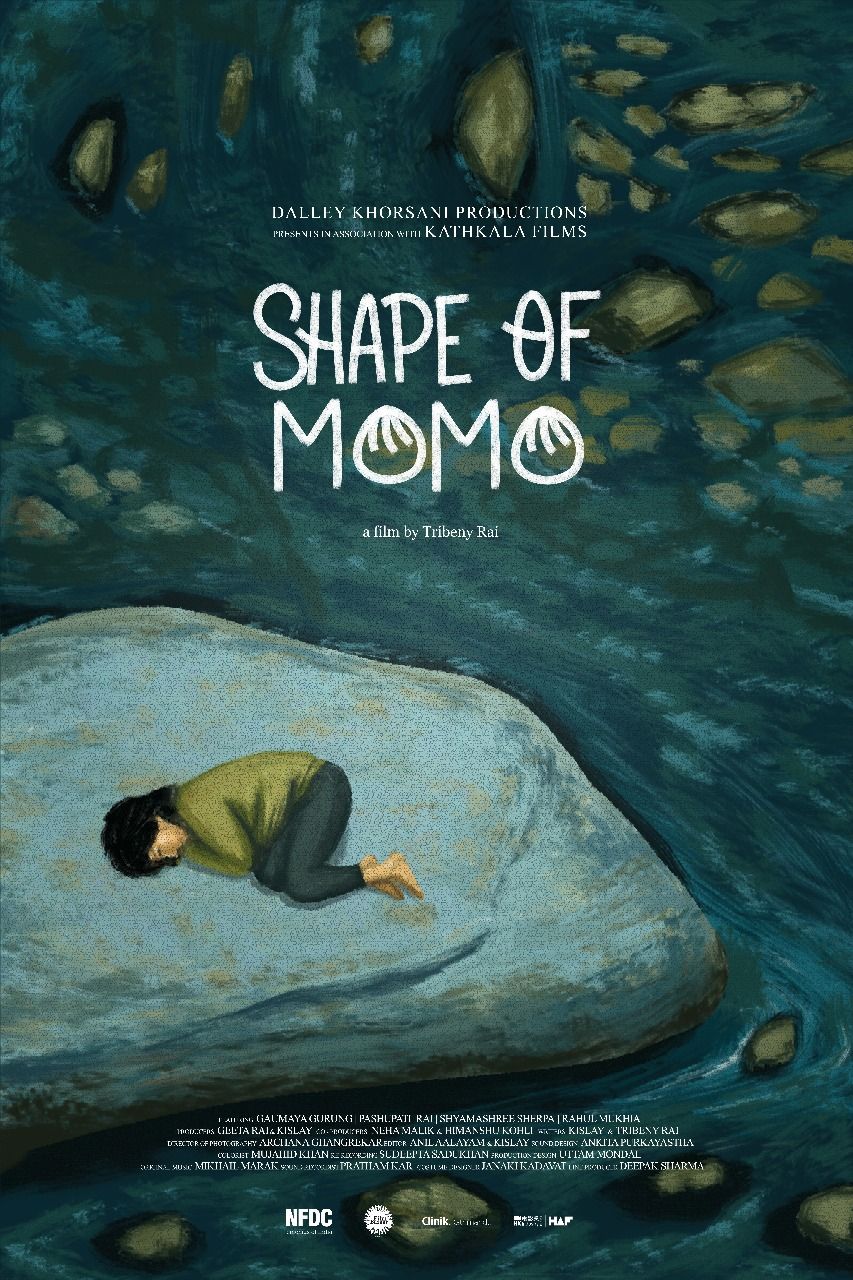
The title of the new film Shape Of Momo straight up holds a bout of relevance. Referenced as the varied shapes of momo prepared by the protagonist Bishnu (Gaumaya Gurung), it also holds its significance of the imperfections of society that we live in. This in particular extends to womenhood, often being shaped ‘imperfectly’ by the prevalence of patriarchy – so much so that their identity itself has turned towards ambiguity. The general thought of feminism remains suppressed to the idea of fate – often viewing patriarchy as a norm of protection more than restriction. This instantly reminded me of the lines from the Malayalam film Eko (2025) that offered a similar ideology on how protection and restriction often look the same. And here, the beautifully scenic setting of Sikkim tells you a similar story of an identity crisis on the part of the protagonist, who has escaped from the crutches of a big city like Delhi only to question the protective views of the ‘mountains’ (read : patriarchy) – and whether the ‘mountains’ are actually protecting her or restricting her!
Written by Kislay and Tribeny Rai, the opening sequence of Shape Of Momo tells you an important trait of the protagonist. In the scene, you see Bishnu reading out aloud an ad that she wrote for a local newspaper – almost with a vibe of flexing her skills, only for the discussion to veer into finding a suitable groom for her. In another scene, you see her being empathetic to a migrant worker much to the dismay of her mother (Pashupati Rai). In another, you see her frowning at the idea of her grandmother (Bhanu Maya Rai) wanting to go to Dubai with her son, or even her sister, Junu’s (Shyama Shree Sherpa) decision to give up on her studies in order to start her family.
It all stems from the fact that the protagonist is fiercely independent, probably having previously stepped out of her home in order to escape the shackles of patriarchy. The idea of living in a big city has toughened her up – ironically, a place where she remained the migrant, while also quitting her job in order to return to her hometown for unsaid reasons of discrimination. But this exposure automatically puts her in a position of power, invariably making her the ‘son’ of the family. But it is interesting on how this very feature, subconsciously brings her closer to the very idea of patriarchy that she had detested earlier.
If you look closely, all the female characters in the fray are essentially variants of the protagonist at different junctures in life. From the ailing grandmother who has quietly spent most of her life confined to the ‘mountains’ of her home, or her mother who has quietly embraced the shackles of patriarchy while transforming her to the extent of her now being an advocate of one, or Junu who has silently given up on her dreams of being an athlete under the pressure of the society, while continuing to endure the pressures of delivering a ‘son’ by her patriarchal family. Or Bishnu herself, who essentially falls for Gyan (Rahul Mukhia), the local politician’s son despite ignoring traits of subtle ‘red-flags’ in him.
In a scene, you see the rebellious side of the protagonist, even as her partner sighs on how cigarettes don’t look good on women. In another, you see him refusing to pose as a girl – even when the ‘pose’ would never directly be equated to his masculinity. It remains a specific shade of patriarchy that is hidden from the world while continuing to modifying the ‘shape of momo’ along the way. And in a way, Gyan acts as a medium for a potential identity crisis for the protagonist, who remains blinded by this fact.
The concept of being the ‘son’ of the household automatically puts the protagonist in a position of power. You see her authoritatively instructing the labourers in her orchard to pay her the full amount, without being empathetic towards them. And it is everything that Bishnu detested in the first place – a quiet little reminder on how absolute power corrupts. The same extends to the locals who she refuses to trust, while emphasizing on the migrants – a sort of conditioning that triggers a subtext of the class divide and the line of division between the locals and the outsiders.
Ironically, the writing wishes to deconstruct and rebuild everything that it stood for, through the antics of the protagonist. In a way, it marks a coming of age story that doesn’t follow a linear approach, but instead opts for an intrinsic one laced with the identity crisis of the protagonist in an area where patriarchy is still prevalent. The crisis in itself is deliberately ambiguous, much like Bishnu who isn’t sure on why she doesn’t fully grasp and understand the people around her. In that sense, it has a lot to do with her having to learn and unlearn the ways of patriarchy, before she turns into one like her mother, or her sister, or her grandma.
The fact that the drama borders on the idea of realisation, even as all female characters around Bishnu are hardened by the idea of patriarchy, makes this a brave and pondering piece of writing that is layered in many ways. Or perhaps alternately, it represents the odd shapes of momo that are hardened over a period of time – thereby leaving the protagonist ‘No Other Choice’ but to leave. They say, home is where the heart is but where does one go when the heart itself is controlled by the beats of patriarchy everywhere. Or perhaps as Bishnu says – it is the taste that matters!
The dialogues are grounded while offering conversational subtexts of the decaying world that remains crucial to the coming of age story of the protagonist. The BGM has a meditative approach to the drama, the one that isn’t on your nose while allowing you to discover the different fragments of the society, much like the protagonist here. The cinematography by Archana Ghangrekar can be viewed on two accounts – one on how scenic they appear to be on the outside, with the mountains and the greenary all around. But the deeper you go with the themes, the more you realise on how the symbols of protection and in reality, the symbols of restriction. Or more so on how the mountains offer limitless thoughts of patriarchy that are beyond the realms of the mind of the protagonist.
The editing pattern remains understated and non-hurried, quietly allowing much of the subtext to do the talking, while maintaining a meditative outlook to the drama. Ironically, this remains in sync with the setting that is far from the chaos of the big city, only for the same to be no different in terms of the prevalence of patriarchy. Director Tribeny Rai tactfully creates a world that is far from the chaos, almost something that is familiar to the protagonist. And within that vicinity, she allows themes of patriarchy to simmer while deconstructing the ‘rigid’ fundamentals of her protagonist. This remains a bold and pondering piece of art that discards the conventional form of linear storytelling, while adding layers of ambiguity to it (again in terms of the prevalence of patriarchy). In that sense, the direction is splendid to witness here.
The performances are exquisite by the members of the cast. The likes of Deepak Sharma, Wangden Sherpa and Janaki Kadayat as the family of Tenants are understated and restrained while delivering performances that are emotionally palpable. Sonam Bomzon as Padam offers a streak of frustration that essentially stems from his idea of differentiation – something that he pulls off with a lot of sincerity. Rahul Mukhia as Gyan is immediately affable with his charm, almost being a walking green-flag on the surface, while subtle and perhaps subconscious streaks of patriarchy engrained in his act. And he delivers a well balanced performance here.
Bhanu Maya Rai as the grandmother is well-restrained, while being an epitome of silent suppression and hope – given how she patiently and futilely awaits her son to take her to Dubai. Shyama Shree Sherpa as Junu is sincere and earnest while mounting her character on regret – of having to succumb to the prevalence of patriarchy while sacrificing her aspirations. She remains a treat to witness here, while showcasing bouts of vulnerability really well.
Pashupati Rai as the mother delivers a standout act, simply given how layered her character was. She remained someone who like her daughter had to sacrifice her aspirations, and blend into patriarchy, so much so that patriarchy would then be engrained in her blood. She still remains vulnerable in crunch moments – like the one involving a telephone call wherein she allows Gyan to do the talking for her. And so, she becomes a rare mix of suppression and patriarchy that is prevalent in many women. The calcification of this trait makes her rigid, while silently harbouring a thought towards the end on how her younger daughter mustn’t fall prey to her ideology. She was terrific to witness here.
Gaumaya Gurung as Bishnu delivers one of the great performances of the year, simply given how her fixed ideas of feminity are deconstructed into a wave of patriarchy, with the latter being something that she has dissented all her life. In that sense, this remains an odd coming of age story filled with an identity crisis and a moral ambiguity that needed a perfect performance. Gaumaya uses her expressions and body language to such great effect, that you are always invested in her journey. She remains a flawed character bordering on the idea of treating patriarchy as a concept, something that triggers a sense of realisation. This was a complex and layered character, essayed brilliantly by Gaumaya in a towering acting masterclass.
Backed by solid performances, Shape Of Momo remains a layered exploration of womanhood in the complex fight against patriarchy, interwoven with themes of home and identity that make for an excellent watch. Available in a theatre near you from 29th May 2026.


