

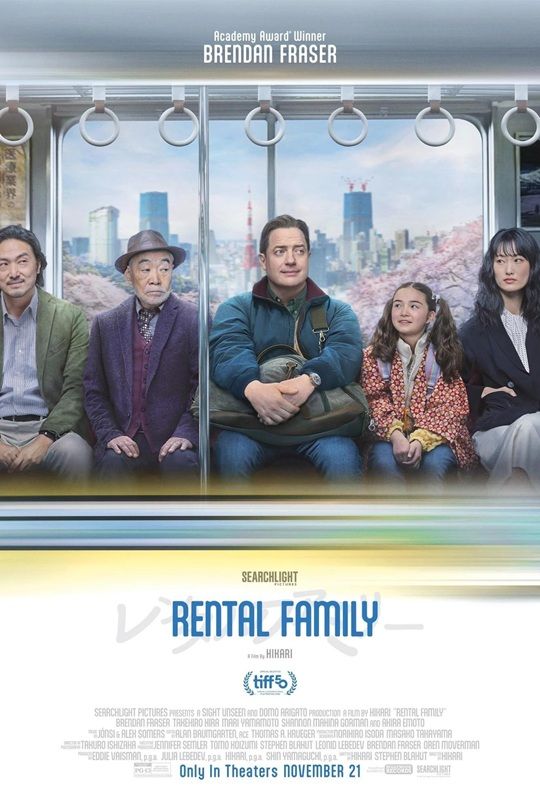
It is interesting on how the English film Rental Gamily is entirely set in Japan, given its recurring theme of loneliness. The latter is an excursion of suppressed feelings that one could immediately associate with in any major city. But the setting of Japan immediately gives a different meaning to the drama – it is a society that is traditionally lonely, with a demand for a human touch that invariably gives relevance to the title of the film. The protagonist Phillip (Brendan Fraser) is no different from the loneliness plague. In an early scene, you see him quietly staring through the window from his room, overlooking a family celebrating a specific occasion – even whilst he quietly has just his own company to contend with. The classic toast is symbolic of his urge for a human touch – something that he might be quietly longing since shifting to Japan seven years ago for better acting opportunities. It might be implied that his reason behind leaving his home country USA might also be loneliness – perhaps running away from the fear of being alone wherein no one really would be waiting for him. Ironically seven years later in another country, the stigma of loneliness remains, perhaps even worsening given his work as an actor that may have further dried up.
Written by Hikari and Stephen Blahut, Rental Family works on the principle of ‘All The World Is A Stage’, while emphasizing in the same breath on how everyone is an actor in real life. The subtext remains on how every single person ‘pretends’ to be someone, even while being unable to communicate the deepest feelings that often remain buried deep within. And yet, there is a hint of playfulness at the start whilst exploiting this trait in a real-life business called ‘Rental Family’.
Given the acting chops of Phillip, you see him being tasked with frivolous real-life acting assignments – one that of a sad American at a mock funeral, or an American husband to a particular lesbian character who is married to her partner and wishes to ‘elope’ with her. The concept remains that of a human touch implied to a society that is craving for exactly that, while blurring the lines of authenticity and a performance. This also extends to a couple of other characters in the fray – one ‘bruised’ character who ‘pretends’ to be a mistress for men in front of their wives, just so the men could continue having an affair on the side. And the other, opting for fake family members to stay connected with his human side even whilst suffering from loneliness himself.
The emotional core of the drama lies in its two important subplots that double up as new acting assignments for Phillip. One involves him acting as a father to a young girl Mia (Shannon Mahina Gorman) as hired by her single mother Hitomi (Shino Shinozaki), just so that she could get admission in a good school. And the other acting as an interviewer for a retired actor Kikuo Hasegawa (Akira Emoto) who is suffering from dementia. And the dynamics that Phillip shares with each of these two characters, allows the drama to be fuzzy and heartwarming while forming an important character arc for the protagonist.
Reluctant at first, you see Phillip giving in to these bonds almost considering them as acting gigs. But the byproduct of any ‘role’ for an actor remains attachment, a muscle that remains underdeveloped for Phillip until the bond that he begins to share with Mia and Kikuo. In a scene, you see him promising to an oblivious Mia on how he will never leave her again. In another, you see him sharing a breezy but measured equation with Kikuo who in turn has a subplot drawing parallels with the 2025 film Sentimental Value too. This, even as the sentiment of attachment acts as a connective tissue; in a scene, you see Mia requesting Phillip to also ‘act’ as a dad to her classmate because his father could not make it during a classroom activity.
Attachment plays a major role for Phillip too. In a scene, you see him declining a rich acting offer that requires him to fly to Korea simply because he wished to spend time with Mia. In another, you see him breaking his company policy and taking Kikuo to his childhood home, just before he loses his memory. It almost feels like a catharsis of sorts for Phillip who begins to develop human emotions that have deserted him for years. My little point of criticism lay in a few moments of resolution, on how easily the conflict was resolved involving Mia and Kikuo – one of acceptance, and the other of a law being broken.
But, it is also here that the drama has a philosophical undertone to it. In a pivotal scene, you see Phillip standing outside a shrine while waiting for Kikuo to finish his chores, and also asking him on what he sees inside. Kikuo calmly answers on how God resides in each one of us, even whilst praying inside the shrine. It is clear that Phillip over the years has lost faith in the garb of loneliness that he has been experiencing. But the circle completes in a beautifully woven final scene wherein Phillip enters the shrine only to see still water in it, and along with it, his reflection. It was a beautiful reminder on self-love along with worshipping our bodies, whilst being quietly grateful of forming new connections along the way. And moments like these truly make the screenplay warm and fuzzy.
The dialogues are soothing and assuring while at times being a rent-free therapy session of sorts. The lines are profound and poignant, while tactfully accounting for the emotional core of its characters. The BGM is gentle, aiding every tiny moment of joy and lies in the narrative while creating an ambience of warmth around. The cinematography captures the lonely yet crowded bylanes of Japan perfectly, allowing the frames to be a metaphor and an anti-thesis at the same time. This, even whilst accounting for an unfiltered connection with the characters, particularly the protagonist, thereby allowing you space to form a fuzzy bond along the way.
The editing pattern is crisp while wonderfully holding onto the emotional core in the drama from one scene to another. I never felt disconnected with the drama or its characters even with varied degrees of emotions inculcated in the narrative at various junctures. Director Hikari meticulously handles its characters whilst always keeping them grounded in reality. She ably swifts through the various tones of the drama, without allowing melodrama to set in. Yes, the events maybe manipulative at times but the emotions ring through, and that sort of control can be attributed to the prowess of the director. There is a gentle gaze exposed at some point through the tentative setting of loneliness, wherein the sensitivity of the filmmaker is beautifully showcased. The direction is superb here.
The performances are wonderful by the members of the cast. Misato Morita as Yoshie, Tamae Ando as Lola and Kimura Bun as Kota are wonderful performances, and each of them have their moments to shine. Sei Matobu as Masami and Shino Shinozaki as Hitomi are pivotal cogs in the screenplay, and both of them are commendable to witness here. Mari Yamamoto as Aiko and Takehiro Hira as Shinjinare surprisingly layered characters working on the principle of pretence, and both of them are sensitive with their portrayals here while putting forth fabulous performances. Shannon Mahina Gorman as Mia and Akira Emoto as Kikuo deliver heartwarming performances while acting as pivotal demographics in the life of the protagonist. The emotional core of the drama can be directly tagged to both these excellent performances.
Brendan Fraser as Phillip delivers one of the most sensitive portrayals of his career, thereby extending his rich form since The Whale (2022). There is an inherent sadness that you witness on his droopy face that has had a journey of its own, even whilst finding himself in a sea of loneliness. Fraser wonderfully uses his body language to convey his emotions, even whilst being gentle with his character arc on display. This remains yet another masterful act by a brilliant performer who has successfully stepped out of his comfort zone in perhaps the most fruitful phase of his career.
Rental Family is a heartwarming tale of loneliness and attachment wrapped in a fuzzy and feel-good drama that will gently tug the strings of your heart. The warm tingling feeling deep within was a reality for me by the end of things in a drama that makes for a brilliant watch. Highly Recommended.


