
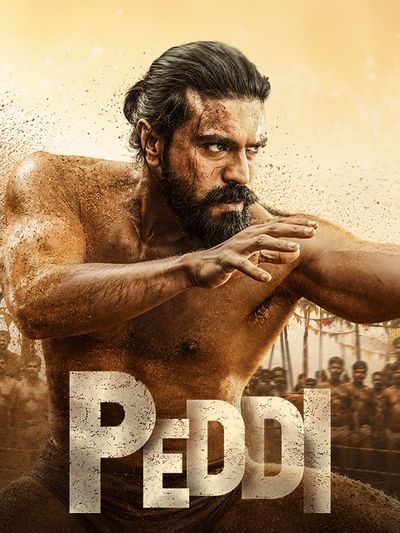
I have probably come to realise that the commercial Telugu movie has a very specific checklist with regards to its structure and a storytelling technique. And it goes like this – a sliver of a conflict followed by a random character narrating the story of the protagonist. The protagonist himself is an epitome of over-the-top swagger – something that would appear cool to the frenzy fans, often going wild to his strangest and abysmal antics. There is a problematic love angle featuring the actress’ navel that would take the limelight, while passing off the cringe-worthy antics of the protagonist as either comedy or a romantic track. And when the main conflict is initiated – the track either transforms into a good versus evil template, a chosen one template, a random nonsensical mytho drama, or a forcibly emotional sports drama. There is nothing in between, and at this point, I am beyond words on how the audience is lapping up every such nonsense. The latest casualty in the list is the new Telugu film Peddi.
Written by Vara Prakash Toleti, Krushna Hari, Nagendra Kasi, Venkat Prasad Gandhi, Sri Raman Ch, and Buchi Babu Sana (phew so many writers for this mess), there felt like a quietly important story waiting to be told in Peddi. The identity crisis of a group of villagers excluded from the society for their caste, so much so that they aren’t even counted as the citizens of the country – not only felt like a relevant issue, but also triggering an emotional journey. In a scene, you are witness to a character literally waving a red flag in front of a moving train – in hope that someday, the train would stop and the village would have a railway station of their own. It remains a heartfelt thought, yet what do you even say to a drama that is not only scrambled with its storytelling technique, but also catering to some low-level fan service that completely takes the emotions out of the equation. And did I mention about the stardard commercial template in use, having a certain checkbox?
The foundation of the drama is built on a random Olympic failure in 2016, that prompts a government employee (Boman Irani) to scout for some talent from the grassroot level. And that brings him to a recurring name Peddi (Ram Charan) who is a cricketing, wrestling and an athletic idol for the young boys. And even as you are transported to flashes from the past, the events begin to get even more amusing. Yes, there is a subtext of a class and a caste divide with respect to the protagonist – even while being frowned upon by men in power. For instance, the owner of a jaggery factory frowns at his absence, even as the protagonist makes his way on the cricket pitch.
You do know that this is a typical commercial potboiler wherein even in major sporting moments in the film, you facepalm! It felt both atrocious and laughable to see the antics of the protagonist on the pitch – twisting and turning for the supposed hoots while having no balance to play the shots. This, even as a caricature veiled as a bowler known to injure players while sticking his tongue out, suddenly starts bowling half-trackers. And while even the most basic rules of cricket are compromised (that wasn’t a legit Mankad runout for crying out loud), the same atrocity applies to other sports too. For instance, the idea of wrestling not only applies to basic moves to earn points but some anti-gravity moves to earn whistles too. Or a paralympic sprint wherein the protagonist runs normally and dives literally like he is playing cricket. What a mockery! There are clearly no rules to the sports template.
I kind of found the protagonist switching sports so amusing, given how thousands of athletes stick to a single ‘professional’ sport all their lives, or alternately switch to sports that have been secondary instances of their lives. But to completely overhaul and restart at an age when reflexes weaken, made no sense to me. So no matter what the emotions tagged to the sport were, majorly with respect to fighting for the identity of his clan following a major tragedy, the proceedings felt compromised for some rather basic fan service that had me facepalming through and through.
At this point, it isn’t even funny that representation of romance in Telugu potboilers is extremely problematic. Here the device remains of a political rivalry between the families of two characters – Achiyamma (Janhvi Kapoor) and Rambujji (Divyenndu) that is soon abandoned, when the focus shifts on the navel of the former. The low-angle titular shots are deliberately placed for the protagonist to not only fall in love, but also force himself on her – only for his sins to be erased when he saves her from the blushes during a rally. It is the most brain-fade and cringe-worthy moment when the protagonist justifies his actions by playing the victim card, only for Achiyamma to eventually fall in love with him. Wow, talk about being progressive and in love! Let me reiterate it – SO….BLOODY…PROBLEMATIC!
There are a few heartfelt moments sprinkled in the narrative, deftly touching upon the massive caste divide and the politics in play, that ought to have been built into something more substantial. But instead, all you get is the most generic fan-service – be it a random training montage of the protagonist, a laughable injury wherein the unaware protagonist begins to showcase his moves in a hospital, a twisted moment in the train that felt so manipulated and forced that it had me invariably cracking into laughter, and a never-ending monologue at the end to reiterate the points that might have been missed out if you weren’t paying attention. Tch tch…and whatever happened to the Olympic issue from 2016 that was previously discussed here? How many medals has India won after that? And how convenient and cliched was that ending anyway? Where were the layers? Where were the emotions? Why are you still reading the review?
The dialogues are atrocious to say the least, even more when the Hindi-dubbed version had characters mouthing dialogues in Bhojpuri (clearly, there was an idea to tap into their market). There was a vein of cringe-worthy running right through the narrative, even as every little moment is amped up by loud emotions that are filled with bravado and refuse to land. To put things to perspective, you have characters twirling their moustaches and mouthing the most standard lines of fury, something that had me paralyzed for most parts of the runtime. The music and BGM by AR Rahman is a mixed bag. It has the beats of some catchy commercial numbers, but the songs themselves aren’t memorable here – something that felt unusual for the ones composed by the maestro. The conflict between composing music for reels to go viral versus a steady and impactful composition is soon beginning to reflect in AR Rahman’s recent works. The same argument can be extended to the BGM that is pretty generic and ordinary without doing much to elevate the impact of the drama.
The cinematography comprises of frames that are designed to be money shots – be it the slow-motion shots involving the protagonist, or the ones capturing the physics-defying motions. And yet, the cringe factor extends to the frames too for maintaining a low-angle frame to deliberately capture the assets of the female character, all in the name of romance and comedy. What era are we even living in? And, even the VFX does no real justice in adding depth to the drama, something that simply felt like being shot against a green screen. The editing pattern is episodic, a trait that you notice particularly in the first hour with random events strung together. The cohesiveness mildly improves in the second hour, but not enough to rescue the film.
Director Buchi Babu Sana had such an important issue to weave his story around. But instead, his focus remains on some basic fan service that completely supersedes and eventually hampers the narrative. This is really something that the Telugu Film Industry needs to learn from – fan service is fine, only until it blends well with the story. Here, even the characterization of the protagonist was modelled on the concept of ‘The Chosen One’ that itself felt like a derivative of so many other films, which along with an even over-the-top and standard sports template felt stale in many ways. The direction wasn’t the best, to put it in a polite manner.
The performances are also over-the-top by the members of the cast, even as the writing further curbs the acts on display. The likes of Ravi Kishan, Upendra Limaye, John Vijay and Ajay Ghosh are completely wasted here. Tarak Ponnappa is decent but the writing makes his character rather one-note and uni-dimensional. Boman Irani is unusually over-the-top and pretty ordinary, often pausing in certain moments of his dialogue delivery that felt like an issue with the brief that he was given.
Divyenndu as Rambujji has one of the most unusually written arcs that felt so convenient and abrupt that it diluted the impact of his performance. Oh, and did I mention on how this character felt like a subdued derivative of Munna from Mirzapur (2019) ? Jagapathi Babu as Appalasoori is probably the only actor whose emotions land frequently, even as the veteran uses his body language and expressions to convey his angst.
Janvhi Kapoor as Achiyamma has a lesser screentime than her navel, and if you think that is cringe then blame the film for it – because the feminist in me was triggered and hurt. Be it objectifying her through and through, or using her sweat patch as a symbol of kink – the problematic levels went through the roof with respect to her character who otherwise had hardly anything to do. Shiva Rajkumar as Gournaidu is sincere and earnest, despite his character hardly having a conflict of his own. His job remained to aide the protagonist, and he managed to do that with a nice little flair.
Ram Charan as Peddi plays to the galleries here. Be it his unusual antics, or his killer moves – the swagger in his act is catered to the front benchers. You can see that he has put in a lot of sweat and blood in his act, be it working on his physique or using his physicality to good effect during some heavy sporting sequences. He also does decently with the emotions in store, but the issue remained an insistence on basic fan service that significantly lowered the impact of his performance.
Peddi had a highly relevant subject up its sleeve, but squandered it into a tone-deaf sports drama. By trying to deliver raw emotion while masking itself as a loud, over-the-top fan vehicle, the film completely loses its identity – making it an utterly atrocious watch. Available in a theatre near you.


