

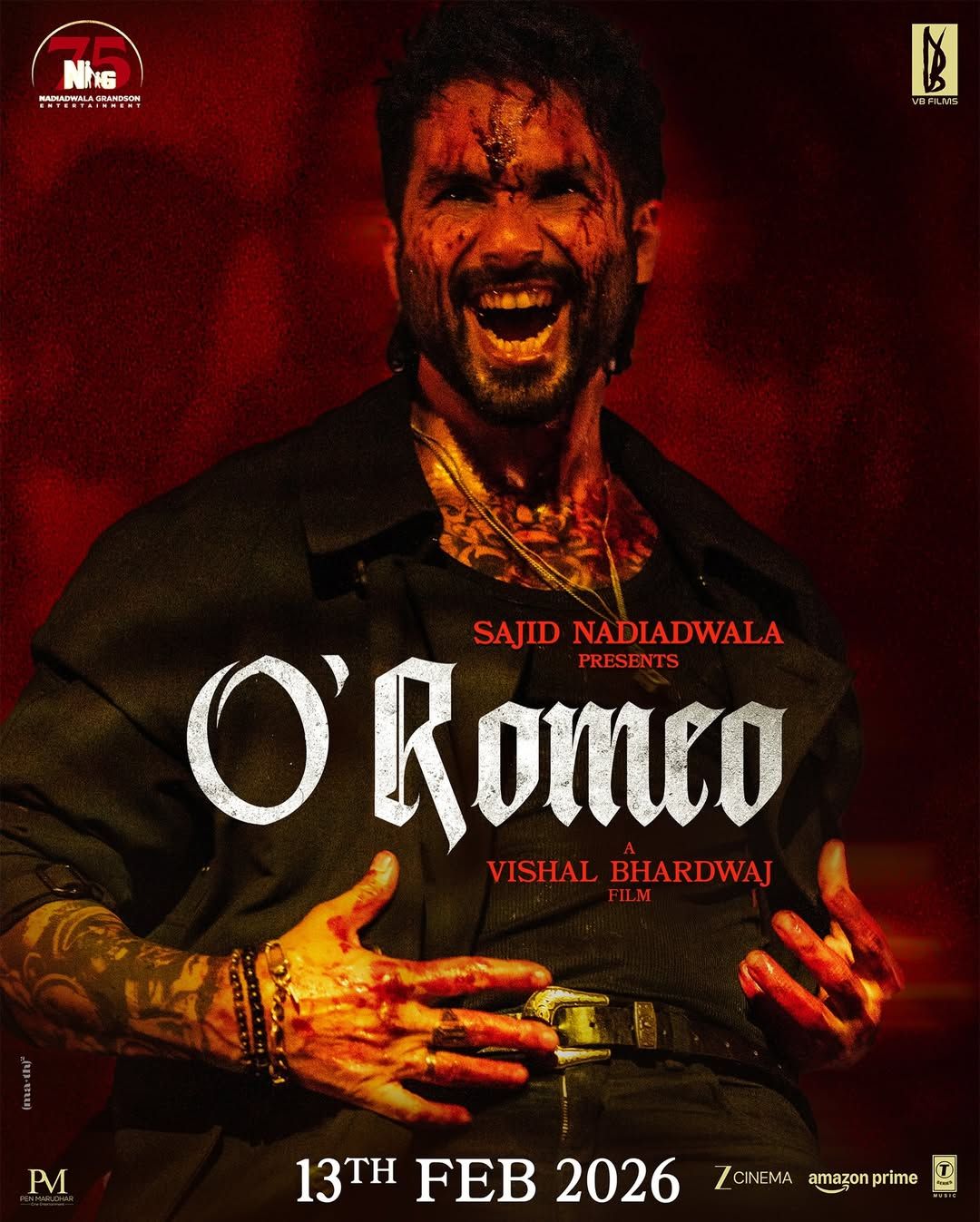
The relevance of the title of the new Hindi film O Romeo can be attributed to the Shakespearean undertones prevalent in the drama. But in many ways, this isn’t a typical Shakespearean tragedy – if anything, the starting point of the film is essential an aftermath of a Shakespearean tragedy. And much of it has to do with how things stand with the characters. When you are first introduced to Arjun Ustara (Shahid Kapoor), you see him being a small-time jobber, carrying out the dirty work for the cop Ismail Khan (Nana Patekar) whilst returning a favour of the latter saving his life. And yet in a specific scene beneath all the bravado that he beholds, he narrates an incident that lead to his name ‘Ustara’ being christened. The roots of the event lay in the death of his father who was killed by a gangster, thereby resulting in a sense of loss for him. Likewise when the character of Afsha (Triptii Dimri) is introduced, you see a vengeful streak right at the beginning, stemming from the loss of her husband who was killed by a notorious gangster Jalal (Avinash Tiwary). The loss remains an integral part of the latter’s life too – with his to-be-born child being killed in a mishap that also results in the death of his brother. The thread connecting each of these characters is loss, and a spate of revenge that erupts as a byproduct.
Adapted from the book ‘Mafia Queens Of Mumbai’ by Hussain Zaidi, and written by Rohan Narula and Vishal Bhardwaj, the core issue with O Romeo remains an identity crisis of what it wishes to stand for. The opening act sets the tone of the drama well – the gritty and grainy specs of Mumbai from the 90s thoroughly compliments the broader themes of the gangster world. This remained a period wherein the existence of gangsters in Mumbai was at its peak, even as the writing is quick to address on how the ‘community’ remained divided on religion after a major incident in the country.
And yet in the very next breath, you are acquainted to the elaborate action set-piece set inside a single screen theatre – the style of which feels eerily close to Animal (yes, again). You may argue that the space is wide (instead of a corridor), and masked men make way for bald ones – but the template and the visual language remains similar. If at all, the sequence is playful and that is the major novelty factor – but is that enough? Nevertheless, both these contrasting themes do find a voice going forward too – even as the drama oscillates being varied moods of playfulness and seriousness. As a result, the larger visual theme remains grittiness mixed with massy action set-pieces.
The basic foundation of the drama remains a love story with traces of revenge. But interestingly, the dynamic between Afsha and Ustara doesn’t necessarily ignite a fire in you. A cutaway flashback sequence notwithstanding, you don’t necessarily feel a sense of rage with the outcome of a certain event – an emotional core that seems hollow because the foundation of the character isn’t well established. After a point, the supposed Shakespearean undertones receded, even as the drama increasingly reminded me of the Hindi dud Tashan (2008). If you notice the structure here, it is eerily close to that film that essentially speaks about a revenge angle at its core too. In other words, this felt like a reheated dish straight out of the microwave – or more specifically an old wine in a new bottle.
This is not to say that the proceedings are a complete trainwreck. I was quite invested in the world that was created in the first hour, even as the drama does briefly show traces of the English film Leon The Professional (1994). The dynamic between Afsha and Ustara may not be emotionally strong from a love angle point of view, but the organic buildup towards a revenge plot does work here. This passage also coincides with the transformation of Afsha – from a petite widower who misses her chance at killing an accomplice of Jalal to turning into a killing machine. Afsha in many ways, is the best written character – with the plot designed to paint targets on specifical characters including a cop, a gangster, and a lawyer – all of whom are a part of Jalal’s gang. But in the same breath, the character of the antagonist isn’t necessarily designed to be powerful enough.
At about the halfway mark when you actually get a glimpse of Jalal, the buildup includes his tryst as a matador in Spain – a track parallelly playing out against a ‘hunt’ taking place elsewhere. Again the duality of the moods is in focus here – wherein the hunter hunts the prey at one end of the world, while the tables turn elsewhere. In a scene, you see Jalal repeatedly smacking the skull of a character after a miss on the latter’s side – an indicator on how he remains invincible on every front. But the ease with which his gang is infiltrated remains a mystery, that too by a rookie who still remains an outsider to the world. The same holds true for the finale too, wherein after much of the buildup – the result is tepid!
If I were to keep some logical flaws aside, I still was moderately invested in Ustara’s journey in his quest for Afsha who suddenly disappears. And yet I wondered on how Ustara wasn’t supposed to be the protagonist here, it was Afsha all along. In that sense, the writing does get its POV wrong – something that was increasingly evident in the second hour. Questions like how did Afsha get into the circle of Jalal while posing as an undercover character would have been better answered if the POV had shifted. Sadly that wasn’t the case!
The writing oscillates between being rewarding and frustrating, given how things take a turn. For instance, a major threat is eliminated against the run of play that had me scratching my head on if things were so easy to bump off a person in broad daylight in front of so many people. But then, I still found myself uncannily invested in the character of Ustara who does his bit to protect Afsha from the gang members. In a wonderfully penned scene, you see major characters cross paths in a moving local train that adds a new texture to the proceedings whilst resulting in an unexpected end. And yet, things go south from here.
It is interesting on how the gritty tone of Mumbai – reminiscent of Vishal Bhardwaj’s Kaminey (2009), holds fort even when the writing is generic. There is an eerie pull to the world – be it the dusty and narrow bylanes or a small but troublesome neighbourhood that allows the drama to be grounded. And yet, this very pull in the drama goes for an absolute toss when the proceedings shift to Spain. It literally made no sense for the protagonist to be stationed there in the first place, but given the mess that was created in his gang, logic would have told you that he would have flown back here. That wasn’t the case, and it derailed the drama.
There is a ‘Matlab Kuch Bhi’ moment in the second hour that was once a go-to trope for innumerous Hindi films from the 90s. And I literally had my head scratching as to how this was approved in a 2026 film written by Vishal Bhardwaj. It was outlandish, and then some more in the following sequence that was a nod to Tashan and that action set-piece involving the protagonists taking down an army of men. What was even worse was the final face-off wherein the all-too-powerful antagonist is hardly intimidating while being reduced to rubble within minutes. It is strange how a buildup of this event gave a different picture, but the reality remained far too cliched and convenient. Overall, the screenplay is a mixed bag here – a black comedy with Shakespearean undertones transforming into a love story with a dash of revenge only to end up being far too outlandish for its own liking.
The dialogues are quirky while being playful at many instances, although this complicates the tone of the drama also. For instance, the famous ‘Ch***ya’ worded line from the trailer comes at a point wherein the mood of the drama wasn’t supposed to be playful. So the lines are good in isolation, but they don’t always compliment the mood of the drama while deepening the identity crisis. The music is so forgettable here that I couldn’t bring myself to hum even one song after the last reel played out. To be fair, a couple of action set-pieces being played out against yesteryear’s renditions was a good move, but the idea of constructing a drama around songs that would randomly play out at the drop of a hat, wasn’t a good idea. Atleast a couple of the songs did break my momentum with ths script.
The cinematography comprises of frames that are stylized, and the frames definitely contribute to the texture and composition of the drama. I also liked how the use of colour to indicate piercing gunshots created an ambience of noir violence, with the drama being set in dim light. The gore and blood are vital cogs in the screenplay, and the frames form a visual poetry with each of them. The editing pattern is weak particularly during action set-pieces that are interlinked with multiple jump cuts. The action in a single motion is missing, a trait that can also be extended to the abrupt cutaways against the tide in the narrative.
Director Vishal Bhardwaj is a legend, but here, he misses the mark. The main issue remained on him literally being on the fence with what he wished the drama to be. Was this supposed to be a Shakespearean tragedy? Was this supposed to be a black comedy? An actioner? A love story? When the identity of the drama is compromised, everything else takes a backseat. The characterization also remains a bit of a fault, some hardly having any meat to aide the tale ahead. All of this whilst the direction was found wanting in multiple aspects – ending up being a massy entertainer that is hollow with emotions.
The performances are pretty good by the members of the cast, even though not all characters are well written. Vikrant Massey aces his cameo here, coming across as pretty sincere. The likes of Natasha Bhardwaj, Shiv Kanungo and Mridul Das have their moments to shine. Kashyap Shangari as Mohsin definitely leaves an impact despite a slender screentime, and he manages to impress. Anubha Fatehpuria as Shilpa Chachi is sincere and earnest here, while holding her own in pivotal scenes. Rohit Pathak as Shankar and Resh Lamba as Ansari are first rate, and both of them manage to do a commendable job. Rahul Deshpande as Inspector Pathare was a specific casting decision that was brilliant – given how the character was a menacing but also flaunting a fetish to sing. These remained unique traits that Rahul carried out with aplomb, coming across as an unassuming character in many ways. He was brilliant to witness here.
The likes of Tamannaah Bhatia, Disha Patani and Aruna Irani have hardly anything to do here, and all of them feel wasted. Farida Jalal as Dadi fairs marginally better, even though her curated one-liners that you may have seen in the trailer are the only real takeaways for her character. Hussain Dalal as Chhotu is top notch with his performance, acing his one-liners filled with sharp retorts while playing the perfect foil for the protagonist. Nana Patekar as Khan is calm and collected while displaying his dry sense of humour with utmost perfection.
Avinash Tiwary as Jalal looks intimidating and does a good job, although the written material of his character falls flat. Hence, the overall impact of his character is missing. Triptii Dimri as Afsha is gritty and unassuming, in perhaps the only written character with a transformative arc. She uses her body language and expressions to great effect while putting forth an intense act that is a step forward for her as an actor.
Shahid Kapoor remains a curious case. A gifted actor who gives everything to his role, but is seldom a good judge of a script. Here too, the script lets him down in a character that he absolutely aces in. This is a familiar tale for him – and here as Ustara, he infuses life and raw energy into the proceedings, making the drama watchable in many ways. But given how his character is written (and that ‘Matlab Kuch Bhi’ moment is reserved for his character in the second hour), you tend to wonder on why is he hell bent on signing bouts of medriocrity – this time even with a filmmaker that has been one half of a solid partnership in the past. Lots to ponder for him, even as it may be a good idea for him to head to the drawing board.
Despite good performances, O Romeo is a middling tale of guns, bullets, and revenge that doesn’t always impress. While the drama here remains watchable, it is largely a hit-and-miss kind of an outing that threatens to explode with intensity but only does so with a whimper. Available in a theatre near you.


