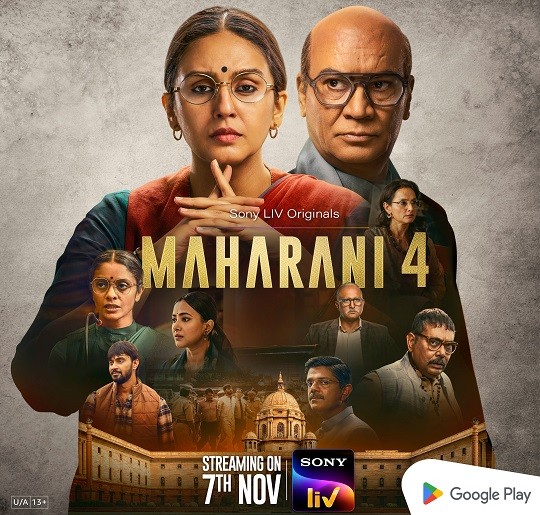

The fourth season of Maharani works both at a macro level as well as the micro level. On the surface (and given that it is now the fourth season of the show), the drama resembles a fruitful bilateral test series between two opponents that look to outwit each other. The difference remains its arena – this ain’t a cricket field but instead a political landscape that is much cruel, and a setup that has no handshakes (oh, wait). The year is said to be 2012 (the season takes a 10 year leap) but the war-lines are eerily familiar to the current setup. At the helm of things is PM Joshi (Vipin Sharma) who must prove his majority here with the help of his allies or opponents, a plot-point that introduces us to the main players – Manik (Baharul Islam), the sitting CM of Bengal, R Sunderraja (N Peru), the superstar-turned-CM of Tamil Nadu, and Rani Bharti (Huma Qureshi), the chief opponent and the CM of Bihar. This remains an interesting start to the political fabric of the show simply given how it introduces the viewers to the inherent political games on show, almost that has a Shakespearean undertone to the proceedings while borrowing several instances from real life incidents. And anyone who follows Indian politics would be able to draw parallels here. It is the game of arm-twisting mixed with I-Scratch-Your-Back-You-Scratch-Mine that remains a key cog in the drama to begin with.
Written by Nandan Singh, Uma Shankar Singh and Subhash Kapoor, the characterization remains the one of the interesting aspects of the fourth season of Maharani. And at the center of things is the Queen – Rani Bharti who finds herself in a fresh set of challenges with respect to her opponents. But there is a marked difference in her demeanor – she isn’t meek or unsure of herself, instead more vocal and self-aware. You can make out that Rani has a mind of her own, even as you spot her rejecting the alliance offer of PM Joshi (who has been arm-twisting her with respect to ‘files’ from her past). You do have the usual suspects aiding Rani – Kaveri (Kani Kusruti) and Mishra (Pramod Pathak), two important members who slowly have harboured political ambitions of their own, something that would challenge their inherent loyalties to Rani from over the years. And that itself accounts for an interesting dynamic that unfolds in a leisurely manner.
Rani has three kids of her own – Roshni (Shweta Basu Prasad) who doubles up as a close aide but is soon pushed into the political landscape at a tender age, Jai (Shardul Bharadwaj) who remains the most politically active and the most ambitious in the family, and Surya (Darsheel Safary) who is away from the chaos, studying in London. Roshni remains the most balanced here, not having a political ambition of her own to begin with while inheriting the grace and dignity from her mother. In a scene, you see her taken aback from a subsequent verdict that would push her in the political landscape against the tide. She may not have the same political mindset as her mother, but there is a gritty restraint that drives her ambition even while being able to distinguish between right and wrong here. In a scene, you see her rejecting the tender of her own brother, simply because it reeked of a layer of corruption. In that regard, you can say that she has a mind of her own that is slowly being nurtured for the future.
Jai remains an important cog given how he is at the center of varied sentiments with respect to his party members. He hasn’t completed his education but vocally harbours a powerful political ambition while being involved in a corruption-filled business with his friend. But the dynamic exhibited by him remains varied – you have the likes of Kaveri and Mishra opposing his participation in a major public post with regards to their party, he is overlooked to be a Chief Minister candidate by his own mother, and his tender is rejected by his sister who becomes a CM. In many ways, Jai remains the black-sheep of his family, something that further strengthens his ambitions given his close-proximity to his mother. In a heartfelt moment, you see Rani consoling Jai while apologizing for not being there for him during his growing up years (she was in jail for a period for the the death of her husband, only to avenge it later on). Jai in return, is known to poison the mind of Rani too with respect to a few members of their party.
The characters around Rani harbouring opposing views also make for a good reading. While the likes of Navin Kumar (Amit Sial) are in jail, you have the shifty Gauri Shankar (Vineet Singh) being a joker in the pack – often known to spew his political pedigree onto others, based on the situation he finds himself in. He is popularly known as ‘Thali Ka Baigan’ for precisely this reason, but he likes to call himself a snake without a tail. Likewise, even the character of Joshi remains an interesting one – he indulges in a ‘muddy’ massage for his skin care routine (oh wait🫣), he eats mushrooms as meals (oh wait🫣), he has a secret affair with a woman Gayatri (Rajeshwari Sachdev) that results in an illegitimate son Nachiket (Saddam Hussain)… (oh wait times ten🫣), and he works with his political advisor Murad (Amit Kumar) to topple his opponents either by buying them off or arm-twisting them (oh wait😶). But the year is 2012 so all of it is fictional ofcourse, it bears no resemblance to anyone dead or alive🙂. By attitude, Joshi is Thanos who poses a huge political challenge to Rani – that makes Rani an avenger too but sadly, she is shown to be the only person with some spine here as opposed to Sunderraja and Manik who are mere political pawns known to frequently switch sides.
For anyone who has been following the political landscape of the show, would know that real life incidents form the basis of inspiration here. Be it a (C)ED raid on a popular corporate office, or even the (C)ED arresting a political opponent without really being able to press charges, every little sub-plot has flavours from real life. And all of it adds to the unpredictability of the drama, while also resulting in a pretty engaging watch. The after-taste of every subplot has hints of black humour that almost holds a mirror of sorts with respect to the possible political games played for power. Hence, power remains an important motivation for all characters that are grey here, something that keeps them and the viewers on their toes, who get to witness their antics.
The one area of criticism for me is in the final episode that marginally lowers the impact of the drama here. I must say that I am not a fan of stories spilling into the next season, something that I had previously witnessed in a show like Search (2025). In a show like Maharani where everything is connected, I get the fetish. But the idea ought to have been to atleast give some conclusion to the existing plotline while setting up context for the next season later on. Instead here, you have a late subplot that changes the dynamics for all the characters – almost aspiring to be a nod to The Godfather (1975). The knockout punch that was about to land, just lost a little of its fizz given how certain plot-points throughout the narrative felt a little undone. This, although the setup for the next season is still promising making the overall impact of this season still pretty solid.
The dialogues formulate the texture of the drama here, and the varied dialects spreading over folks with different cultural backgrounds here, was a sight to behold. There is an evidence of dry humour in play too that cuts through the seriousness of the drama, thereby keeping you thoroughly engaged. The BGM is sparingly use, almost relying on the terrific sound design that adds to the rustic nature of the drama. The cinematography comprises of frames that alternate between mid-shots to some tight closeups that allow you to peek into the psyche of the characters while staying in the moment with respect to the dynamics that they share with everyone. The production design is immaculate, allowing the ambience and the atmospherics to reek of a searing political landscape. The costumes by Veera Kaur add a certain aesthetic to the personality of the characters, almost playing around with colours that are different outdoors and different indoors. This allows for a viewing experience wherein you judge the characters in different situations and in different settings.
The editing pattern is leisurely which honestly comes as a breath of fresh air in an era where reels rule the roosts. The idea to keep the drama engaging through conversations is a lost art, and here you see that in its full bloom without any cuts along the way. Director Puneet Prakash does an incredible job in keep you engaged through his world building and characterization. To mount a major chunk of the show on just the dynamics between the characters can be tricky, but here it is done to near perfect while maintaining a firm grip on the narrative. And that for me remained a victory for the director who just was self-aware of his craft in constructing a riveting political drama.
The performances are immaculate by the members of the cast. The regular faces like Amit Sial as Navin Kumar and Kumar Saurabh as Sanyasi leave a mark despite a limited screen time, with a potential promise that both of them would be back to their full bloom in the next season (with respect to their screentime). Vasanti Sundaram as Srilatha, Rajeshwari Sachdev as Gayatri, and Medini Kelamane as Bharathi represent Lady Portia in their own respective worlds, and all of them manage to leave an impact. Likewise, Kartick Sitaraman as Nelson and N Peru as R Sunderraja leave a mark too – the latter exhibiting traces of black humour even with respect to exhibiting meta-references of the representation of superstars from the Tamil and Telugu film industry. Sarah Hashmi as Aditi has a superb screen presence, and you see tiny moments of her scheming self here, something that has the potential to define the landscape of the next season given an angle of revenge in play. Manurishi Chadha as Balkumar and Bahural Islam as Manik are opportunists, and they bring out the slender vily side to their characters with perfection. Mukesh Bhatt as Somshekhar Singh has his moments to shine too.
Happy Ranajit as Rishi and Saddam Hussain as Nachiket are two characters that are cut from the same cloth, but the difference lies in the characters that they side with, that defines their fate. And both are superb to witness here while coming across as supremely competent performers. Atul Kumar as Murad is outstanding to witness here. He brings restraint to his character with strands of grey that will keep you on your toes with respect to the unpredictability of the character. The idea of winning at all cost is his driving mechanism, and he pulls off his role wonderfully well. Darsheel Safary as Surya is understated and does a good job, again with an eye on the next season wherein you will see his character blossoming.
Kani Kusruti as Kaveri and Pramod Pathak as Mishra are loyalists with fractured ambitions that act as driving mechanisms for their respective characters here. They are sincere and earnest but also complex this time around, almost doubling up as jokers in the pack that could change the political landscape here. And both are such tremendous performers who manage to impress here. Vineet Singh as Gauri Shankar is impressive in a vily and scheming character that adds to the unpredictability of the drama. You aren’t sure on which side he will sway towards, even with respect to his own political lineage and aspirations that are driven by hunger and revenge. That makes his character exciting, and a performance that remains brilliant through and through.
Shardul Bharadwaj as Jai is fiery and ambitious, two traits that define his character here. At a point, you see that he is also hungry for power that at times leads to desperate measures, something that define his impulsive antics as well. For most parts of the runtime, you see him as a game-changer but in this Game-Of-Thrones landscape, it becomes increasingly difficult to predict anything. But in terms of his performance, Shardul uses his expressions and body language to great effect in communicating the inherent angst of his character. Shweta Basu Prasad as Roshni is just the opposite here. She is well-restrained, calm and collected while coming across as an assured personalith who has a mind of her own. In crunch situations, she maintains a calm demeanor while never really been shown to be agitated. And Shweta does a solid job here.
Vipin Sharma as PM Joshi is a metaphor for the person who must not be named in current times. His antics are deliberately designed to be slight over-the-top with a nod to reality, even though you see his power hungry ambition being the sole motivator of his character. The win-at-all-cost attitude is perfectly exhibited by him, through his body language and expressions that will infuriate and amuse you, through and through. In that regard, he is brilliant to the core!
Huma Qureshi as Rani Bharati is yet again in top form here. Her gradual transition from a naive woman to someone who not only understands politics but also implements it, is a character arc in itself. And yet, you see traces of morality defining her character even while donning multiple hats of a politician and a mother. The chief conflict for her remains the politics around her family and her legacy (another chapter from Indian politics), and she exhibits the charm and grace to carry her performance with aplomb, even in times of vulnerability. She is excellent here in a character that she has made her own.
Despite a minor stumble at the end, the fourth season of Maharani is a compelling political drama with solid performances that makes for a wonderful watch. Available on Sonyliv.