

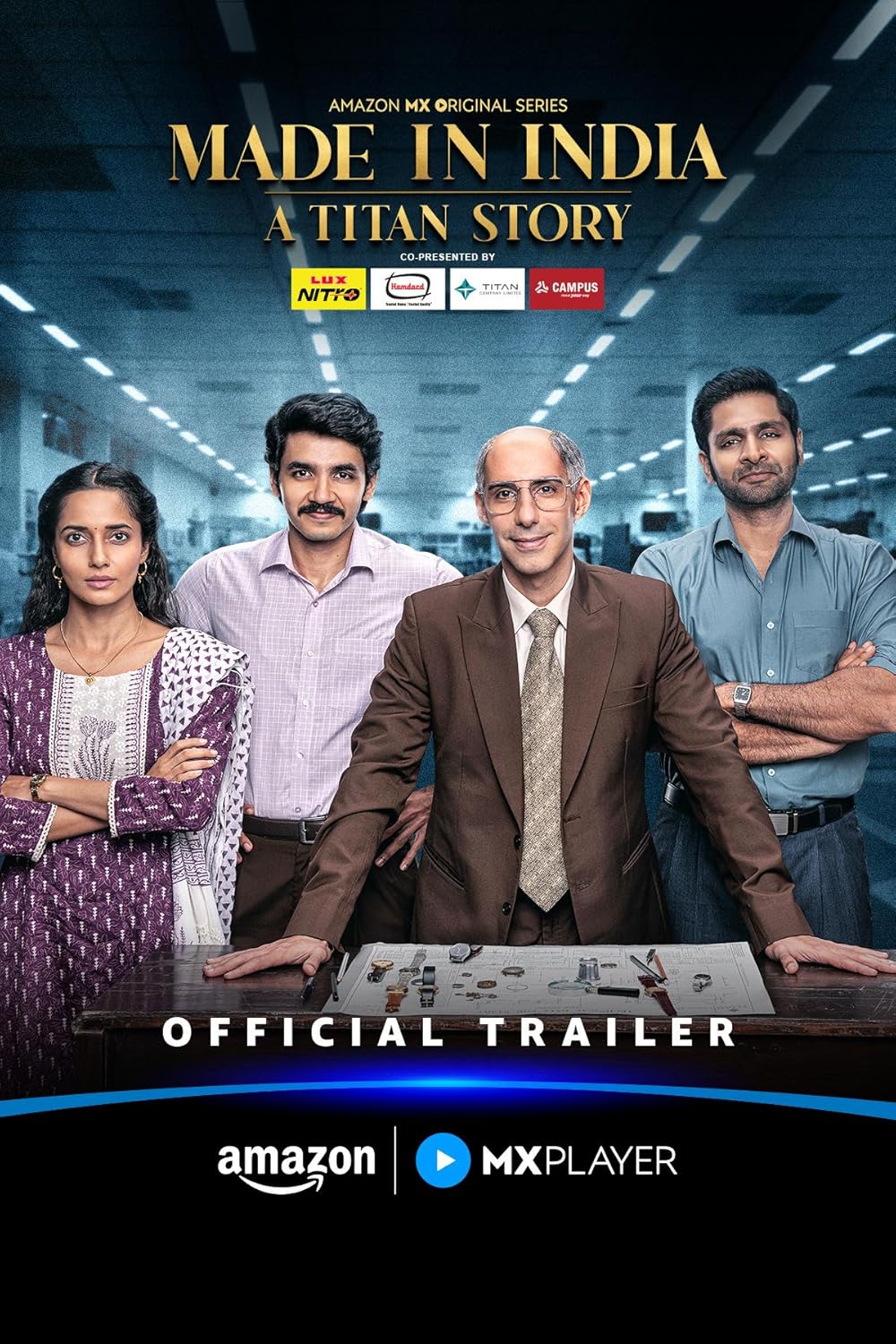
At a point in the new Hindi show Made In India: A Titan Story, a character remarks on how much he enjoys being a part of the Tata company (Titan in this case but a fact that could once-upon-a-time be extended to all Tata companies), given that the ‘air’ in it was driven by passion. I would concur that statement too, given my close association with the Tatas – a company that was essentially built with an employee-friendly work-culture. And while that culture might be marred by the ‘outsiders’ running the company today (those who follow the news know exactly who they are), the company did hold some strong values that were inculcated in every employee who was hired in the Tata Family (you need to take my word for this, although the same may not hold true currently). I still remember having being acquainted with the Tata values of punctuality and honesty during my early days with TCS, something that had me in awe back in the day.
At a point, I remember gifting myself a swanky Titan wrist-watch – a symbol of remembrance and the celebration of working in one of the most prestigious companies then. And how things went downhill towards the end of my 11 year stint, is a story for another day. But the important thing is on how this show remains a sort of a homecoming for me, even as an inside joke remained about me being the next CEO of the company given that I was a Parsi! Yes, that didn’t happen (lol), but atleast I have the chance of watching and writing on the origin story of my Titan watch (wink wink).
Based on a book by Vinay Kamath, and written by Niraj Dasa, Kandarp Shroff and Karan Vyas, you immediately get a glimpse of the Tata work-culture when you are introduced to the two protagonists – Xerxes Desai (Jim Sarbh) and JRD Tata (Naseeruddin Shah) at the start of Made In India: A Titan Story. In an early scene, you see the empathetic side of Xerxes who brings umbrellas for the workers staging a protest, just so that don’t get wet. You also see him working out a strategy to reach a middle-ground with the management – just so that everybody benefits from the project, including the workers whom he refers to as ‘developers’.
In another scene, you see him reasoning with a character who has just been demoted, only to send a bunch of flowers to her with the note on how she still remains his favourite employee. Elsewhere, you also witness JRD Tata telling a character to enjoy his first day, citing a question on ‘who even works on the 1st day?’ These moments remain fleeting but important in establishing the empathetic approach of an empire that looked at people beyond the usual profit and loss assets.
One of the core dynamics that the writing focuses on, is between Xerxes and JRD aka Jeh (as he was fondly called), with the latter doubling up as a life mentor with pearls of advice sprinkled in the narrative. Be it backing the idea of a ‘Make In India’ watch company with a global ambition, or quietly pushing Xerxes in board-meetings to avoid a conflict of interest, or being firm with his set of requirements to counter complacency, or even nudging Xerxes to try again and probably fail better the next time – the bar of leadership being set is pretty righteous and encouraging in equal measures.
Another important dynamic remains between Xerxes and Akash (Vaibhav Tatwawaadi), an erstwhile Jai-Viru combo that would go onto define the foundation of their company. Essentially, both these characters are pretty much the same people – putting company goals beyond everything else, being pillars and the mentors to founding members like Megha (Kaveri Seth) and Gaurav (Lakshvir Singh Saran), often indulging in disagreements but being the best of friends otherwise. In a couple of heartwarming instances, you see the friend in Xerxes apologising to Akash, while in another, you see the latter willing to swallow his ego and uncertainty while joining forces with his fellow teammate!
Interestingly, both these characters are shown to be making sacrifices at their homes too – with Akash having to compete with his father’s deteriorating memory, and Xerxes having to miss out on important events of his children while having to stay away from home for work. Who said entrepreneurship was easy? Who said setting up a brand from scratch was easy? The impact of it you get to know in two specific instances – one wherein Akash’s father refuses to recognize him, and other wherein Xerxes gets to know about his daughter’s writing skills.
The narrative from a structural perspective is crowd-pleasing as opposed to being complex which isn’t such a bad thing given that the emotions land beautifully. From a quirky encounter with a goon initiated as a part of the market research initially, to convincing the Tata board for greenlighting the project. From hiring founding members through interesting activities and convincing the government for the land in exchange for employment, to designing swanky designs for the wrist watches. From applying for loans to eventually distributing their own ‘convenient’ quartz watches. From disagreements on structural changes of the organization to eventually planning a gateway to expand it on a global scale. From the idea of changing the consumer habit of switching from a traditional watch that needed to be wound, to creating a famous jingle (an Indian rendition using Mozart’s 25th Symphony) for attracting customers – the moments are simplistic but feel like a warm hug.
In the midst of things, I really liked the cross-cultural inferences being infused in the narrative – be it that of a Parsi and Maharashtrian joining forces for an iconic watch brand. Or a foreigner warming up to the Indian culture by taking a liking to the Idlis. Or a set of characters returning the favour by giving him idlis as his farewell gift. Or a Japanese character giving to the requirements of the Indian characters after consuming an Indian sweet. Or even a character ably speaking Tamil and Japanese in two different instances to narrow the language barrier. It was a beautiful life lesson of togetherness that formed a key value of the Tata empire. So if we grow, we all grow together!
The narrative comprises of these heartfelt moments that supersede the fact that the narrative doesn’t really get into the depth of any issue, while consistently remaining on the surface. Perhaps that was also reflective of the times when life was simple and every little obstacle wasn’t equated to life and death, and when solutions felt simple enough to discreetly also carry some inspiring life-lessons of turning up and continuing even when things spiralled downwards. As a result, even the abrupt end didn’t bother me much – given that I was thoroughly invested in a narrative that chose warmth over complexity and depth, people over problems, and celebration over obstacles – much like the Tatas back in the day! The screenplay in that sense, is a celebration of Indian entrepreneurship, while being a winner through and through!
The dialogues are laced with simplicity and humour along with an empathetic touch that defines its characters along the way. In a way, this also remains a coming of age tale, and here, the life lessons are veiled as dialogues that establish the growth of the characters in question. This, while also creating a sense of contrast (even politically speaking) with current times with lines like – ‘Achche Din Aate Nahi, Laane Padte Hain’ (good days don’t arrive on their own, they need to be brought/created). If anything, the one flaw remained on how two Parsi characters didn’t always converse in Gujarati and English, but in Hindi too. That generally isn’t the case in real life, but I shall let that pass😅.
The music utilizes yesteryear’s iconic numbers to create a parallel to the situation that the characters find themselves in. And that automatically creates a vibrant environment with regards to the narrative. On a side note, another instance of a cross-cultural dynamic is established when the drama shifts from Mumbai to Tamil Nadu – and the music shifts from the popular Kishore Kumar and Mohd Rafi numbers of the 70s to an SP Balasubramanium number from the 70s. A fleeting instance, but an important one. The BGM is delightfully poignant while creating a feel-good emotion around every event that follows a similar trope – from a show-stopper to a victorious transformation. The notes also help in elevating the emotional quotient of the drama.
The cinematography successfully recreates the era of the 70s and 80s through grainy imageries, while beautifully playing with a contrived aspect ratio that soon blends towards a bigger picture. This technique is effectively used as transition shots as well, through its crisp and sharp editing pattern (that remain a direct counter to the episodic nature of the drama). The frames also keep you connected to its characters and their journey, even while creating an aura of goodwill around them, in a manner that will tug the strings of your heart. And on a side note, the idea of shooting at real locations, adds to the authenticity and depth of the drama.
Director Robbie Grewal beautifully inculcates the values of the Tatas in his storytelling technique. While the events remain slightly episodic, the focus is on the characterization and the world building, something that is beautifully renditioned by the filmmaker. The amount of emotions packed in the narrative, and feel-good moments being recreated, collectively make the drama heartwarming. In that sense, the filmmaking is truly wonderful to experience.
The performances are pretty solid by the members of the ensemble cast, and a huge shoutout to casting director Yash Nagarkoti for handpicking some fine talents for the respective roles here. The likes of Ishita Singh, Ghanshyam Garg, and Olga Yumasheva have their moments to shine. Rahul Dev felt like the only odd character from a writing perspective, but he still manages to hold his own. Prateeksha Lonkar as Sudha is sincere and earnest, while putting forth a commendable act. Saurabh Soni and Shilpa Iyer play important cogs that drive the narrative, and both of them manage to impress.
Viraf Patel as Murli Shankar Dalmia (slightly gimmicky with the shortform ‘MSD’) is confident here, while instantly making an impression. This character could so easily have been cocky, but the writing doesn’t delve into the ‘dark’ territory, even as Viraf manages to score with his assertive body language. Paresh Ganatra as Ravindr (and Devendra) has a charming effervescence to his persona that instantly makes him affable. There are deeper emotions to be explored through his character, and he does a heartwarming job.
Namita Dubey as Rajini is wonderfully restrained while being a pivotal emotional support for her husband. In some beautifully moments, you see the warmth that she brings to the table – like being patient with her husband in a few scenes of vulnerability, or determining his mood through the ‘Akoori’ that he makes. And in all these moments, she remains wonderfully grounded!
Ashwath Bhatt as Shankar is wonderfully understated while lacing his character with a lot of sincerity and dignity. And it was quite refreshing to witness him in a character that wasn’t a scheming Pakistani, something that had made him typecast. So happy to see him break that image! Joy Sengupta as SK Gopalan beautifully blends himself in a character that remains a little practical with his approach, something that doesn’t make him a crowd favourite. And yet, the focus remains on his posture and subtle mannerisms that make for a rather polished performance that is excellent to witness.
Lakshvir Singh Saran is a serious talent to reckon with, a glimpse of which one already did witness in the recently released show Lukkhe. But as Gaurav here, he is in even better control – almost approaching his character with a lot of sincerity and warmth, often going from a simpleton to a silent lover and a hardworking employee with an inherent charm. The scene in which he defends his colleague, equating him to a mother adds emotional gravitas to the drama, while elevating his stature as a performer.
Kaveri Seth as Megha has an assured aura around her, while using her beautifully expressive eyes to do the talking. You literally witness different shades of her character – from a young girl being forced into marriage to an independent woman who would go onto choose her own life partner. There is a clear arc defined here, even with traces of vulnerability sandwiched between sincerity. She accounts for each of these emotions rather beautifully, while putting forth a wonderful act.
Vaibhav Tatwawaadi is a wonderful actor, and as Akash, he tactfully matches and reflects on the emotional core of the protagonist. At the start, you see him as a man with a streak of uncertainty, only for him to play a big part in establishing India’s most successful consumer brand. Along the way, you witness traces of disagreement and vulnerability along with dollops of brotherhood, and Vaibhav does a tremendous job in defining the nuance of every little emotion. He was terrific to witness here.
Naseeruddin Shah as JRD Tata delivers one of the most dignified performances you will ever see thia year. He oozes of a grandeur with his demeanor while having an endearing personality that instantly makes him approachable. The subtle words of wisdom pave way for inspiring breakthroughs, thereby adding to the earnestness of his character. And the manner in which he uses his expressions sparingly, is an acting masterclass in itself.
Jim Sarbh as Xerxes Desai is outstanding to witness here. There is an instant sense of likeability with regards to his character, so much so that I found myself invariably invested in his journey from the first frame. Be it his calm demeanor or his disarming smile, or his ability to absorb the pressure even while pushing his team to strive for excellence – Xerxes remained an endearing character. And Jim brings such nuances to his performance (it did help that he was aware of the world given that he is a Parsi himself), using his pleasant expressions and body language to do the talking. He is phenomenal in every sense of the word in an act that remains the chief anchor in the narrative – soaking in the emotions and creating a heartwarming impact around it.
An instantly uplifting and inspiring biopic with solid performances, Made In India: A Titan Story oozes warmth and affection coupled with a crowd-pleasing narrative. It perfectly captures the grit, vision, and extraordinary Indian entrepreneurship behind a legacy brand. Being someone who was previously associated with the Tatas, watching this show felt like a true Homecoming. Available on Amazon MX Player.


