

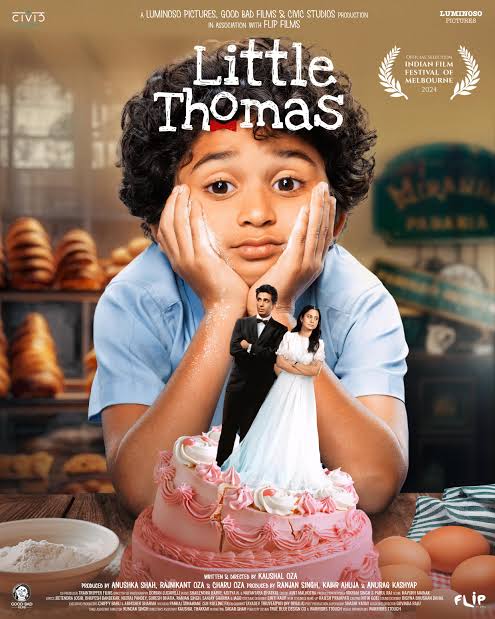
From a macro perspective, the seven year old protagonist Thomas (Hridansh Parekh) is a happy child, as seen in the new Hindi film Little Thomas. He is luckily born in an era of the 90s, wherein social media ceases to exist, detention of youth is an uncommon topic, and schools exist whilst still holding the curriculum centered around imaginative intelligence. It is also an era where media is neutral, and people believe everything that is rightly printed in newspapers (there is a legit scene wherein a child character tells another about this fact, concluding that their supposed concensus about a particular topic is true). Moreover, he also has loving parents – namely Desmond (Gulshan Devaiah) and Jessie (Rasika Dugal), who share cutsie moments while brushing their teeth, and sharing a laugh or two with their beloved son, daily. But when you choose to probe a little further, there is an unsaid subtext of loneliness and solitude that peeks its way through the keyhole as far as little Thomas is concerned. You get an early glimpse of the same in the very first scene, wherein he is at his liberating best while trying to get a glimpse of a little child in a church. In another, you see him subconsciously considering the baby to be his brother, much to the dismay of his peer at school, who taunts him to have an ‘actual’ brother of his own. And therein lies the conflict – the new quest for the young protagonist remains to have a younger brother, almost as a means of escaping his unsaid solitude.
Written by Kaushal Oza, Little Thomas is immediately a spiritual companion piece to Malgudi Days, particularly the POV that it employs owing to simple conflicts and simpler resolution. But there is also a hint of Kabhi Haan Kabhi Na (1994), specifically with regards to its vibrant setting of Goa that is also deeply coded on simplicity. It is almost like the movie shares an unsaid universe with the former, creating an imaginary sequel to the love story of Sunil and Anna – should they have gotten married by the end of things. And much like the life of the little protagonist, the lives of Desmond and Jessie doesn’t appear to be in turmoil on the face of things. They are a small happy family casually living their quiet lives in Goa, while embarking on the leisurely vibe of the setting. Life is settled but is it also complicated? The answer remains a resounding YES!
The writing is quick to give a fleeting glimpse into the lives of Desmond and Jessie at the start. The former is struggling with his family business of a bakery (Anna from Kabhi Haan Kabhi Na did too); the latter is lending a helping hand by imparting piano lessons to a dwindling set of people. In other words, both these characters are struggling financially whilst trying to put up a strong face in front of their little son. In fact, their lives could be compared to the seemingly beautiful wedding cake that is baked by Desmond, only for it to sink during its final frontier. And that acts as a metaphor in many ways – being beautiful on the outside but steadily sinking as a family as far as the finances are concerned. This, even as Desmond remains a honest soul, never willing to charge his customers any extra sum of money, whilst Jessie remains the giver – reluctantly selling off her piano in order to fund for a fridge for the bakery.
One of the themes employed in the screenplay remains that of innocence on behalf of the protagonist. His oblivious eyes miss out on the dark realities of his family, while imbibing the unsteady atmospheric – something that remains a trigger for his solitude. His idea of wanting a baby brother stems from this fact, which in a state of innocence is also an extension of his loneliness. And the writing does well in tapping into this zone!
There are titbits of humour gently sprinkled in the narrative, even as the protagonist makes it his (temporary) life quest of wanting a baby brother. The conflict of innocence remains on how he doesn’t know the process – jostling between his parents to the local priest, and pestering his young friends to his friendly elderly neighbour Mrs Braganza (ahaan; Mahabanoo Mody-Kotwal) to gain some insights into the same. The evolution of his knowledge directly coincides with the subtext of religious mythology, the Darwinism of monkeys and humans, to the beautifully sinful act of kissing – each of which is christened with bouts of innocence and humour.
In a hilarious little scene, you see the protagonist offering his mother an apple after listening to the sinful tale of Adam and Eve from the local priest. In another, you notice him gaining a scientific insight of exchanging germs that would later go onto form a child – as told through the incredibly creative lens of his fellow friends – the ultra intellectually brilliant but naive Murthy (Ninad Pandith) and the playfully silly ‘Fatty Bambola’ Nigel (Hridyaansh Gokani). And if you look closer, the larger theme of a marital unrest between Desmond and Jessie is subverted by a quest of love – wherein the protagonist tries his best for his parents to share a kiss, a searing metaphor of truce amidst a darker sentiment of ‘war’ and ‘unrest’.
The little criticism that I had was with regards to its final act, something that felt a little rushed with even its superior plot points. The obvious creative choice remained that of simplicity, and whilst that worked for most parts of the narrative – it slightly came across as convenient with the multiple resolutions on offer. If a set of issues are ably resolved after a moment of self introspection followed by a montage of resolutions to close the arc, then the intended impact of the drama is lowered to an extent; something that is the case here.
Luckily, the fall isn’t steep enough because the narrative in general is christened with palpable emotions of love, loss, and humour tied together by a thread of innocence that felt refreshing in many ways, particularly the manner in which it subverted the individual arcs of the characters. In that regard, the screenplay offers some consistent moments of joy that remains a far cry from the dark times that we find ourselves in. The streak of nostalgia pertaining to the 90s is also a real deal in the film – the times when cold drinks were a luxury, and playing with friends was a necessity, in what felt like an ode to the good ol’ days of innocence.
The dialogues are simplistic while oozing with bouts of innocence, while keeping the emotional core of the drama intact. There is a frolicking vibe to the music and the BGM that effectively reflects the vibrancy of the setting, even whilst having a melancholic aftertaste to the notes. If one were to look closely, the lives of the characters are sandwiched between these two sentiments, the latter also doing its bit in building a power yet unsaid emotional core to the proceedings.
The cinematography comprises of frames that allow the liberating setting to play an important character in the film – invariably drawing a parallel with the age group of the little protagonist too. It is funny on how the city you grow up in, grows along based on the experiences you have – steadily stripping away your innocence, bit by bit. Likewise, the Goa we see here is from Thomas’ POV – vibrant, protected and heartfelt, as opposed to the one offering claustrophobia to his parents. The camera angles do well in catering to both these gazes throughout the narrative, while emphasizing on the one involving innocence. The costumes department headed by Smiti Kaur wonderfully adds touches of simplicity to the attires of the characters, that also blend well with the charming setting on offer. The attires aren’t flashy but grounded with a calming influence that directly captures the leisurely vibe of the surroundings, subverted by a financial crisis on offer.
The editing pattern holds the narrative together by frequently tying the proceedings with a layer of emotions that are kept intact while traversing from one scene to another. The seamless integration of two parallel tracks unfolding (one involving the protagonist, and the other one of his parents) isn’t jarring, while wonderfully blending to the vibe of the setting. If anything, the final act felt slightly rushed even with its editing pattern – the sole criticism in a film that is otherwise nicely edited.
Director Kaushal Oza brilliantly captures the world through a child’s wonderfully uncomplicated eyes. He anchors the narrative around the pure, unfiltered curiosity of the young protagonist, making childhood innocence a beautiful, recurring theme. He deliberately avoids grand spectacles, scoring immensely with a gentle simplicity that mirrors the nostalgic charm of classic storytelling. His masterful direction ensures that the young protagonist’s genuine bouts of curiosity remain the moving heart of the entire movie.
The performances are wonderful to witness by the members of the cast. And full marks to the casting director Nitin NS Goel for tactfully handpicking some superbly talented performers. The likes of Aseem Hattangady as Reuben, and Faezeh Jalali as the confession lady definitely leave an impact with subtle bouts of humour while contributing to the fabric of the setting on offer. Mahabanoo Mody-Kotwal as Mrs Braganza has a very specific Mrs Godinho vibe from Har Dil Jo Pyaar Karega (2000), elevating some gentle moments with heartfelt compassion and sincerity. Hridyaansh Gokani as Nigel, and Nimad Pandith as Murthy exude of a wave of innocence that is well complicated by their vividly imaginative minds – offering a sense of humour mixed with a lot of flair and earnestness.
Rasika Dugal as Jessie excels as the mother, grounding the family dynamic with her trademark nuance and emotional range. She effortlessly portrays the layers of maternal care beneath the daily bickering, infusing her character with a rare, soulful authenticity. There is a layer of unsaid resilience mixed with bouts of practicality that acts as a binding agent for the family. She is a treat to witness here.
Gulshan Devaiah as Desmond shines by bringing a perfect blend of comedic timing and subtle depth to his role as the father. His character reminded me of Vishnu from Perfect Family (2025; also essayed by Gulshan), with regards to the pressures encountered around running a family. He brilliantly balances the character’s outward frustrations with a quiet, endearing warmth that makes his performance incredibly heartfelt.
Hridansh Parekh as Thomas delivers a standout, deeply charming performance in the titular role, anchoring the narrative with his raw, innocent curiosity christened with bouts of humour. His natural screen presence effortlessly captures the wonder and vulnerability of childhood, making him the emotional heart and soul of the film.
Despite a rushed final act, Little Thomas is a heartwarming love letter to innocence and childhood that, backed by brilliant performances, makes for a wonderful watch. It is a small film with a massive heart, gently tugging at your heartstrings to deliver a refreshing, sweet drama filled with genuine compassion and warmth. By blending nostalgia with emotional depth, the film offered a lasting, comforting impression that left me with a tingling, fuzzy feeling and a wide smile on my face. Available in a theatre near you from 23rd October 2026 onwards.


