

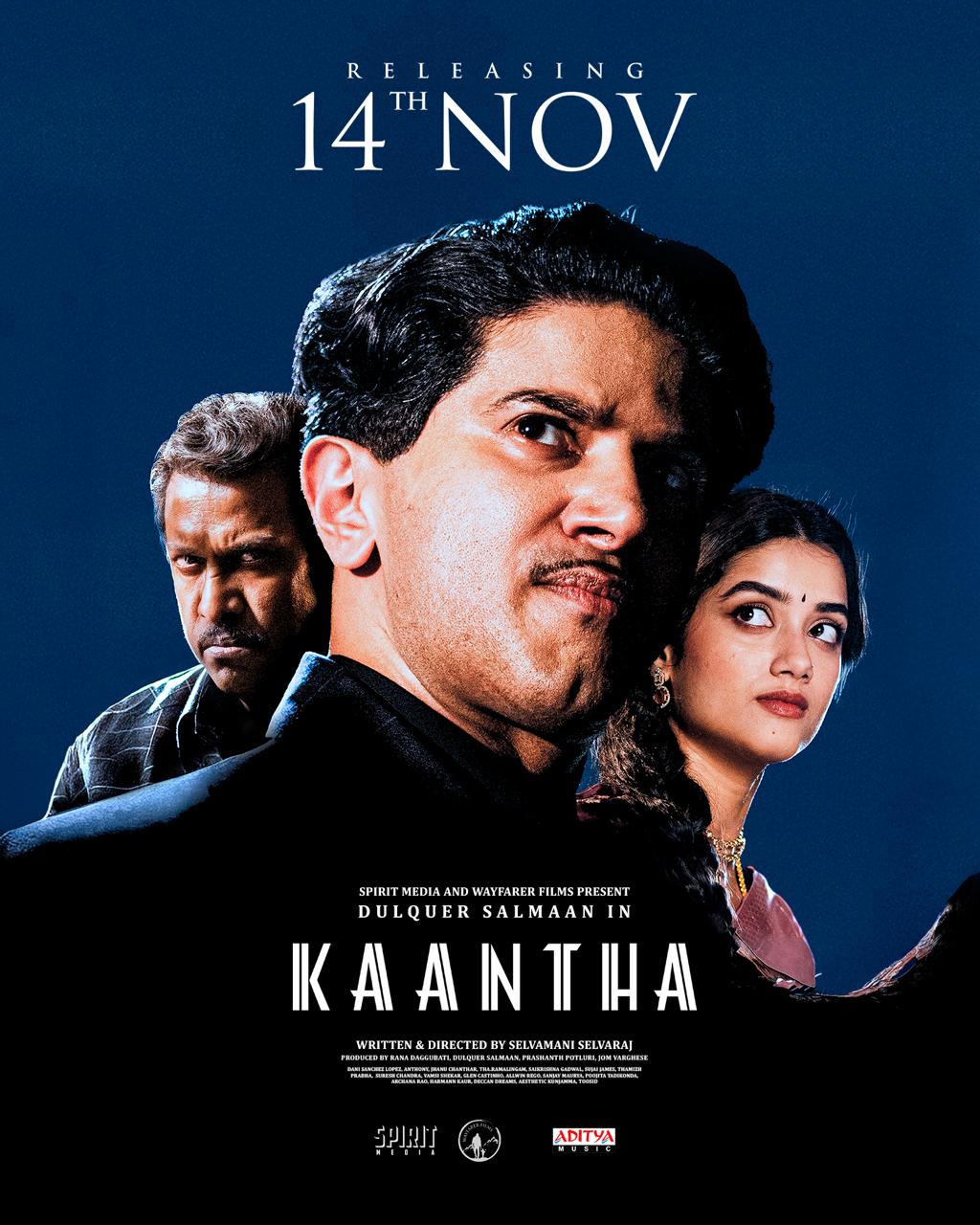
The mirror reflections in the new Tamil film Kaantha play such an important metaphor in the film. Given the setting of the showbiz, the only real reflections exhibited are through the mirrors, even as you witness T.K. Mahadevan (Dulquer Salmaan) banging his head on it in one scene at one point. The mirror is a reminder on the vulnerability of an artist like Mahadevan, a people’s actor who is told to have delivered ten back-to-back blockbusters. Clearly, Mahadevan resembles much of the superstars that have lived dual lives on celluloid and in reality, often driven by ego and being respectable narcissists in their own capacity. Mahadevan has all of these qualities but there is also a sense of empathy that you feel towards Mahadevan given his humble beginnings.
In a scene, you see him exclaiming on how the number of applause that was accounted by his audience during his street plays directly correlated with the amount of money he would gather to satiate his hunger. It is the kind of conflict that has blurred lines even during his tryst with cinema – with the want to continue to receive the applause from his viewers, in turn making him vulnerable with his onscreen image and hence, wanting to play to the galleries every single time, at times even at the cost of the film being tweaked around him. This single virtue makes Mahadevan a complex character, someone whom you don’t complete hate or empathize, wherein the greys in his persona are more pronounced than his other binary traits.
Written by Selvamani Selvaraj, Thamizh Prabha and Shri Harsha Rameshwaram, Kaantha can best be described as a film within a film, wherein the events that transpire are eerily similar to the film that is being shot. The setting remains of the 1950s, even as the cold open gives you a trace of a Hitchcockian mystery that the film is ‘probably’ staged around. But as you linger on with the drama, you get a hint that the broader picture remains similar to a Shakespearean tragedy, more specifically Othello, even while you are transported on a film set. Almost instantly, the theme touches upon the ego clash between two individuals – Mahadevan and his once-upon-a-time mentor Ayya (Samuthirakani). And it is evident from their first appearance together that they don’t see eye to eye with each other, something that fuels this complex character study even more.
Ayya, who is the film director, happens to be a cinema purist, having previously hand-picked Mahadevan from the streets to play the character of a God, only to later witness a Godly figure to emerge out of Mahadevan (atleast for his fans). In a scene from the past, you see Ayya telling Mahadevan -‘Do Not Continue To Act, Once The Director Calls For A Cut’. It is one of those life advices of Ayya who wishes to remain the ‘God’ of the set, while overlooking the point that there are no directors in real life. In real life, there are only entourages who would boost the ego of the superstar without criticizing him in anyway. So if a superstar requests for a retake, the required measures are taken accordingly – something that Ayya continues to witness on his set. So then the question arises – who is the real ‘God’ on a film set even?
The third wheel of the film (and the film set) remains Kumari (Bhagyashri Borse), a timid young girl in her to-be feature film debut who tries to bridge the gap between the superstars. She often coaxes a communication medium, only to fall on deaf ears – even as Ayya promises her loyalty for a film that is extremely close to him. On the other hand, Mahadevan after wanting a change in the climax and the title of the film from Shaantha to Kaantha (the inherent meta-reference here that tells us that this is Mahadevan’s story), you see him falling in love with her despite being previously married. Needless to say, this further complicates the matters between him and Ayya.
You see the lines blur between reel and real given how closely entangled the two plots play out to be. This remains true even at the halfway mark in which a scene being shot in the film is a death scene, only for a crime to be committed by an unknown entity. The hint of deviation towards the investigative zone in the second hour featuring a decorated but brash officer Phoenix (Rana Daggubati) is also fascinating to witness, despite the adjustment that I had to make with the tone of the narrative that went from a meta-drama to a mystery. But even in that zone, you see how the dots are connected to multiple characters, even while holding the importance of knowing them better in order to fully understand on why certain actions were committed. On the face of it, it may seem to be routine but the grip with respect to the tone is very much in play – something that doesn’t completely deviate the drama towards a Knives Out Mystery.
(SPOILERS IN THIS PARAGRAPH)
The ultimate revelation that occurs may not instantly come as a shocker to you simply because the drama doesn’t wish to play on the familiar tropes of a murder mystery. The core theme is a tragedy, or should I say a Shakespearean tragedy that plays out like a character study wherein fate brings both Ayya and Mahadevan to reconcile at the most bizarre circumstances. The subtext is of a communication gap followed by a sense of guilt, that sees a character smashing his head on a mirror in frustration (a replica of the previous scene doubling up as a metaphor of his broken personality), even while being a cause of not one but two deaths. It is a conflict of his narcissistic trait mixed with guilt that wants the people to remember him as the ‘God Of Acting’ – whilst also wishing to concede with his ego at the end (something when you see the ultimate film poster and the name on it). It is a perfect Shakespearean tragedy that is not only external but also internal in perhaps one of the most complex character studies that I may have encountered this year.
The dialogues are driven by the meta-nature of the drama, even as you witness a character mouthing the dialogue ‘You Ungrateful Dog’, a line that is also present in the film that is being made. The music is outstanding with the songs always being in sync with the emotions in play in the drama. The BGM beautifully presents the era of the 1950s with the setting of a film set, while wonderfully curating a score that heightens the impact of the conflict felt by the characters. The cinematography by Dani Salo brilliantly transitions between monochromes to feature colour, and switching the aspect ratios seamlessly without hampering the visual impact of the drama. The aesthetics are beautiful and grand while blending itself with the colour coordinated corridors of the drama, something that accounts for a brilliant production design too. The editing pattern is crisp and taut in the first hour while marginally lagging in the second hour, but still the themes remain intact even while lending a wealthy grip on the proceedings.
Director Selvamani Selvaraj does a magnificent job in mounting this drama with grandeur without treading on the familiar tropes of the investigative mystery thriller. In fact, this remains a creative decision on delving into a complex character study that is fascinating to witness with its meta references, while using the investigation as a medium to enhance it. The results maybe divisive but personally speaking, this remained a stellar effort that lands with near perfection even as the director does a brilliant job, through and through.
The performances are excellent to witness by the members of the cast. Bijesh Nagesh as Babu uses his body language perfectly to depict the ‘Yes-Man’ of the superstar. Tamizh Selvi as Rani, Nizhal Ravi as Sivalingam (exceptionally shrewd and incredible to witness) and Vaiyapuri as Selvam have their moments to shine. Bagavathi ‘Bucks’ Perumal as Constable Kaathu contributes to subtle moments of humour rather seamlessly. Gayathrie Shankar as Devi exudes of the aura of a superstar’s wife and she carries off her character with aplomb, while always maintaining her rich body poster perfectly. Ravindra Vijay as Martin leaves a lasting impact as the studio head while contributing to the investigative part of the drama rather efficiently.
Rana Daggubati as Phoenix is clearly having a ball here with his body language and demeanor that exudes of bouts of playfulness, which was pretty good to witness here. Bhagyashri Borse as Kumari is sincere and earnest while reeking of an innocence that goes wonderfully with her character. And despite that, there are layers and layers to be discovered with respect to her character wherein she manages to leave a lasting impression. Samuthirakani as Ayya is fiery while depicting his vulnerable side with a lot of flair. You see his helplessness transition into a retaliation, only later for the viewers to realise that his character is mounted on guilt and despair – contrasting traits that are beautifully essayed in a stellar act.
The show though belongs to Dulquer Salmaan who effortlessly sails through such a complex character here. There is a fine line that he treads while essaying a character driven by a dual dilemma of fun and the conflict tagged to it. As a result, you empathize with him but not completely, a fine line that defines his greyness. There are conflicting emotions in play that are beautifully depicted by him in a scene resembling the-man-in-the-mirror, his moment of truth that is hidden to the world. This is yet another exceptional performance by a supremely talented performer.
Kaantha is a brilliantly complex character study veiled as a mysterious meta-Shakespearean tragedy that makes for a brilliant watch. Available in theatres and Highly Recommended!


