

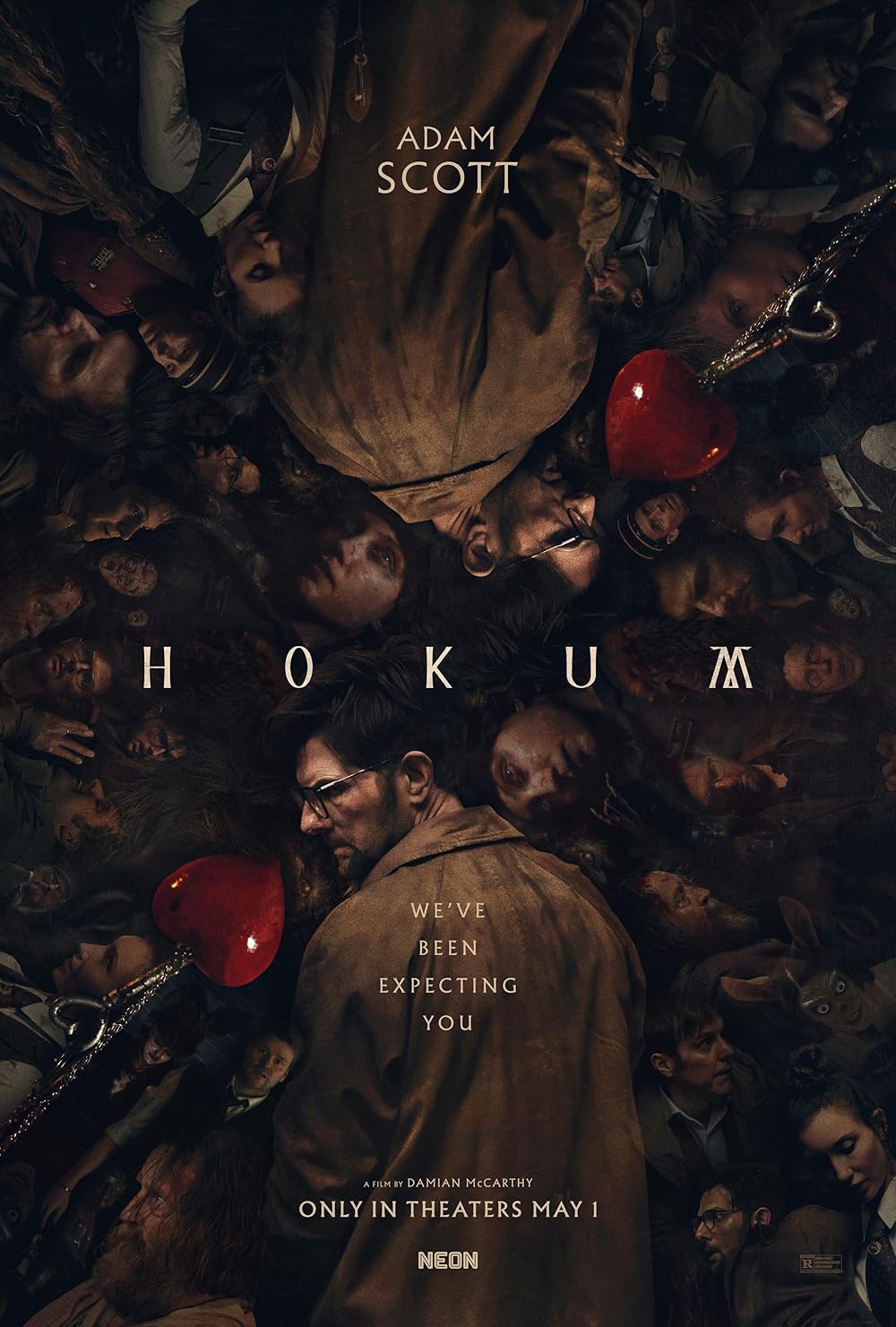
The cold open of the new English film Hokum is both psychological and internal at once, with respect to the protagonist in question. The opening shot of an unknown man walking through a desert with his young squire is search of a map is actually a part of a story from The Conquistador, more specifically a dark trilogy that is penned by Ohm (Adam Scott). In the scene, you witness Ohm wanting to opt for a dark end – with the man killing off the young boy in order to regain a map, a sequence that can directly be equated to the internal journey of the protagonist who is driven by trauma over the years. The sequence is an important cornerstone in the story, given how it indirectly ties up to Ohm’s own life of living with a guilt with respect to his mother’s death, even while witnessing his alcoholic father’s life spiral downwards. At some point in the narrative, you witness this point being specifically emohasized upon – even as he gently lays down his mother’s ashes beneath a tree, while nonchalantly emptying his father’s ashes in the very next moment. Clearly, the trauma induced by his father and the guilt from his mother’s death, is indirectly reflected in the epilogue for his story that forms the basis of a dark foundation here.
Written by Damian McCarthy, Hokum can easily be a companion piece to Oddity (2024), particularly with respect to the setting employed in both films. If it was a haunted home in Oddity, it is a haunted hotel that forms a primary setting, even as the protagonist makes his way in order to complete the epilogue of his book and search for his parents’ honeymoon location – to lessen the burden of his guilt. But this is where the writing has its own share of individuality – it touches upon a theme of folklore that is integral to the plotline here, even as the protagonist overhears a character narrating a story of a witch that kidnaps children and leads them in the underworld.
The characterization plays an important part with respect to the drama. For instance, the character of Ohm is as cold and rude as one can be – mostly stemming from his past. In a scene, you see him declining to give a career advice to a character, in another, you see him dismissing the idea of a folklore (hence, the title Hokum that stands for dismissiveness). But ironically, you also see him warming up to the bartender Fiona (Florence Ordesh), who in turn helps him locate the exact spot from the honeymoon picture of his mother. Clearly, a feminine streak of the past that has been missing for the protagonist, forms the basis of the connection here. Hence, it is hardly surprising on how both form a symbiotic relationship – with Fiona rescuing Ohm from hanging himself, and Ohm returning to the haunted hotel upon hearing about her disappearance.
The storyline remains a basic one-liner centered around the mystery behind the disappearance of Fiona, along with a host of characters that play a pivotal part – an shady owner Cob (Brendan Conroy), a front-end desk clerk Mal (Peter Coonan), a groundskeeper Fergal (Michael Patric), a friendly stranger Jerry (David Wilmot), and a honeymoon suite filled with folklore. And yet, the storytelling is immensely deceptive – often relying on symbolisms to convey the importance of the folklore.
Be it ‘The Witch’ that doubles up as a central antogonist in mythology, while also signifying trauma or an insufferable death. Or the use of ‘Rabbits’ that are integral shapeshifters in Irish folklore. Or even the ‘chalk circle’ that would protect the protagonist from the underworld (much like its reference from the Ramayana). Or even the honeymoon suite that is reflective of the closed mindset of the protagonist – an extension of the claustrophobic lift that is symbolic of the trauma. And interestingly, the protagonist is named ‘Ohm’ – after a unit of electrical resistance that is reflective of its ‘resistive’ mindset before finally coming to terms with an alternate reality.
The horror elements are atmospheric, often allowing the drama to get under your skin. Be it the shadowy corridors with occasional glimpses of the unknown, or the eerie lighting of the suite, or even the chilling visuals of corpses – all of these instances extend beyond the standard tropes of the film. But more importantly, the journey offers an introspection on the part of the protagonist that automatically leads to a sense of transformation – coming to terms with his guilt, and eventually also believing in an alternate world that continue to watch him and in a way, protect him. These shifts reflect in his behavior towards a character, even while circling back to a happier ending for his book. The screenplay is really well written in that respect of a character transformation.
The dialogues are used sparingly, often being bartered with some chilling visuals – including some incredible tracking shots that add to the chills in the narrative. It is interesting on how the cinematography isn’t designed just for jump scares. You will get your share of them every once in a while, but the still camera work offers a deeper psychological impact on the drama that also uses its score sparingly. You don’t get blazing sounds that would drown the horror element in it – instead, the use of silence offers a deeper impact here, even with the frames that toggle between eerie outdoors or claustrophobic indoors. In a way, the setting of the suite plays a character too – offering chills that are immaculate in every sense of the word.
The editing pattern is crisp and sharp, often holding its shape at pivotal moments of intrigue without trying to get innovative with the jumpscares. The idea of maintaining the chilling ambience of the drama extends even to its editing style, that doesn’t corrupt the frames or the scenes, while effortlessly transitioning from one scene to another.
Director Damian McCarthy is a modern day master as far as the horror genre is concerned, and he uses the idea of minimalism rather effectively. If you look closely, the story is simplistic but the presentation is complex – never fully wanting to enter the gory space, while quietly being confident in its own ‘spooky’ attire. The craft on display is impeccable – relying on the atmospherics and the chilling ambience, without venturing into the cliched zone of the supernatural curated and repeated by Vikram Bhatt in most of his horror films. The emotional streak keeps the drama grounded and palpable, even as the direction remains spectacular throughout the narrative.
The performances are pretty good by the members of the cast. Sioux Carroll as the Witch and Mallory Adams as Della team up to provide some memorable chills throughout the narrative. Ezra Carlisle as the Squire and Austin Amelio as Conquistador have their moments to shine, while offering a strong emotional core in the drama. Brendan Conroy as Mr Cobbs and Michael Patric as Fergal are understated with their respective performances. Will O’Connell as Alby offers some subtle comedic moments rather effectively, that surprisingly felt a part of the narrative as opposed to sticking out like a sore thumb. David Wilmot as Jerry and Florence Ordesh as Fiona are sincere and earnest with their performances, and both of them manage to leave a mark. Peter Coonan as Mal is pretty good to witness here, while accounting for varied shades of his character.
Adam Scott as Ohm probably delivers one of the finest performances of the film. He remains secluded and unapproachable to begin with, but often relies on his trauma-based core to justify his actions. His eyes speak a language of guilt, even while being subdued with his body language. In a scene when he is trapped only to witness a shadowy figure approaching him, the shock isn’t as dramatic given how the same was reserved for his past that resulted in the death of his mother. Such smaller nuances of his character coupled with an able character transformation, acts as an anchor for the drama that has a rich vein of emotions cutting through the horror elements. His performance is excellent here.
With solid performances and a chilling atmosphere, Hokum is a brilliantly crafted folklore horror film that makes for a wonderful watch. Available in a theatre near you.


