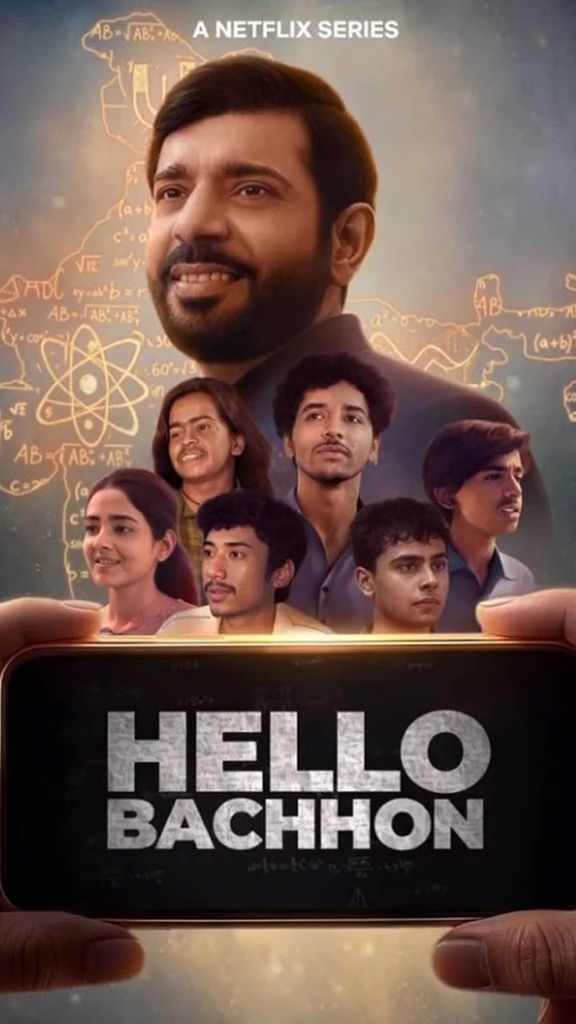

In an early scene in the new Hindi show Hello Bachhon, you notice a nascent conflict with respect to the protagonist Alakh Pandey (Vineet Kumar Singh), who is on the cusp of expanding his institute – Physics Wallah. As a glimpse into his mindset, you notice his early insecurities of opting for an expansion of his Ed-Tech business, a distinct departure from his early life of opting to impart free knowledge through Youtube videos – something that was his bread and butter, once upon a time. In that sense, Hello Bachhon can be a spiritual sequel to the other Hindi show ‘Physics Wallah’ (2022) which essentially catered towards the origin story of Alakh Pandey. It must be noted that the protagonist is in a much better space financially speaking, but the urge to continue imparting education to the lowest common denominator is the driving force of the narrative here. In another scene, you see Alakh telling his co-founder Prateek (Vikram Kochhar) on how his ‘teaching’ ranking is considerably decreasing – a nod to how it remained a task for him to manage teaching and the business around it in equal measures. And this specific conflict acts as a connective tissue throughout the show.
Written by Abhishek Yadav, Vernaali, Ankit Yadav and Sandeep Singh Rawat, the first season of Hello Bachchon follows a familiar TVF template that essentially hinges on emotions to drive the narrative. The format remains episodic with each episode delving into the lives of different students from across the country in the context of their tryst with Physics Wallah. In one episode, you have a couple of kids aspiring to clear the NEET exam in the wake of the setting of poverty that they find themselves in. In another, you follow the story of a youth immersed in the world of drugs suddenly waking up to the idea of clearing IIT to improve the economic state of his family. You also have a track on a character having to endure a potential career choice, or even a character having to fight patriarchy to break the shackles around her, or a familiar stance on the Kota-ridden streets that witness a familiar suicide-attempt.
Each of these tales are marginally isolated and may instantly seem like check boxes of sincerity with regards to the format. But the differentiating factor in each of these tales remains the emotions that they cater to. There is a miniature version of TVF’s other shows in each of them – namely Kota Factory or Medical Dreams or even Flames, wherein the writing is designed to be crowd-pleasing while touching upon a strong emotional core. And I couldn’t help but be invested in each of them, even whilst the larger picture aimed at being an advertisement for Physics Wallah.
I didn’t seem to mind it at all, even as there are subtly heartfelt moments sprinkled in the narrative – like a character realising the financial reality of his father, or the pressure-cooker situation leading to a bright student trying to commit suicide, or even a potential teenage love story in the midst of an exam fever, or a couple of characters breaking the wall while forming a parallel with the protagonist talking about breaking the ‘barrier’. The events may appear to be convenient and cliched but they have their hearts in the right place.
On the broader front, the writing wishes to dwell on the insecurities of the protagonist, even while reluctantly treading on the journey of investments. The proceedings reminded me of last year’s Hindi show 13th, which dealt with a similar dynamic in play. So MT Sir (Gagan Dev Riar) and Ritesh (Paresh Pahuja) are replaced by Alakh sir and Prateek who along with their team go onto pitch their business proposal, only to be looked upon as numbers. One small criticism that I had was in the form of a missed opportunity in dwelling a little on the origin story of the protagonist – something that you only get a fleeting glimpse of. The hardships that were indicated in a humble household needed to be fleshed out a little more – even with respect to the rocky equation that Alakh shared with his father – even as his sister (Girija Oak Godbole) remained an emotional anchor.
But having said that, I would be lying if I were to tell you that I wasn’t emotionally invested in the journey of the protagonist who at various points chooses to put his morality before everything else. Hence, even a standard trope like a washroom gossip session being searingly interrupted by him, hit the mark for me. And be it his decision to reject an offer to make Physics Wallah a unicorn, or a session at a restaurant with Prateek that ended up in a eureka moment for the protagonist, I was thoroughly engaged.
I also liked the rousing monologue at the end that wonderfully summarized the psyche of the protagonist – this, while papering over the cracks with respect to the propagandist elements in the drama owing to a conspiracy theory of other coaching institutes, something that felt unnecessary and devoid of any substantial impact. And despite the abrupt ending, the trademark TVF magic was evident in an inspiring and heartwarming tale that did hit home despite the cliches in play.
The dialogues are ridden with life wisdom be it lines like the importance of education outside the aspirations of an IIT or an IIM, or the heartfelt conversations between characters that tap into a plethora of emotions along with a dash of social issues in play. The lines truly hit home while being a signature of magic in most TVF shows. The music and BGM by Anand Bajpai follow a similar trope of brilliance – doing their bit in enhancing the underlying emotions in every scene, and lacing the narrative with heartfelt notes through and through. The cinematography by Amogh Deshpande does its bit in keeping you invested with the characters and the setting. And interestingly, there are different shades employed for different cities in play – a sharper and greyer undertone for Slums in Mumbai, a yellow tone for Allahbad, a blue tinge for Haryana to name a few. And that definitely adds texture to the narrative, even allowing your mind to encapsulate the different backgrounds of the kids in play. This, invariably helps in forming an emotional connect with the characters and the surroundings.
The costumes by Yashika Kakkar and Prachi Upreti (and team) go a long way in establishing the characters with respect to their surroundings. And in a way, the costumes are also instrumental in adding an arc to the characters – almost like a picture of ‘before’ and ‘after’ (in some cases). The editing pattern by Akash Bundhoo is crisp and sharp, keeping the length of the drama in check while also accounting for a strong emotional core that is maintained through the intercutting episodes linking the lives of the characters.
Director Pratish Mehta has got to be one of the promising filmmakers doing the rounds lately. And it emerges from the fact of how easily he is able enhance the emotional core of the drama without really losing sight of the conflicts in play. The measured approach of balancing the narrative of the protagonist and ‘unrelated’ but ‘related’ characters around him was commendable, given how this may have been a tricky proposition on paper. His direction also took away from the fact that not all characters were written to perfection, and that some curveballs felt convenient on paper. But the emotional core was a resounding success here, and that can be equated to the direction which was brilliant to witness here.
The performances are excellent by the members of the cast, and once again, a large part of the credit must go to Mukesh Chhabra and his eye for handpicking fresh talent. The likes of Ghanshyam Garg, Joy Sengupta, Avtar Vaishnani, Kiran Khoje, Vinod Suryavanshi, Rohit Tiwari and Jairoop Jeevan have their moments to shine here. Anshul Dogra as Negi delivers a heartfelt performance of a youth confused about his future career prospects. Satendra Soni as Bhola and Sonu Kumar as Hariya are sincere and honest while forming a subtext of a heartwarming friendship in the larger context of poverty that links both characters together. Prem Anand as Wahid and Sidd Rawle follow a similar trope in their track, while being earnest with their acts.
Samta Sudiksha as Tripti and Varun Buddhadev as Ankit are phenomenal to the core, and their dynamic forms an arc of its own – almost reminiscent to TVF’s Flames in a different context. Naman Jain as Lakshya and Divesh as Aditya have contrasting arcs to contend with, and both of them manage to leave a lasting impression here. Anumeha Jain as Shivangi and Chitransh Raj as Sanyam are natural to the core in characters that are vital cogs in the life of the protagonist.
Girija Oak Godbole as Alakh’s sister has a pleasant personality onscreen and offers a measured act that doubles up as a pivotal guiding force in the life of the protagonist. There is a similar affable quality while witnessing Vikram Kochhar perform. As Prateek, he is amiable and understated while matching the ideologies of the protagonist. In fact, it wouldn’t be wrong to say that Hello Bachhon is a two-hero show – as acknowledged in a scene by the character of Alakh too. You see the calming influence and perspective that Prateek brings in the life of Alakh, without having the need to compete with him. The mutual respect is evident here, and that automatically makes Vikram’s portrayal endearing.
Vineet Kumar Singh as Alakh Pandey is spectacular to the core. The show being a biopic is designed to hinge the emotional core towards his character. But such is his nuanced and understated performance, that he accounts for a beautiful emotional core on his own – be it through his ever so expressive eyes, or his effortless body language. He quickly manages the pitch of his performance forming a consistent thread despite an episodic nature of the conflicts in play. And that is a sign of a superb performer who is familiar with the craft and its nuances. The year 2024 that started off with Chhava has only put him on the scale of mainstream cinema – wherein the world has stood up to take witness of his brilliance. And kudos to him for extending his purple patch here. As they say, you cannot keep a great performer down for too long – and I am the happiest for him.
Despite some bouts of cliches and convenience, the first season of Hello Bachhon is an inspiring tale of resilience and commitment wrapped in a heartwarming drama with a trademark TVF magic, something that makes for a warm and fuzzy watch. Available on Netflix.