
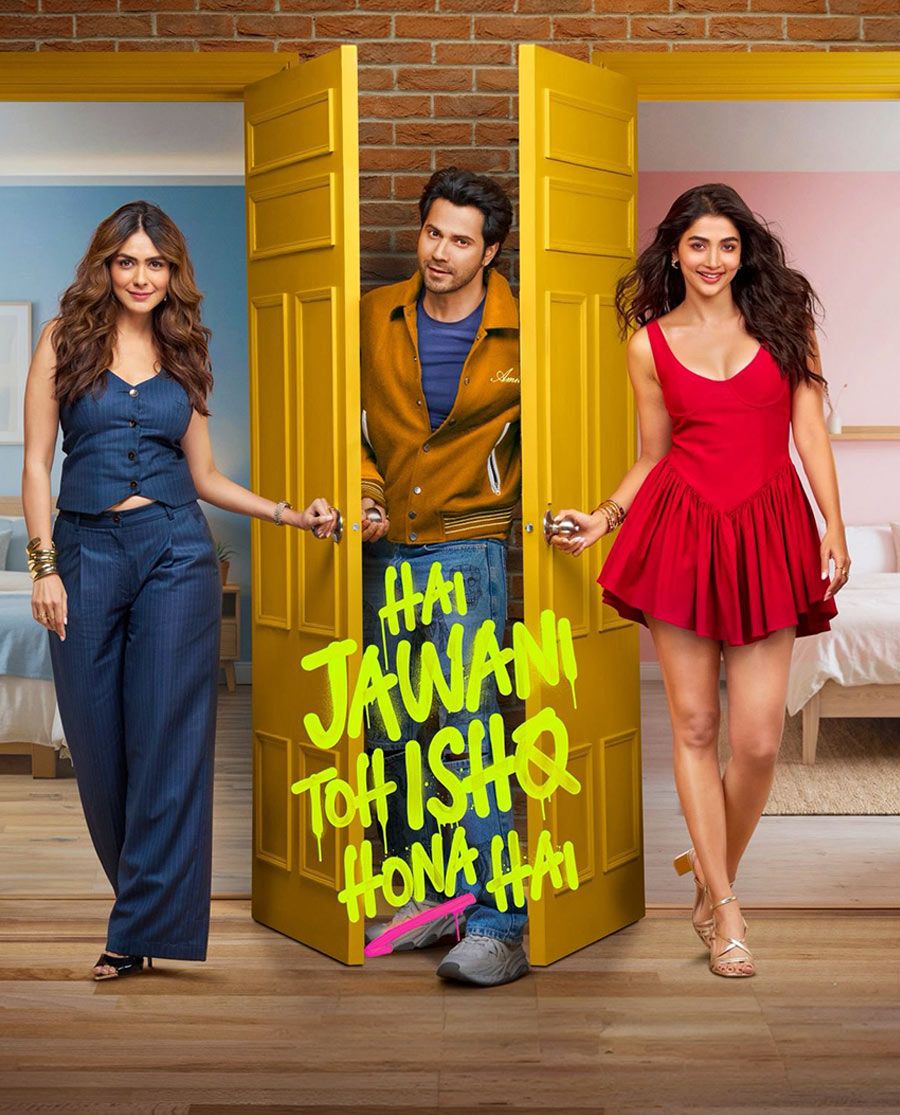
I have finally come to a conclusion after watching the new Hindi film Hai Jawani Toh Ishq Hona Hai that Dhawan’s (not Darwin’s) theory of evolution itself needs to evolve. This theory of pairing a male heartthrob with six packs and two damsels is literally a thing from the 90s with films like Saajan Chale Sasural (1996) and Biwi No.1 (1999), but is somehow reused, reduced, and recycled in a 2026 film. And no, the protagonist Jass (Varun Dhawan) ain’t Captain Planet – just a problematic man-child who wishes to have unprotected s*x with his ambitious wife Baani (Mrunal Thakur), against her wish just so that he could be a father. I mean damn her ambition and play the victim card, hide the fact that you are a s*x-maniac and put all the blame onto the woman. And when she disagrees and asks for a divorce, spend one night under the influence of alcohol, make her pregnant and change her mind, and in the meanwhile, cheat on her with another girl Preet (Pooja Hegde), make her pregnant too – and invariably become a victim of the circumstances. How progressive, how 1999…I mean 2026!
Written by Yunus Sajawal and Farhad Samji (we have nothing in common apart from the first name and an erstwhile show that shares its name with my brand ‘Popcorn’ Reviewss), Hai Jawani Toh Ishq Hona Hai is the kind of film that you get when you ask ChatGPT to reimagine a fresh original story from the original source material of Biwi No.1 and to an extent Garam Masala (2005). In fact, the dish literally served here is ‘water balls with a sourness of tamarind and the sweetness of dates’ at a five star restaurant wherein actually you are consuming ‘Pani Puri’. And for a film that has its brand of comedy stuck in the 90s, this film is nothing short of a nightmare.
There are clearly no rules to the universe – Jass and Baani meet by accident, she bangs his car and punctures his heart only for them to meet at a wedding and be newly-weds after a song and a misunderstanding later. And the Dulhan Hum Le Jayenge (2000) montage immediately felt spoofy in the context of the situation. Years later, she doesn’t want a child but he does – making them opt for a divorce that is more like a ‘break’ from their ongoing relationship. So much for Ross and Rachel to do the same if they were a part of the David Dhawan cinematic universe.
The change in setting from India to UK brings a change in the girl too – with Preet entering the fray (she was kissed…ummm CPRed by the protagonist previously, all in the name of comedy), along with her intimidating brother Randhawa (Jimmy Shergill) and his right hand man (Rajesh Kumar). The next thing you know – both are pregnant by this highly fertile man-child, and suddenly, both want a happy ending. And so what follows is a gag-less immersive headache that had me scratching my head – in passages that felt like an never-ending drills in my brain. Oh so much for my braincells – I owe you my life.
The gags are typically unfunny, which may not have been the worst thing if the proceedings were bearable. But what you get is a deeply sexist film with such ‘pretty’ dumb characters who just couldn’t sniff something fishy. Maybe they were vegetarians? If this lame joke makes you laugh, this film is for you. Or maybe, a dumb doctor who cannot tell a masked version of Jass from the unmasked one. If you giggle while reading this gag, this film is for you. Or even, the idea of the protagonist using his bestie (Maniesh Paul) to act as a gay in order to hide his Mr Hyde identity (why did that rhyme?) from his twin-lovers. Honestly at this point, I was laughing – not at the gags but on myself. Yes, this film has the ability to turn yourself into a joke – more like a boomer uncle who keeps cracking lame jokes just to see your reaction, until you laugh to end the trauma.
The drama still refuses to end while spiralling on the streets of London, with an atrocious version of Chunnari Chunnari. Imagine Indians dancing on the streets in foreign land, while earning a reputation for themselves. You also have an upgraded version of the mother Nirupa Roy (essayed by Mouni Roy), who is injected in the plot as an after-thought – a dancer by profession who later is termed as a gold-digger with a figure. Such nuanced writing, but wait for the peak detailing moment when both the lovers are about to deliver, and the protagonist invariably plays 2 ODIs in a single day.
There was a reason why films of the similar genre worked in the 90s. They may appear to be problematic in hindsight, but there was this unsaid innocence that came across as comedy, without having to justify the actions of the protagonists. But with the onset of social media, you cannot cater to similar sensibilities when everything is dissected. So here, there is an attempt to be progressive out of nowhere (a welcome change from the 90s) but why wouldn’t you fully commit to it? Why was there an attempt at a redemption arc by playing the victim card? Why is there a need for a mindless outro that makes the ‘cheater’ win? Why did the ending seem unfunny? Why are you still reading the review?
The dialogues are ridiculously bad, and that itself is an understatement. Lines like ‘Galgotia University Ke Doctor’ or ‘Tera Hona Laga Hoon’, or ‘I Am A Vegetarian But I Smell Something Fishy’ or ‘A Gold-Digger With A Figure’ are the kind of lines that invariably made me facepalm and cringe in succession. The music is horrible, with one a single song being a standout. Even the renditions of iconic numbers from yesteryear seemed unusually pale – another sign that my childhood is done and dusted. The BGM wishes to accompany every irritating gag with a ‘toing’ sound that amplifies the effect of annoyance.
The cinematography features some eye popping colours including a green car for the perennial red-flag, that invariably does nothing to the drama. The frames feel artificial while lacking any sort of depth, despite having an opportunity to shoot abroad. The gags and the emotions equally fail in a series of frames that feel flat as a pancake. The editing pattern resembles a reel, with every passage cut in isolation to the entire drama. At a point, it literally felt like a collection of gags that are stitched together, without accounting for any sort of continuity or cohesion. As I had said, there are no rules to the universe.
Director David Dhawan in probably his final outing (he is retiring), ends his career on a whimper. For a veteran who was an integral part of my childhood and the laughters that I had shared with friends and family around me, some part of me is heartbroken at the end result of his last few outings including this film. It did feel way underpar, wherein he failed to adapt to the sensibilities of the modern generation, thereby creating a frivolous world filled with sketchy characters. And the filmmaker who was regarded as the King Of Comedy once upon a time, has sadly ended his illustrious career on an unfunny and underwhelming note. I will pause my criticism here in a hope that there is a next time….because the ‘King’ deserves a better farewell!
One of the reasons on why the comedies of this genre had worked two decades ago was due to its performances – be it a Govinda acing his one-liners, or Kader Khan who aced his poker-faced comedy, or even a Shakti Kapoor whose funny antics would bring the hall down with laughter. But when the artist doesn’t fully commit to the histrionics, this is the result. The performances are over the top by every single actor. Talented veteran actors like Manoj Pahwa, Rajpal Yadav, Johnny Lever and Rakesh Bedi are woefully halted here, due to the randomly sketchy characters.
Kubbra Sait and Ali Asgar hardly get a chance to showcase their prowess. Maniesh Paul is irritating as ever with his brand of comedy that skips the heart and directly pierces your brain. Chunky Pandey is the Aakhri-Pasta version of a doctor here, and he barely manages to tickle your funny bone. Mouni Roy is only used as eye-candy, even as the writers apparently introduce her character as an after-thought. Even a supremely talented actor like Rajesh Kumar falls short due to the insipid writing. Jimmy Shergill remains the only actor who seems somewhat in control, in a film that is nothing short of a hot mess.
Pooja Hegde as Preet is alright but there is nothing major that I can say with respect to her performance. Her screen presence is good but the writing never fully allows her character to be layered in any manner. At this point, I feel sorry for someone like Mrunal Thakur who is getting just leftovers in Bollywood. She is a serious talent who isn’t taken seriously, and as a result, this is yet another brain-dead comedy after Son Of Sardaar (2025) that she is a part of. Her performance isn’t bad, but it never fully realises his potential. Varun Dhawan as Jass hams and hams and hams, without any success. The idea of trying too hard to make you laugh – through impersonations, or fake accents, or over-the-top antics isn’t a bright idea if you are NOT Govinda. And unfortunately for Varun, his problematic character is further downgraded to a caricature due to his performance that felt more erratic and unfunny than in control.
Hai Jawani Toh Ishq Hona Hai is an immersive headache caught in the timeloop of the 90s. It is unfunny, and unimaginably irritating that it practically had me singing – ‘Tera Dhyaan Kidhar Hai, Tera Migraine Idhar Hai’. Or even more like ‘Hai Boomer Toh Headache Hona Hai’. Available in a theatre near you.


