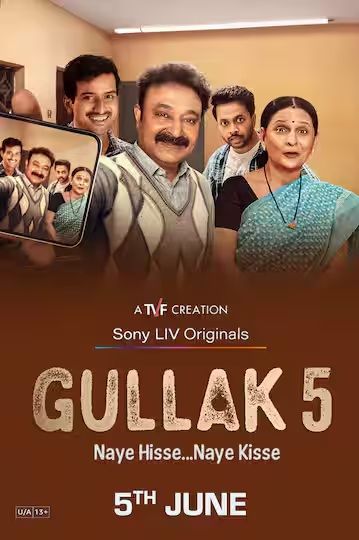

The air of a generational change in the Mishra household, early on in Gullak season 5. The event remains that of a need for a fresh coat of paint to be applied on the walls which are now looking pale, with water seepage running through the cracks. It remains a very specific metaphor keeping the middle-class mentality in mind, who often opt for a change only when it is required. So even when you see the Mishra household cribbing, the change would only be implemented when things are at a tipping point. The same goes for the installation of the new WiFi which would generally be a necessity usually, but the idea has surfaced only because the eldest son Annu (Anant Joshi replacing Vaibhav Raj Gupta) would probably need it for his virtual office meetings. In other words, the change is directly proportional to necessity – even as a quiet inanimate object (read: The Gullak) is witness to the chaos. Its story remains that of a toy that was most loved by children once upon a time, before being restricted to one part of the house. And with the WiFi being installed, its position changes again – almost being equivalent to Woody from Toy Story (1996). This, while the new season of Gullak brings with it, its own set of events in the lives of the Mishra household.
Written by Vidit Tripathi, the fifth season of Gullak has a subtext of a generational shift for the Mishra household amidst the ever-changing landscape of the society. Given that the setting remains that of a small town in the North of India, it also comes with a more traditional mindset with respect to its characters – something that is evident when Shanti (Geetanjali Kulkarni) is acquainted to an exclusive women’s group headed by her neighbour Bittu Ki Mummy (Sunita Rajwar), who likes to pick on petty subjects to fuel the argument of women’s rights. She is eager to have Shanti with her, and in the process use her household to make videos. She is nosy and intruding, but also tapping into the trait of Shanti who just cannot say no.
The generational shift along with the subtext of financial crisis is also in play with respect to the other characters – the youngest son Aman (Harsh Mayar) has quietly made a living through an unethical path of astrology, wherein he tries predicting the future of his clients in a rather shady manner. Elsewhere, Annu is on the verge of a promotion, continuing his work as a medical representative, while harbouring feelings for a local dentist Priti (Helly Shah) and trying to woo a neighbouring doctor Prithvi (Siddhaarth Mishra) for business. It is a clear shift in his dynamic that points towards an independent future, as opposed to relying on his parents’ income to survive.
The emotional hinge in the drama comes in the form of Santosh (Jameel Khan) – the patriarch of the family who continues to strive and work in order to secure the future of his family. You understand the subtext of the character during his quiet interactions with Shanti at night – wherein both characters after slogging for most parts of their day, quietly sit and discuss the future of their children. In a heartfelt moment, you see Shanti telling her husband on how the new women in the household (the future wives of their children) won’t like to stay in a joint family, thereby prompting her husband to ponder on the thought of purchasing a new home, even at the cost of a home loan.
The mood remains light and frothy, while significantly underplaying events with subtle bouts of humour. Be it the introduction of a new character Pinky Mama (Gopal Datt) who probably shares a dynamic similar to Sundar from Taarak Mehta Ka Oolta Chashma, when it comes to Santosh. The entire ‘paneer’ sequence remained ticklish, something that cracked me up to bits. Or even the sequence involving the attempt of Annu to woo Priti by arranging a dental camp for her, or even opting to take his brother to her for a dental checkup. Or the sequence involving Aman whose gets kidnapped due to his astrology skills, only for him to play a uno-reverse card before the skeletons tumble out of the closet. <span;>On a side note, the contrasting patterns of ‘sorry’ that forms a subplot of the show makes for a nice little heartfelt moment with subtle bouts of humour – signalling and enhancing the plight of the characters in contrasting situations.
The writing also ably focuses on the interpersonal dynamic between the characters, along with focusing on their own internal conflicts. For instance, there continues to remain a communication barrier between Annu and Santosh – wherein the former can’t quite communicate on his idea of wanting to live separately. Or even that he doesn’t wish to work but instead start his own venture (so bloody relatable). Even from the POV of Santosh, he hesitates to ask for help with regards to the home loan – eventually wanting Annu to be his partner in it. The internal conflict also holds true for Shanti who doesn’t wish to sell her ancestral property – a house that holds her childhood memories, but eventually takes the decision to counter the financial crisis of her family.
My only real criticism about the show lay in its familiarity, a trait that was once its biggest strength but is now slowly beginning to wear out its paint – much like the walls of the Mishra household. The low stakes narrative is a crowd-pleaser yes, but it also fuels the predictability of the drama into creating situations that would often resemble each other. This is not to say that the makers could try doing something different altogether, but smaller forms of reinvention may not be such a bad idea. The idea is to keep the interests piqued without getting too familiar with the writing. The smaller element of surprise won’t be such a bad thing going forward. But overall, I still liked the writing here which is simplistic and heartfelt.
The dialogues are witty with the one-liners but the deeper you go with the lines, the more you realise that there are some beautiful emotions to be discovered along the way. The life-lessons inculcated in the narrative while accounting for a strong emotional core remains the highlight of the show. The music and BGM compliment the screenplay nicely as well while enhancing the emotional quotient of the drama at multiple junctures. And the title track continues to remain a winner – so hummable still!
The cinematography is simplistic with its framing, and that automatically helps you invest in the individual journeys of the characters. The lighting resonates with the frothy mood of the narrative, with shades of darkness engulfing the narrative to signal a deep-dive into the emotional core of the characters. And the frames continuously represent the plight of the characters, that would invariably put a smile on your face. The editing pattern is crisp and sharp while deliberately being episodic and traversing from one event to another. But in doing so, it doesn’t compromise on the a strong emotional core that forms a searing connective thread in the narrative.
Directors Abhay Raut and Shreyansh Pandey manage to continue the simplicity of the show, while focusing on smaller everyday arcs of the characters. They manage to maintain the mood of the drama really well, while keeping things relatable and familiar (at times, a little too familiar but it still works). The direction is really good here and puts a smile on your face by creating beautiful moments throughout the narrative.
The performances are excellent by the ensemble cast. Spriha Chandra as Vani has a good screen presence, and she remains very well restrained. Rahul Tewari as Madhav has an incredible flair for comedy, and he manages to effortlessly tickle your funny bone. Ankit Motghare as Chandan, Aashish Bhatt as Negi, and Jay Thakker as Suryanarayan aka Sunny are wonderful performers who lend dependable support in a job well done. Manuj Sharma as Shashi and Siddhaarth Mishra as Dr Prithvi remain obstacles in the life of Annu, and both manage to leave a lasting impression. Gopal Datt as Pinky Mama is hilarious to the core even while ably balancing his humour with moments of poignancy and grey shades.
Sunita Rajwar as Bittu ki mummy is such a natural onscreen and her comic timing will often make you chuckle. You see a slightly softer side to her persona in glimpses, making me believe on how she is fighting her own insecurities while putting on a facade of annoyance. She was a treat to witness here. Shivankit Singh Parihar as the voice of Gullak is heartwarming as always. Helly Shah as Dr. Priti has a warm presence onscreen, and she remains sincere and earnest despite the thriving influence of patriarchy around her.
The Mishra family won’t be what it is without the presence of four wonderful actors. Harsh Mayar as Aman is phenomenal with a hint of playful energy and a subtle rebellious nature that makes for a commendable act. And his comic timing is superb to witness here. Anant V Joshi as Annu is outstanding to witness here, having a chirpy demeanor as an exterior while harbouring a storm of emotions within. This balance was crucial for his character, and he is terrific to witness here. And the fact that he had some big shows to fill given that he came in as a replacement for another actor – makes this performance even better to witness.
Geetanjali Kulkarni as Shanti Mishra aka the mother of the household delivers a dual performance that is hard on the exterior but almost molten with emotions underneath. She uses her expressions and body language to convey her vulnerability, making her performance, a treat to watch throughout the show. Jameel Khan as Santosh aka the patriarch of the family is in top form here. His characterization was such that he worried about his children’s future but couldn’t quite break the barriers of his established relationship of the father – while fighting a lone battle of opting for a loan and continuing his government job in a restrained manner. And these conflicting and simmering emotions were just so beautiful to witness in a phenomenal act of the highest order.
Despite its familiarity, the fifth season of Gullak features the chronicles of warmth and emotions in a typical middle-class household. And with solid performances, this makes for a wonderfully relatable watch despite its familiarity. Available on SonyLiv.