

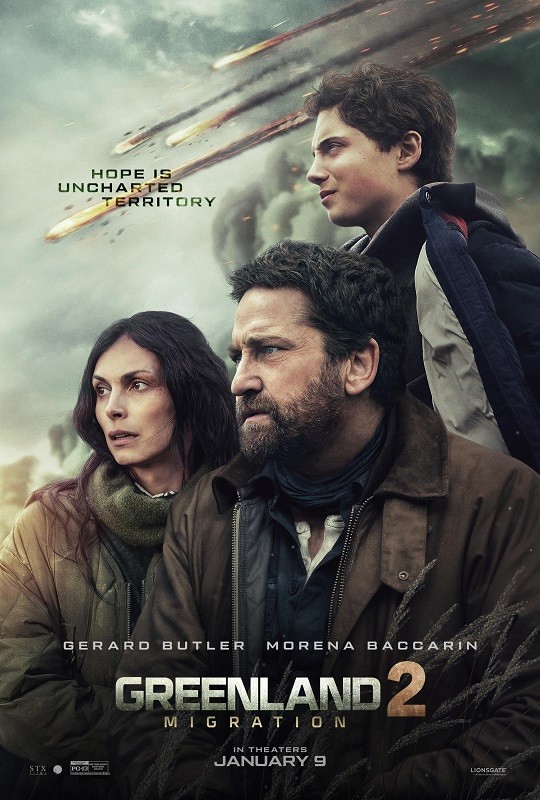
One of the few things that instantly works for Greenland 2: Migration – a sequel to the 2020 film Greenland, is the real time progression of the drama. So after the Clarke comet that ‘nearly’ destroyed half of humanity in the first part, the drama opens on a bunker in Greenland, housing most of the principal characters here. The time gap between the two films is warranted for – John (Gerard Butler) works as an engineering scout, finding ways for the group to migrate back to the surface, his wife Allison (Morena Baccarin) finds herself in the leadership group taking care of the diminishing resources of the group, and his son Nathan (Roman Griffin Davis) is all grown-up while getting used to studying in bunkers. And yet as the story unfolds, you kind of wish to question the purpose of the film, given how the first Greenland had met with a decent enough conclusion on its own – the comet had struck the earth while a handful had survived to fight another day. And this remains the sole issue of the drama in terms of the foundation that it has to offer all over again – it just feels needless and less effective this time.
Written by Chris Sparling and Michael LaFortune, the core differentiator between Greenland 1 and 2 remains the emotional core. While the first film had a relatively deeper emotional core with respect to its characters – something that papered over the convenience of the plot, Greenland 2 lets go off its emotional core to instead trade it with a survival thriller. And herein lies the flaw – it offers nothing new to the post-apocalyptic world that we have previously seen as late as this week’s 28 Years Later: The Bone Temple. The early impression of this survival thriller is that it remains generic – even with the techtonic chaos and the electromagnetic storms that cause an early dent to the group, in the film. In the first film, such occurences were only used in the backdrop, allowing the family dynamics to take center-stage. But here, that again was not the case.
Despite a runtime of about 90 odd minutes, I found myself increasingly disconnected with the characters even during their hustle to escape the bunkers during an early incision, that saw John and his family barely surviving with a handful of people. It remained a weird sort of a roadtrip that wished to go from point A to point B with the characters – with point B being the exact crater formed by the impact of the Clarke comet in Southern France, that was rumoured to bring a new lease of life to humanity. That itself felt like a convenient resolution that felt simplistic after all the mayhem that occured in the first part, nullying the edginess of the drama.
The events too feel uneventful – hardly warranting the adrenaline rush you would expect from a survival thriller. Remember how each of the family members of John had separated at one instance in the first film? That dynamic remains unexplored given how they are always together through their journey. Even Nathan’s diabetic angle from the first film is conveniently sidelined here. As a result of which the stakes in the drama are never high enough for you to care – even as you are witness to a sudden explosion during the middle of the field, or superficially curated heartfelt events of humanity being alive.
The angle that seemed interesting was the conflict of humanity in their bid to survive, often allowing greed and helplessness to rule their violent streaks. And yet, these instances are abrupt and don’t really come together – even wherein John and his family are greeted with gunshots in England, or a group of robbers attacking the family. Even the moments of adventure feel insipid – like the characters having to cross a narrow ropeway across the English channel, or a heartfelt French family welcoming John and his family out of nowhere. The spunk was just missing, particularly given the low stakes and the lack of emotions in the drama, so much so that you don’t quite feel the rush of a survival drama even towards the end, despite a seemingly distant tragedy that becomes a reality. It all felt too manipulative and convenient in terms of the writing and staging, and despite a heartfelt and relevant message at the end, there was barely anything to write home about. It all but felt pointless and tactfully curated.
The dialogues barring the outro monologue, are bland while lacking the intensity in the drama. The BGM is barely memorable, doing nothing to elevate the impact of various scenes. The visuals and the VFX range from being commendable to tacky, even as the frames refuse to form an emotional connect with its characters. The editing pattern does well to keep the length of the drama in check, but given the no-show of the writing, there are passages of lags in the narrative that invariably still find a place here.
Director Ric Roman Waugh has nothing new to offer here, while steering away from all the elements that had clicked from the first film. Neither does the world building impress here nor do the new characters who literally come and go here. There were even staging issues sprinkled throughout the narrative that made this drama look rather amateurish, almost like a student film. And that remains a red tick mark in the report card of the director.
The performances are decent by the members of the cast, although none of the actors own the arena here. Amber Rose Revah as Dr Amina, Nelia Valery Da Costa as Camille, Peter Polycarpou as Dr Haugen and Trond Fausa Aurvag as Lars are alright but the writing lets each of these characters down. Roman Griffin Davis as Nathan hardly has an impact here, mostly reduced to a member of the travelling group. Morena Baccarin as Allison does a pretty good job here, maintaining the urgency of her character through her mannerisms, and scoring brownie points with her screen presence. Gerard Butler as John is fairly decent too, scoring in moments of combat but stuttering in quieter moments. His limited ability is on full display here, given how his expressions don’t really convey the wrath and pain of his character. He was strictly decent here.
Greenland 2: Migration is a fan-fiction school project veiled as an insipid survival thriller in a sequel that remains rather pointless. The drama here is meh…just meh! Available in a theatre near you.