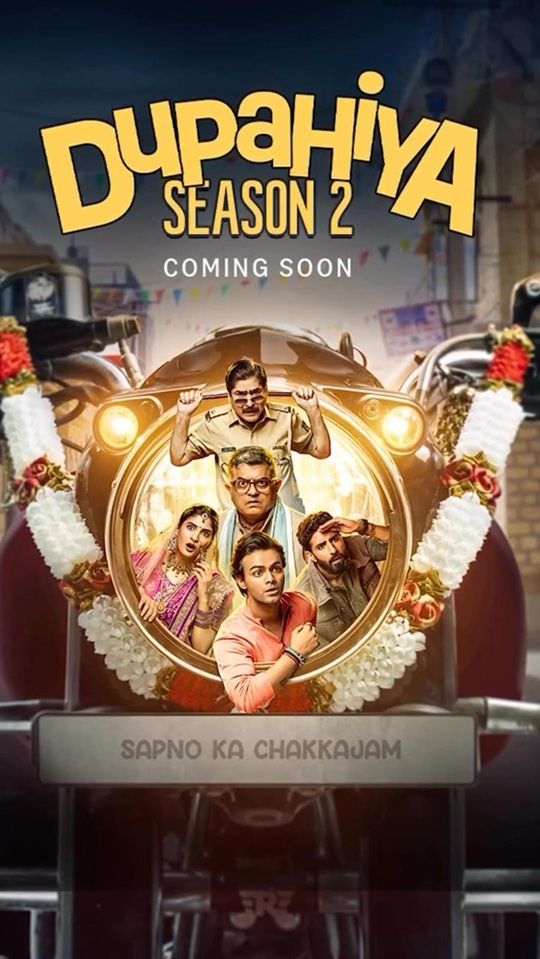

The second season of Dupahiya immediately begins with the repercussions wherein a heroic end of the previous season, is met with hardships to kickstart the new season. It all begins with Roshni (Shivani Raghuvanshi) who has had a heroic monologue of female empowerment – promising to choose independence over a dowry request, in addition to her ability to pass a government exam and make a living as an established officer. The repercussion is that she isn’t as intelligent in reality to even compete in her exams. On the other hand, her father Banwari (Gajraj Rao) has lost his government teaching job after the wedding fiasco, only to pin all his hopes on his daughter to succeed – often struggling to make ends meet with the finances of the family. This, even as Roshni’s brother Bhugol (Sparsh Srivastava) still craves for internet virality, whilst having to make a living through the dance of femininity, all while aspiring to make a living as an actor in the city of Mumbai. There is a searing social conflict mixed in a personal commentary on ‘want’ tagged to every character here – each of them tied by their actions of the past.
Written by Chirag Garg and Avinash Dwivedi, there is a definite topical upgrade on paper, as far as the second season of the Hindi show Dupahiya is concerned. The broader issue of a missing motorcycle is replaced by a graver issue of paper leak – the latter triggering a humongous student movement in the country, a couple of months back. But in this world, it is Roshni who reluctantly reaches out to her perennial crush Amavas (Bhuvan Arora) to explore a way of her scoring well in her exams. It is here that the arc of Roshni remains fractured – having claimed her independence at her wedding, while silently withdrawing her notion, to the extent of desperation.
The light-hearted proceedings contribute to some light-hearted conflicts too. Be it Bhugol’s new found faith in helping a woman out unconditionally, all in order to break the curse of having to restrict his ‘virality’ under the shadow of femininity. This causes him to support his sister in her quest to secure the ‘leaked’ exam paper. This coincides with the financial glimmer for Banwari, whose land is chosen for a mobile tower to be erected in exchange for a monthly sum of money, much to the dismay of the villagers who oppose it due to a wildly hilarious rumour on phone waves causing sterility in males. The political subtext writes a joke on itself here, even as the local Sarpanch Pushpalata (Renuka Shahane) chooses to join hands with the villagers against Banwari to protect her vote bank.
One of the issues that I had with the writing was with regards to its structure, particularly given how it never quite found a balance between a frivolous comedy and a profound satire. The comedy isn’t very spritely, and the sature isn’t very sharp – often contradicting with one another, as opposed to seamlessly blending itself with the narrative. This includes a subplot involving Pratham Kumar (Dinesh Lal Yadav aka Nirahua), the head of the coaching center involved in the paper leaks scam, that threatened to be interesting before being cut through with a plot point involving the tactics applied by Banwari to manipulate and forge the signatures of the villagers to get a ‘green signal’ for the mobile tower. Each sequence had the potential to thrive in its own capacity, but the mishmash of low-stakes comedy with a topical satire flattened the impact of the drama.
Unlike the first season that largely centered around the missing motorcycle (further being layered by the relevant social commentary in the mix), the proceedings also suffered from a crowded narrative of sorts, often thriving on momentous dynamics between characters as opposed to building on their individual character traits. For instance, the bearing of a brewing dynamic between Sheetal (Suryansh Mishra), the employee of the mobile company tasked with the chore of the logistics around the tower, and Nirmal (Komal Kushwaha), the daughter of the Sarpanch – and their supposedly cutsie love triangle with a third wheel Teepu (Samarth Mahor), was just intended for laughs; whilst completely steering my focus away from the paper leaks issue. An alternate issue remained on how a few characters felt slightly underwritten, and as a result restricted to moments of isolation. <span;>For instance, a sequence involving a group of wrestlers backing Banwari, or a gun-totting Pushpalata uno-reversing the ongoing power-tussle felt a tad too frivolous for my liking. Ironically, the comedy is low-key too, almost a condiment to the main course, but never a main course itself.
The real deal for me was the topical issue of paper leaks, often pursued by the cop Mithilesh (Yashpal Sharma) – particularly given how the commentary itself subverted in a world of police hierarchy including a streak of politics, something that he had to contend with. And yet, some of the fun bits in the narrative are centered around the ‘arrest’ that non-chalantly elevates a cat-and-mouse chase, leading to scattered laughs and a couple of bumpy but heartfelt character transformations. This, followed by a repulsive nostalgic reintroduction of a specific character from the ‘past’ that adds to the humour mounted on a past frivolous dynamic.
However, the ghosts of convenience return to haunt the drama in its final act. The ‘heist’ angle may have been dipped in a sea of satire, but the writing isn’t half as serious in addressing a pertinent issue – touching upon elements of suicide, or a potential medical disaster almost in isolation, before quickly pivoting to a template chase. The heist itself isn’t as entertaining – ranging from an indoor sequence of trapping the culprit before transitioning into a fairly hilarious car chase that ends in a damp squib, further lowering the impact of the proceedings with cliched seeds of convenience – the one wherein the solution is largely binary and not quite convincing. And despite the late emotional streak to cap the narrative (a prickly father-son dynamic that finally completes a searing arc), I couldn’t quite shrug off the emptiness in tackling a rather pertinent issue that has plagued the nation for years. And that sums up the screenplay that had its moments to shine but is letdown by dragging bouts of convenience.
The dialogues add wonderful texture to proceedings while incorporating a layer of authenticity to the drama, through the dialect. This, even as the lines felt like a significant downgrade in terms of humour as compared to the first season. The music and BGM are light and frothy, while tapping into the earthiness of the setting. And while the earthy notes also contribute to the fabric of storytelling by enhancing the impact of a handful of scenes, the desperate use of the score doesn’t quite elevate the gags in the narrative this time around.
The cinematography comprises of frames that often steer clear of tapping into the emotional psyche of the characters, something that is overshadowed by the gags in the narrative, scarcely deprived of humour. This, even as the village of Dhadakpur did not play a significant character, unlike that in the first season – wherein it boasted of a texture of its own. The editing pattern suffers in the middle act, wherein the meandering lags needed to be ironed out for a crisper watch. This, even as the editing pattern doesn’t quite find the right balance between a palpable comedy, and a profound satire – diluting the impact of both, at various stages in the narrative.
Director Sonam Nair has a mixed outing this time around. On one hand, she masterfully retains the eccentric charm, warmth, and grounded satirical tone of Dhadakpur, crafting a handful of highly engaging individual character moments. However, the season stumbles due to an overly ambitious scope; unlike the streamlined narrative of the first season, this chapter attempts to juggle too many concurrent storylines at once – spanning a mobile tower conflict, viral influencer fame, and an intense exam paper-leak scam. This narrative overcrowding results in uneven pacing and occasional lapses in storytelling focus, making the overall directorial execution a somewhat bumpy, yet fairly watchable, ride.
The performances are pretty solid by the members of the cast, even though the identity of a few characters remains slightly compromised by the writing. Bhaskar Jha as Deendayal, the goody police aide of Mithilesh is wonderful to witness with a streak of humour that had me giggling at various instances. Chandan Kumar as Madan, Neeraj Sood as DSP, and Manoj Singh Tiger as Ghuttan are commendable with their performances. Anjuman Saxena as the mother Roshni and Bhugol is sincere and earnest even as her silence speaks volumes of the unsaid patriarchy that she has to deal with.
Samarth Mahor as Teepu is an affable character who forms an uncanny dynamic with both Bhugol and Nirmal at different junctures in the screenplay. While he remains goofy, there is an endearing heartfelt quality that allows his character to land well (despite not fully having enough to contribute to the main plot, this time around). Suryansh Mishra as Sheetal is sincere while putting forth a solid little act as the representative of the ambitious mobile company tasked with setting up the mobile tower. There is a pleasant synergy that he brings to his performance that is palpably earnest in many ways. Komal Kushwahaa as Nirmal is pretty good here, despite the writing failing to provide a substantial arc to her character. The significance of the character in the narrative is slightly underpar this time around, but Komal still manages to impress.
Renuka Shahane commands the screen with immense grace and dominance whenever she appears the village Sarpanch, Pushpalata Yadav, her character is unfortunately sidelined this season. The writing shifts its focus heavily toward the external mobile tower panic and the examination scam, leaving her with far less screen time and material to dig into compared to her central role in the initial season. Despite being pushed to the periphery of the main plot, she delivers a characteristically solid and authoritative performance, commanding absolute attention in the few pivotal village meetings she oversees.
Yashpal Sharma as Mithilesh remains one of the moralistic amchors in the narrative. Tasked with investigating the paper leaks issue, he finds himself constantly fighting up against highly connected culprits and the sheer administrative inertia from above. He handles this heavier arc with absolute sincerity, presenting a law enforcement official whose earnest dedication to duty offers a brilliant, grounded contrast to the surrounding hysteria of Dhadakpur. His performance provides a much-needed emotional and narrative weight, which was a joy to witness here.
Avinash Dwivedi brings a wonderfully arrogant energy back to the ensemble as Kuber Tripathi, the jilted groom who remains a thorn in the Jha family’s side. He excels at playing this deeply materialistic, swaggering character, infusing him with just the right amount of small-town elitism. Dinesh Lal Yadav aka Nirahua as Pratham Kumar excels as the smooth-talking mastermind behind the local competitive exam paper leak operation. Utilizing sharp body language and effortless deadpan line delivery, he injects a solid dose or synergy to the proceedings.
Gajraj Rao delivers a brilliantly layered performance as the family patriarch, Banwari Jha, whose seemingly useless land becomes the epicenter of village hysteria when it is chosen for a mobile tower installation. He masterfully handles a character operating in gray moral areas, all due to a financial thread attached to his family. Despite Banwari’s flaws, he injects the character with such earnest, small-town desperation that made parts watchable, even when the humour inherently dried up. His quiet, dramatic restraint in a standout father-son scene hit home against the tide!
Bhuvan Arora brings a brooding, macho charm to Amavas, who remains deeply in love with Roshni but feels unworthy of her. He captures the desperation of a jilted lover trying to win love through questionable shortcuts, leading Roshni straight into the dangerous world of paper-leak operators. He plays the role with a perfect blend of rough exterior and soft-hearted loyalty, leaving a lasting impression on viewers.
Shivani Raghuvanshi as Roshni Jha with an admirable fire, capturing the frantic desperation of a young woman racing against a seven-day clock to clear her SSC examinations and claim her independence. She carries her character’s evolution rather well (despite a slightly jarring transformation), shifting Roshni from a pressured student contemplating a quick fix into an ethical compass who stands up against a massive competitive exam scam. Her expressive, sharp reactions add a layer of authenticity to the show’s lighthearted universe.
Sparsh Shrivastava as Bhugol masterfully balances the character’s internal conflict as a young man who desperately wants to escape his viral internet identity as a female influencer to pursue an acting career in Mumbai. He infuses his character with a sensitive, empathetic depth, transitioning flawlessly from riotous physical comedy to raw vulnerability. His performance truly peaks in his emotionally charged scenes opposite Gajraj Rao, where his bravado crumbles in the face of paternal rejection, and in his deeply believable sibling dynamic with Roshni.
Despite commendable performances from its cast, the second season of Dupahiya partially flattens out in its execution, struggling to strike a harmonious balance between riotous comedy and profound satire. While the writing remains commendably topical, the narrative is frequently diluted by convenient plot points and a crowded, unfocused series of events. This structural imbalance causes the show’s signature humour to noticeably dry up in the second half, with its once-witty set-pieces routinely giving way to forced jokes. The lack of momentum extends all the way to the climax, where a highly clichéd resolution undercuts the story’s stakes, even as the overall emotional beats remain noticeably under-par and scattered throughout the show. Consequently, these narrative missteps partially blunt the impact of the drama, causing a promising season to fall short of its true potential. Available on Amazon Prime Video.