

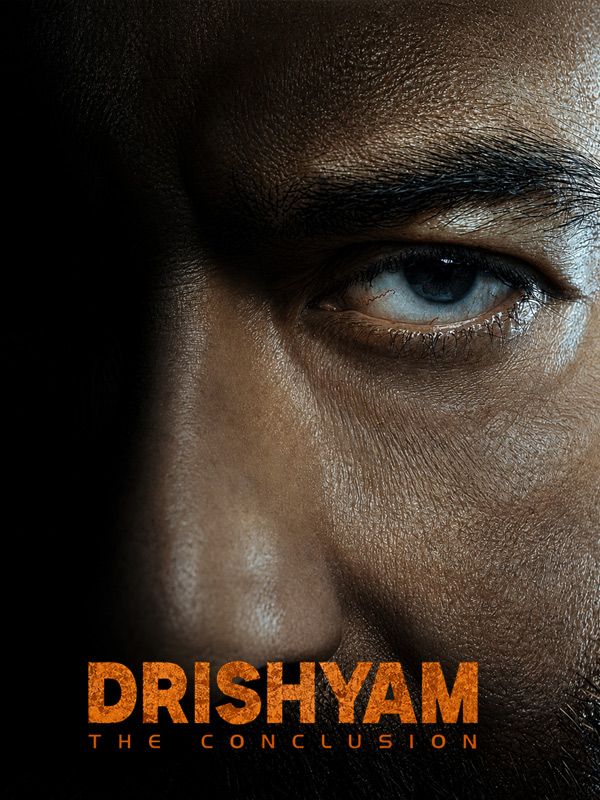
One of the biggest criticisms that I had with the third installment of the Malayalam Drishyam was its narrative structure. The meandering beats of the narrative had put a lot of pressure on the final twist for the entire film to work. And I must admit that my red flags were up for the Hindi version, despite the makers explicitly mentioning that Drishyam The Conclusion would be an original film. I mean think about it – how ‘original’ can the story actually be when it is already two films old. The idea of a gimmicky twist veiling as a shocking Uno-Reverse card, might be unforeseen the first time, lucky in its second outing, but a predictable template of its own in its third. Yet even in that space, there is a lot of things that the latest concluding Hindi film of the iconic Drishyam franchise, does right – a film that is comfortable in its own skin. The drama runs thin (deliberately so unlike its Malayalam counterpart), the thrilling beats remain consistently spread out, the fatigue remains explicitly written in the narrative, and the gotcha-twist isn’t overbearing or even built around the idea of wanting to shock (and impress) the viewers. The writing remains self-aware through and through.
Written by Abhishek Pathak, Aamil Keeyan Khan, and Parveez Shaikh, the repetitive nature of the plot is refreshingly addressed through certain sequences in the narrative. Even after Vijay Salgaonkar (Ajay Devgn), the now-famous citizen of Goa has successfully kept the cops at bay, the self-indulgent humour is addressed through the introduction of the infamous cop Gaitonde (Kamlesh Sawant), certifyingly boasting of how he remains the last cop standing in his fight versus the Salgaonkars, even as his bosses keep changing. He further goes onto hint at a meta-humour of the internet, who prioritize the Pav Bhaji ‘may-mays’ (memes) over Mahatma Gandhi. Clearly, the definition of truth has been skewed from the times of Bapu. He even goes onto compare the protagonist with his nagging wife, creating a parallel on how both of them have individually created havoc in his life – so much so that he has become increasingly frustrated over the years. The subtext remains similar to a face-off between Coyote and The RoadRunner – wherein the latter always pips the former in a hilarious exchange of events. Just that the humour here is catered to the palate of viewers, rather than the characters of this world – a strong reason why it works in the first place.
The writing is also self-aware to introduce the emotional beats of the narrative early on, with the reintroduction of victims of the crime, the parents of Sam – ex-cop Meera (Tabu), and her husband Mahesh (Rajat Kapoor). In an early scene, you sense the vulnerability of Meera who wishes to end her life, prompting her husband to hustle in reopening his son’s case. The same angle was inexplicitly showcased as a forced twist in the Malayalam film, something that just didn’t stick. But the writers here wish to keep all their cards on the table, atleast the ones that are pretty obvious and crucial to the emotional beats of the narrative.
The early proceedings are also quick to remind the viewers of the ‘reason’ of the ongoing, and a fresh bout of the cat-and-mouse chase – something that is easy to forget in the chaos of the Drishyam franchise. In the words of the new entrant in the form of a ruthless top cop Rajveer Singh Tomar (Jaideep Ahlawat), he compares the events of the world to a deer running from its predator, emphasizing the fact that after a point, even the prey is unaware of why it is running in the first place. This anecdote also doubles up as a self-aware spree in a narrative that is essentially built around the cat-and-mouse template. In the same breath, he also reminds the characters of a fresh bout of evidence based on a DNA test, that would ideally have been the logical next step in the first place – a pretty strong counter to the obvious pieces of evidence that remain untapped and ‘buried’.
I liked how the tension in the form of vital beats is consistently spread throughout the narrative. You do have the regular low-key plot-points – be it a fleeting reference to a land issue, or a mysterious phone call, or a discreet grave, all of which would circle back as vital call backs in the narrative. You also have two naive and understated alibis, being the center of an investigation brewing; something that results in a compelling cat-and-mouse chase. There is also a reference to the ghost of the past featuring another body, another date on the lines of 2nd October in question, and a cocky lawyer namely Indrajith (Prakash Raj) who doubles up as a formidable opponent to the more sincere but fiery defence lawyer Gayatri (Samvedna Suwalka). In between, there is a searing face-off between the Salgaonkars and Rajveer, the latter doubling up as an angel of death – except that he is on the right side of the law.
One of the reasons why you as a viewer are invested in the emotional beats of the Salgaonkar family, isn’t because of their crime that felt sensationalized – but more so because of how the court would only perceive their actions in black and white. The law wouldn’t note the evil advances of Sam, or even consider the burden of truth concealed by the family, almost viewing their crime in isolation. But from the protagonist’s POV – the idea always remains to protect the family, a trait that minutely threatens to transform his inherent characteristic at one point in the narrative. And I am glad that the writers did not take that bait of transforming the protagonist into a vigilante, making the protagonist consistently someone that one would root for.
This ‘defiance’ also makes the protagonist an underdog caught in not only a legal battle with his counterparts, but also a battle of ego. Remember, he is a fourth-grade failure, as opposed to the highly educated folks around him, who just can’t get the better of him. This underdog persona mounting his intellect on films, and overpowering the intellect of the characters around him in a compelling cat-and-mouse chase is what makes Drishyam exciting here.
As a viewer, I knew what was coming my way. I just needed to know how. And this little bit also acts as a slightly more negative merit of the drama; not because the reverse engineered twists in the final act are less impactful. But because I was immune to the ‘Drishyam’ template coined after the franchise, wherein I knew what to expect. As a result, the highs didn’t touch the skyscraping ones of the first two Drishyam films. But at the same time, I couldn’t say that I didn’t enjoy it – I did! And effectively circling back on the point, that the screenplay wasn’t designed around the intercutting ‘twists’ at the end. It wasn’t meant to shock or impress the viewers. It just very much defined the world of Drishyam, and sometimes that is all you need.
The dialogues are intellectually stimulating without taking the intellect of the viewers for granted. The BGM comprises of notes that are constantly ticking like a timebomb, so much so that it doesn’t allow you any respite in the form of a narrative dip in the drama. Ironically, the score also blares away unnecessarily during a revelation sequence that overpowered the emotional intelligence of the moment, transforming it into a stylized montage more than a tactful antic of the protagonist.
The cinematography comprises of frames that effectively create a gritty atmosphere through the grey hues that symbolize the greyness of the world. This, while also utilizing external factors like rain to build up the levels of tension in the narrative. The tight-frames are effective in tapping into the psyche of the characters, allowing a fleeting glimpse into their minds – something that helps in creating an intellectual cusion on which the narrative is mounted. The editing pattern infuses meticulous cuts in order to shepherd the narrative ahead, without allowing it to be bogged downat any given point. The trademark intercutting narrative style at the end, marks an interesting harmony between the courtroom scenes and the ultimate revelation, something that effectively cut through the predictability of the drama.
Director Abhishek Pathak steers his world with a sharp, calculated precision, consciously keeping the entire proceeding intensely cerebral. He treats the narrative as a high-stakes chess match where every move is dictated by sheer mental endurance and strategic restraint. He masterfully balances this tension by effectively indulging in self-aware humor, while ensuring that the script never breaks character or dilutes the high-wire gravity of Vijay Salgaonkar’s desperate situation. As a result, the drama ends up being gripping, visceral and cerebral in many ways, something that stands firmly on its own merit. The direction is pretty impressive here.
The performances are impeccable by the members of the cast. Saurabh Shukla, Aarti Desai as the head of the medical institute, Neha Joshi as SI Jenny, and Nishant Singh as SI Shiv have their moments to shine, particularly in the final act. Sanjay Dadhich as Paolo is an absolute treat to witness, transforming his raw intensity into subtle bouts of humour. Samvedna Suwalka as Gayatri has a resounding presence onscreen, matching the beats of a veteran like Prakash Raj in courtroom scenes, while holding her own ground with grace and flair. Rajat Kapoor as Mahesh and Tabu as Meera remain dignified and restrained, while deftly showcasing their vulnerability that is subverted in a battle of wits with the protagonist. Ajeet Singh Palawat as the security guard, and Ramchandra Singh as Savio offer varied degrees of naivety and sincerity through the different shades of their characters. And ironically, the streaks of humour and thrills are individually accounted for respectively in their wonderfully curated performances.
Ishita Dutta as Anju and Mrunal Jadhav as Anu are slightly sidelined by the writing here, even though their screen presence wonderfully acts as a connecting tissue in the narrative. Prakash Raj injects a fresh, electric energy into the thriller by playing the part of Lawyer Indrajith Shetty with a delicious, over-the-artistic cockiness. His character breezes through legal corridors with the smug confidence of a man who believes he is intellectually superior to everyone in the room. He masterfully uses an assertive vocal cadence, patronising smiles, and an expansive physical presence to create a persona who is as deeply entertaining as he is genuinely threatening (a callback to Jaikant Shikre from Singham). This calculated bravado acts as a perfect foil to Vijay’s quiet desperation, elevating their courtroom and interrogation face-offs into thrilling chess matches.
Shriya Saran as Nandini has an interesting character here, weaponizing her hesitation to ultimately land one of the unexpected twists of the film. While her character’s actions remain tethered to the defensive perimeter constructed by her husband, she infuses her limited screen time with an evocative, raw vulnerability that is later laced with a late twist. And she was a delight to witness here.
Kamlesh Sawant as Gaitonde returns to deliver an impactful performance that benefits tremendously from his character’s unique, self-aware humor. Haunted by the ghosts of his past failures against the Salgaonkars, he balances his character’s underlying bitterness with a wry, dark sense of irony about his own historical incompetence. His performance successfully subverts the typical corrupt cop archetype by acknowledging his past mistakes with humorous, self-deprecating wit.
Jaideep Ahlawat is absolutely formidable as Rajveer Singh Tomar, the sharp Crime Branch officer determined to crack the Salgaonkar case once and for all. He plays the investigator with a cold, relentless intensity that avoids predictable, loud policing tropes in favor of predatory patience. His piercing, unblinking gaze and heavy, calculating physical stance make him look like an immovable force targeting an unshakeable object. Every scene he shares with the protagonist is charged with a quiet, menacing volatility, as he brilliantly showcases the single-minded focus of a hunter who knows he is finally closing in on his prey.
Ajay Devgn anchors the drama with a remarkably minimalistic portrayal that relies almost entirely on subtle shifts in his body language and expressions. As Vijay Salgaonkar, he opts for a deeply understated presence, channeling the intense psychological toll of keeping his family’s secret safe for years. Instead of relying on explosive dialogue or overt histrionics, he lets his tired posture and the micro-expressions of panic behind his stoic eyes convey his character’s profound inner turmoil. This calculated restraint creates a twisted magnetic center for the narrative, turning every silent twitch and deliberate breath into a masterclass in tension. As a result, every shift of expressions is a plot reveal by itself – wherein his mannerisms and death stares elevate the impact of the drama here.
Drishyam The Conclusion serves as a fitting finale to the Hindi franchise, delivering a visceral and intellectually stimulating crime thriller driven by powerhouse performances. The screenplay’s ultimate achievement lies in its ability to deeply engage an audience already well-versed in the series’ formula, transforming an established template into an unpredictable, high-stakes game. In a rare turn of events for a franchise built on remakes, this original Hindi script charts its own unique trajectory, delivering a tight, mainstream-optimized climax that stands as a far superior and less convoluted product compared to its Malayalam counterpart, Drishyam 3. Available in a theatre near you.


