

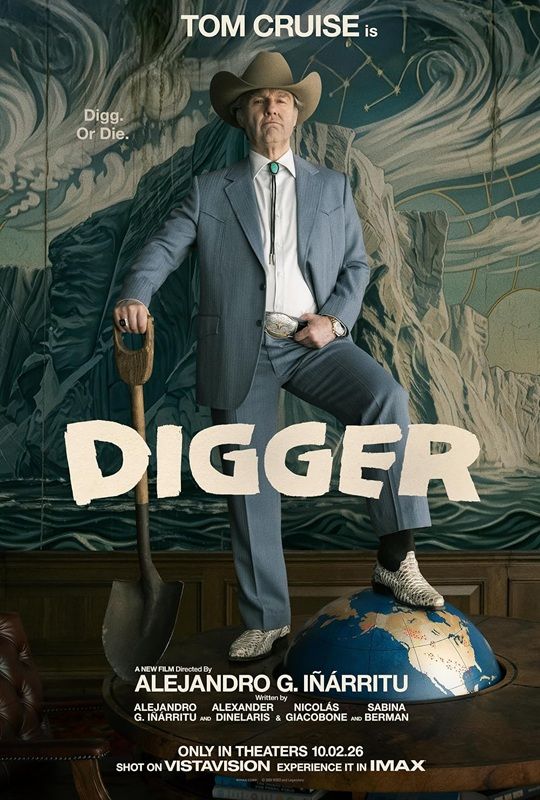
In a particular scene in the new English film Digger, a character refers to the protagonist Rockwell (Tom Cruise) as tacky and narcissistic. And get an immediate glimpse of the same in a hilarious opening sequence. In its cold open, you notice the boisterous protagonist deeply caring about its half-dead and decaying cat. This, while completely ignoring a plea with regards to an environmental catastrophe in Greenland, triggered as a part of his ‘digging’ work. The satire remains heavy-handed but sharp, almost fully highlighting the corrupted nature of a narcissistic individual sharing a hypertensive and corrupted dynamic with nature – keeping the partially dead cat at his disposal, while rigging the final breath out of a glacier. It is a very specific example that the writing provides through the symbolism of a shovel – which in the words of the protagonist was used by his grandfather to dig up some gold, almost labelling it as his legacy. Ironically, the legacy isn’t centered around a shovel but that of greed that has passed onto from generations – even making the protagonist an evil capitalist who belives himself to be the pioneer of a green revolution, as opposed to an eco-terrorist.
Written by Alejandro G. Inarritu, Alexander Dinelaris, Nicolas Giacobone, Sabina Berman, and Jez Butterworth, the early tone employed for the film Digger makes it an immediate companion piece to the English film Don’t Look Up (2024). There is a palpable satire on the environment that engulfs the narrative, even as the rhythmic form of the proceedings take care. This is true in its cold open scene wherein the introduction of the protagonist petting his ailing cat transforms into a microcosm of global destruction by the end of things. In between, you are also introduced to the environmental advisor Nirav Ganesh (a very Fahadh Faasil looking Riz Ahmed), whose morals and principles are drowned through bouts of ridicule, even as the protagonist hilariously dismisses his claims of a potential catastrophic situation in Europe following an environmental mishap triggered by his own greed. This, whilst being answerable to the President Of The United States. The rhythmic outburst may seem to be loud and silly, but it almost presents a deliberately frivolous lens with events unfolding through the psyche of individuals in power, most of whom who continue to live in a bubble of their own – even today!
In a outrageously hilarious sequence, the setting shifts to a board room with all the influential people in power, trying to brain storm on ways to prevent the man-made triggered disaster from reaching Northern Europe. My mind immediately wandered to the hilarious Stanley Kubrick directed film Dr Stangelove (1964), that tackled on a similar theme. Ironically, both the films handshake on the idea of setting a narrative that is people pleasing, rather than being use to the public. And within the moment, the genre deftly subverts itself with themes of patriarchy that have for ages been impacting the planet – a point further elevated through a passing inference on women, when there weren’t any women at the table (tragically speaking). Some jokes write themselves – this one on all males who are born with a silverspoon, while continuing to blame women for petty things. Petty Little Beings, really!
There is a searing political commentary that slices through the narrative through the character of President Compson (John Goodman) – an incapable, silly little piece of sh*t having cancer in his a*shole (literally), while invariably comparing his cancer to the world around him. Ironically, this also remains a commentary on the institutional breakdown of the government, making them incapable of resolving a global environmental issue. In a hilarious sequence, you see him brainstorming with his colleagues on how to tackle the situation of the catastrophe, while only opting for a comforting narrative built around the idea of the country guilty of the catastrophe, providing support and standing in unity with others. In another sequence, you see him impulsively triggering the idea of nuking countries like Russia and China – particularly when the tables turn with another piece of ice heading the way of America. And if things aren’t any worse already, the second in command – the Vice President is an incompetent loser too! Yep, the government entities remain farcical networks known to paint targets on themselves, and the world alike.
The writing also chooses to offer a searing commentary on human complacency that subverts the predominant blame-game centered around the elite 1% of the world who trade planet’s future for immediate wealth. In a stealthy scene involving the protagonist addressing a ferocious crowd, you witness the satire in full display even as the protagonist pushes the blame on all members who have passively contributed to the decaying state of the environment – be it through the excessive use of cellular devices, or the consumption of oil, or through AI, or through carbon footprints, all of which have meticulously played a part in causing a global catastrophe. It is ironic on how there is no immediate pushback to the argument, highlighting the complacency of humans as a race in protecting the natural resources of the planet.
The writing also critiques the ongoing issue of capitalism through a deliberately self-indulgent clash between the protagonist and his environmentally conscious sister Emma (Sandra Huller). The latter is shown to run a company Verdant, designed to push the green energy alternatives – a direct take on the consumption of green capitalism. But it is the ultimate glacial disaster that forms a searing reminder on how capitalism works on the fundamentals of greed, without fundamentally altering or preventing the destructive structures from being set up.
Spoilers (Skip This Sub-Segment If You Haven’t Watched The Film) :
There is a mid-movie genre twist that separates its heavy-duty political satire from the reality of the world, atleast for the time-being – when it is revealed that the entire political and environmental plot remained an active part of a play carried out by Curtis (Tom Cruise). The latter remains a method actor who jostles through his petty (and underwritten) personal life, while forming a creative dissatifaction with his performance too. In hindsight, this trait also remains a petty one given the end result of the catastrophe, almost highlighting a self-indulgent fact on how humanity will continue to remain selfish and unperturbed in different shapes and form. It also actively forms a satire for humanity – wherein everybody is an actor, acting their way through various obstacles, often being detached to the larger microcosm of destruction around them.
This underlying commentary is even better defined in its final act (of the film and the ongoing play), that is met with a rapturous response – a moment that uncannily turned meta with the capacity crowd in my auditorium. A play on the turn of events occured 30 years ago, was eventually met with a form of appreciation that remained escapist in nature – almost using the play as a form of momentary critique, before exiting into the real world plagued with darkness, grime, floods and garbage; something that was actually caused by the people on whom the play was based on.
It was a form of criticism that actively remains meta even today, even when the global issues are treated as momentary vehicles of criticism in the age of social media, before being forgotten for good. In a way, the final scene was a mirror to the society – a form of a dark, dystopian world that would be awaiting mankind on the cusp of destroying the elements of earth, in the wake of insurmountable greed! Hence, this also remained symbolic of the name of the play (in the film) that was called ‘Fossil Fools’, an thesis on the general public who choose to consume a past tragedy in the form of art, while using it as a form of escapism.
On a side note, there were minor issues with respect to a subdued dynamic between the protagonist and his daughter that met with a simplistic ending, or even some characters being partially sidelined at some instance in the narrative, or even the lack of a strong emotional core existing between the protagonist and his grandson. But these remain smaller shortcomings in a screenplay that remains a masterclass on every other account! The humour might be a niche, often referencing itself with much of the geo-political noise doing the rounds, even whilst being inherently American in many ways. But every beat of it landed beautifully, summing up the presentation and the writing that is one to be studied and savoured!
The dialogues are deliciously witty, and laced with dry humour that is rhythmic in many ways. The beats are synchronized and at times elevated with a delicious political commentary that adds to the smiles and tickles, whilst being pondering in many ways. The BGM often is observed to be aiding the drama, often doubling up as a ticking time-bomb that invariably cushions itself in the larger theme of ‘time running out for the planet’, environmentally speaking. This, while glazing the narrative with playful and rhythmic beats that offer an immersive streak in the narrative.
The cinematography comprises of frames that delightfully separate the political commentary from the reality, before stitching it back. Be it the emphasis on the setting of Rockwell’s estate packed with taxidermy-animals lining the walls, a direct commentary on humanity’s violent dominance over the ecosystem, or frames highlighting the rotting buffonary of the characters, that is a direct satire on the crumbling institutions of humanity in the wake of a global disaster. The frames are profound, often veiling its social and political commentary in the form of wacky, and quirky experiments – that keep you invested in the characters and their absurdist arcs. Even the crumbling production design in a particular scene, involving a tree falling off as a part of a set – was a searing reminder of the larger ecological losses endured by the planet.
The editing pattern mirrors the chaotic mind of its unhinged oil baron, flawlessly balancing extended, slow-roving tracking shots with frantic narrative transitions. By juxtaposing wide, surreal framing with an escalating comedic tension, the cuts trap the audience directly inside the film’s claustrophobic yet global crisis. This, whilst ably maintaining a consistently seamless transition between the two contrasting moods of the narratives, something that wonderfully binds the story together.
Director Alejandro G. Iñárritu maintains a bombastic direction transforming a catastrophic global ecological crisis into a dizzying, metafictional funhouse of narrative control. He relentlessly drives the film’s frenetic pace, trapping the audience inside the unhinged reality of a cartoonish oil tycoon. By orchestrating a confrontational, multi-layered satire that actively subverts expectations, he expertly balances apocalyptic scale with cynical, Dr. Strangelove-esque absurdism. His visionary approach fearlessly forces viewers to peel back the layers of corporate spin, much like a Russian doll approach to the existing themes in the narrative, something that results in a bold cinematic experience – wherein the direction is outstanding!
The performances are wonderful to witness by the members of the cast. Sophie Wilde has her moments to shine, and her confrontational scenes with the protagonist offer a searing side-commentary on the ominous of star culture, and the toxicity around the human institutions of art. Michael Stuhlbarg brings a brilliant dose of physical comedy to the screen as the film’s hopelessly ineffective, wet-noodle Vice President. Inhabiting a world of spin control and institutional incompetence, he turns his character’s spineless political cowardice into an incredibly funny asset. Jesse Plamons as Kenny brings about a restrained energy to the proceedings, with an assured act laced with measured calmness and subtle intensity with a sense of enigma. His performance is wonderfully grounded, despite the writing underutilizing his character.
Sandra Huller as Emma delivers a wildly comedic act despite being an underwritten character here. This act of hers remains a departure from the dramatic subtleties usually associated with her act, almost leaning into a wild zone that is entertaining to witness. John Goodman as President Compson is hilarious to the core, commanding his scenes with effortless gravitas in the role of a politician hopelessly buried under political negligence and optics. He captures the cynical, comically dark essence of a leader more concerned with public relations than preventing literal cataclysm. His natural comedic timing and towering screen presence turn the government’s inner circle meetings into sharp, Dr. Strangelove-esque satire.
Riz Ahmed as Ganesh offers a brilliant, grounded performance, the chief environmental advisor who acts as the movie’s moral anchor. He injects a quiet, fierce intelligence into the chaotic narrative as the lone voice of sanity trying to warn a corrupt war room of an impending global eco-disaster. His intense restraint perfectly balances the protagonist’s bombast, making their ideological clashes a riveting highlight of the satire. Overall, his act remains deliciously chaotic and immensely sincere.
Tom Cruise delivers a career-defining performance as Digger Rockwell, entirely shedding his clean-cut action hero image to embrace a loud, hilarious, and rhythmic caricature of pure arrogance. Leaning heavily into a grotesque physical transformation, he weaponizes his natural intensity to create a brilliantly unhinged oil tycoon whose every erratic outburst and bizarre dance movement feels meticulously choreographed. He blends entirely into the absurdity of an arrogant billionaire obsessed with narrative control and his dying cat. By subverting his usually controlled, prudish action persona, he unleashes a wave of unadulterated, comedic chaos that stands out as his most adventurous and electric performance in decades. This was a brilliant act that deserves an Academy Award, and if he doesn’t – then we riot!
Anchored by exceptional performances, Digger is a brilliantly rhythmic, multi-layered satire that seamlessly subverts sharp political and environmental commentary into a dizzying, metafictional funhouse. The film manages to be both thoroughly entertaining and deeply profound in its cultural critique, carving out a wholly unique cinematic identity. By wrapping its message in an offbeat, deliciously dry comedic tone, it weaponises niche quirks and sharp wit to expose the privilege of those in power, the fragility of humanity, and our collective ignorance toward the planet. This singular eco-drama is as intellectually stimulating as it is captivating, making it an essential, thought-provoking watch. Available in a theatre near you and Highly Recommended!


