

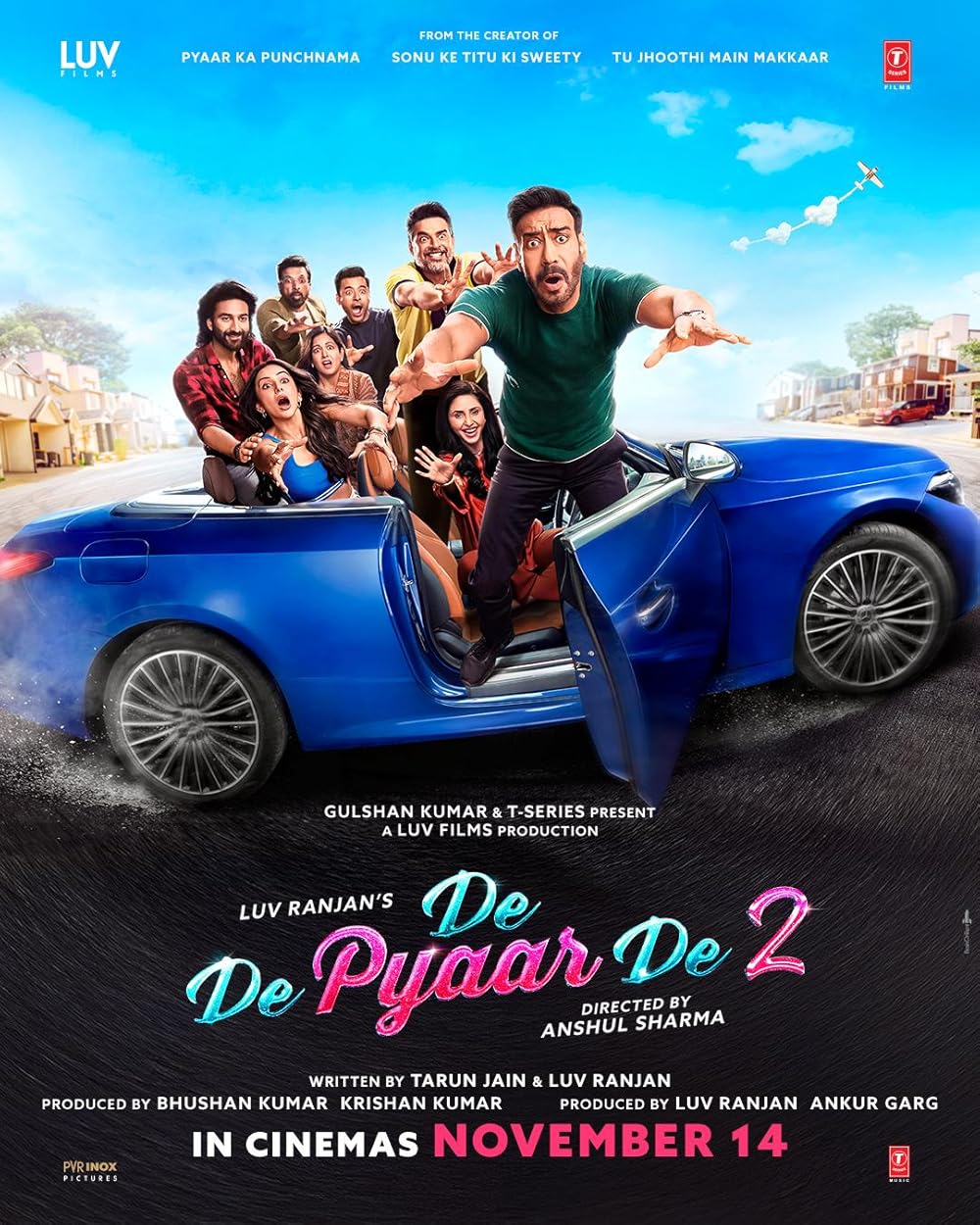
It is interesting how the premise of the new Hindi film De De Pyaar De 2, a direct sequel to the 2019 Hindi film De De Pyaar De, reminded me of the third act of the Amitabh Bachchan-Tabu starrer Cheeni Kum (2007). The idea of an older man falling for a younger girl isn’t really a novel idea on celluloid, given how all the older male contemporaries are seen romancing actresses half their age. But the novelty lies in taking this concept forward to the family, and that is where this sequel does work. When you are reintroduced to Ayesha (Rakul Preet Singh), she is still madly in love with Ashish (Ajay Devgn), a man several years elder to her – so much so that the immediate next step remains marriage, which basically means conveying the same to her ‘progressive and liberating’ parents about her match. In other words, it is similar to the character of Tabu taking the character of Amitabh Bachchan to meet her father Paresh Rawal, a single event that triggers a chain of events that would go onto complicate her relationship. But the expectations here for Ayesha are different – her father Rakesh (R Madhavan) isn’t a Gandhian (like Paresh Rawal), but ‘progressive and liberating’ in order for him to accept her relationship with Ashish despite a huge age gap. Or so she thinks……
Written by Tarun Jain and Luv Ranjan, De De Pyaar De 2 can be described as a deconstructed take on DDLJ (1995) and any of Priyadarshan’s mad caper comedies. It is almost like Ashish here plays Raj to woo Simran’s (Ayesha’s) family, just so he could get married. But this Raj comes with his own baggage – he is divorced with his previous wife, he has two children almost of the age of Ayesha (the love of his life), and he is only a year and a half younger to Rakesh, Ayesha’s father. On the other hand, Rakesh wants to portray to the world that he is a progressive person, whereas in reality, he is discreetly hurt with her daughter’s decision. He is representative of a set of parents who aspire to be progressive but are closet conservatives, often being okay with the progressive outlook of others around them until the eventuality falls on their own families. In that case, the foundation of the drama is built around the personality (and baggage) of these individuals – Ashish is the matured and restrained one, Rakesh is the aggressive and dominating one, making this combo that of fire and ice.
It can’t be discounted on how De De Pyaar De 2 boasts of a multiverse of madness with respect to the actors from so many films of Ajay Devgn. It is like Drishyam (Ishita Dutta) meeting Raid 2 (Tarun Gahlot) meeting Shaitaan (R Madhavan) meeting De De Pyaar De 1 (Rakul Preet Singh). This even features a real life father-son duo (Jaaved Jaaferi, Meezaan Jaaferi) in the mix, all of which formulate the fabric of the drama. In other words, the humour of the drama here is built around the meta-references, some of it also being self-aware with regards to its DDLJ theme that sees Ashish getting sacks of grains after a morning walk, only to be questioned on how anyone in the wisest of minds would carry grains to distribute during a morning walk. Yeah, damn you ‘Raj’, it doesn’t work that way😂. And also Raj if ever you were Bauji’s age, he would introduce you to his friends by referring to you as a ‘college friend’. Oh wait😝!
The events are enjoyable particularly when the drama doesn’t resort to a game of one-upmanship between Ashish, and Ayesha’s parents – even as the former is confused on what to refer to them by. The real game is the clash of ideologies between Ayesha and her father Rakesh, even as the personality of the latter comes to the fore at a party, prompting a strong retaliation by the former. It is almost like a game of tug and war that unfolds, leading up to the halfway mark that prompts an interesting twist to the narrative – the inclusion of the third wheel Aditya (Meezaan Jaaferi) that would potentially complicate things.
I was definitely in the game with Aditya – a charming guy in the same age group as Ayesha, and her childhood friend who loves to flirt with her and take her on hikes, much to the dismay of Ashish. But at the same time, I couldn’t help but think on how the writing decided to reverse engineer the obvious ending into a subplot that really pushes the boundaries of a relationship. Yes, the emotional core is tapped into with respect to the character of Ashish, but the ‘intimate’ antics of Ayesha towards Aditya remained a strong bone of contention in disconnecting you with the drama, particularly given how the payoff was designed to be. It remained equivalent to wrapping your hand around your head to eat, as opposed to a direct movement towards your mouth. Yes again, it did add to the confusion of the drama but that 40-minute subplot was against the mood of the drama while briefly towing into the melodramatic territory. The good thing though remained the humour interspersed at the end which was ticklish (again focusing on a game of one-upmanship between Ashish and Rakesh), and something that marginally papered over the cracks in a finale that otherwise was underwhelming from a writing perspective. So overall despite the flaws in the second hour, the screenplay still remains an enjoyable affair.
The dialogues are filled with meta-references that will keep you engaged through the through. The lines are crisp and hilarious to the point that I found myself cracking up, everytime a clever and self-aware meta-reference was plugged in. For instance in a scene, you see Ronak (Jaaved Jaaferi) telling Aditya (Meezaan Jaaferi) that ‘Main Tere Liye Ek Achchi Ladki Dhundunga’ (I will search for a good partner for you), it landed perfectly with its humour quotient. However, the use of whistle to censor the abuses felt like a gimmick and an unnecessary distraction. The music is a little underpar here particularly because none of the songs really stick during the course of the film. The BGM is adequate and does its job in elevating the humour quotient in the drama at a few places. The cinematography comprises of frames that are colourful, almost synonymous to the themes of the drama. Yet, the production design could have been a shade better – given how every locations (and the interiors) feel eerily similar to Luv Ranjan’s previous films like Tu Jhoothi Main Makkaar (2023).
The editing pattern again comprises of an amalgamation of scenes as opposed to a connected set of sequences, and this is increasingly becoming a trend of sorts that is inspired from the reel culture. This is not to say that it doesn’t work here but probably a little work could have been put in transition sequences that needed to be written (outside the connecting theme in the drama). Director Anshul Sharma manages to impress with his handling of the humour in the drama, that forms the building blocks of the world and the characters. There is a certain rhythm that he sticks to with the narrative, something that adds to the humour in the drama. Even in scenes of (melo)drama, the emotions do come through, making this piece of direction pretty impressive. The only little point of criticism remained in the briefing of a few scenes wherein the degree of humour did get a little loud with its pitch. But other than that, it was a pretty good outing for Anshul.
The performances are pretty good by the members of the cast. The likes of Sanjeev Seth as Kittu’s dad, Meneka Arora as Kittu’s mom, Ekavalli Khanna as Anita, and Gracy Goswami and Anvesha Vij as Tia and Dia respectively, have their moments to shine. Suhasini Mulay as Nani absolutely nails that one sequence that she features in, while being able to tickle your funny bone. Tarun Gahlot as Rohan is decent here. Ishita Dutta as Kittu aces her comedic set-pieces and she makes for a hilarious watch.
Jaaved Jaaferi as Ronak is sincere and earnest while having traces of humour to his character. Meezaan Jaaferi as Aditya is a revelation here, coming across as charming while also being supremely effective with his comic timing. Gautami Kapoor as Anju is competent while managing to do a swell job here. Rakul Preet Singh as Ayesha has a wonderful screen presence while using her body language and expressions to do a good job. A little criticism may have been with respect to the briefing given to her in a few scenes – wherein the pitch of her performance enters the ‘loud’ territory. But overall, she still manages to impress here.
Ajay Devgn as Ashish is understated here while mounting his performance on the maturity of his character. While he does score decently with his comedy, his expressive eyes take over during scenes boasting of raw emotions. There is a sincerity in his performance that was ‘kind of’ missing in his recent few ventures. R Madhavan is that one actor who has understood the pitch of the drama perfectly here. As Rakesh, he is excellent with his sense of humour, almost using his shifting expressions perfectly to convey the internal turmoils of his character. His body language added layers to his character while being reflective of his dual personality. This remained yet another outstanding performance by him wherein he does a swell job.
Despite its flaws in the second hour, De De Pyaar De 2 is a fun entertainer with enjoyable performances that makes for a fairly entertaining watch. Available in a theatre near you.


