

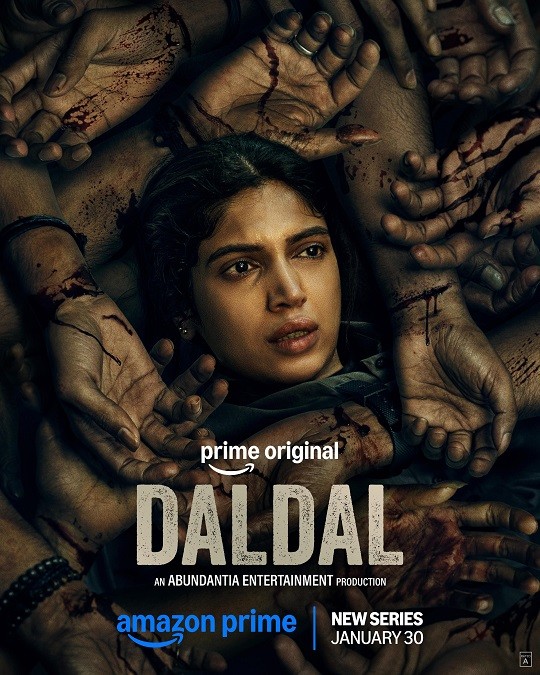
The start of the new Hindi show Daldal felt like a distant cousin to the show Khauf (2025). Whilst it was a shadowy creature following a female character in the latter, the male gaze is again a center of attraction while being introduced to Rita Ferreira (Bhumi Pednekar) and her acquaintance. You see a moment of discomfort at the start, even as Rita chooses to ignore a male gaze staring at her from across the table. In the same breath, you witness trauma making its presence felt in its subtext, something that would be the main character of the show. The scene is abruptly cut even as you get to know that Rita is a cop, working undercover as a teacher (which explains the advances of the student character from across the table), only to infiltrate a trafficking row and in process be a candidate for a promotion.
It must be said that the character of Rita is seemingly fascinating at the start – a silent survivor of trauma quietly returning home to a softening presence in the form of her partner, only for us to get to know that she is on the verge of separation. Deep down, she also imagines herself to murder folks who double up as bouts of irritation for her. It must be noted on the discrimination that Rota is subjected to at her work place – featuring a jealous colleague and a micro-managing boss, both males who like to dominate a female character. And yet, the character is left high and dry when the focus of the drama shifts elsewhere.
Adapted from the book Bhendi Bazaar by Vish Dhamija and written by Suresh Triveni, Hussain Haidry, Priya Saggi, Sreekanth Agneeswaran and Rohan D’souza, Daldal has an interesting premise of typically male citizens of Mumbai being killed off with their wrists slashed and their mouth muffled with various items. It may also be conveyed on how the identities of the killers are revealed by the end of the first episode. Both Sajid (Aditya Rawal) and Anita Acharya (Samara Tijori) are victims of trauma often embracing each other in the real world while forming an unlikely partnership during the killings. It almost remains a clear case of them trying to fight against the very existence of trauma by committing crimes that offer them a sense of catharsis and satisfaction – almost viewing every other character as problematic and patriarchal.
The character of Anita remains most fascinating given how she disguises herself as a reporter who reports the very crimes that she has been discreetly committing. Anita remains a direct companion piece to Rita, the similar ‘Sahprem’ partnership that tied Ramanna (Nawazuddin Siddiqui) and Raghavan (Vicky Kaushal) in Raman Raghav 2.0 (2016). Both remain very similar characters with similar traits – both have violent streaks bottled in the wake of their traumas that were passed on from their mothers. And both ironically conceive on killing the patriarchs in a similar manner with the only difference being that one has the company of a fellow downtrodden trauma-induced soul Sajid, while the other invariably finds herself on the right side of the law. But the main issue lies with the focus of the writing that keeps shifting its goal-posts.
Given the structure that was formulated, the biggest cardinal sin in the writing remained the revelation of the serial killer(s) early on in the narrative. The drama here is a whydunnit but wants to position itself as a whodunnit – something that deviates from its main USP of an interesting character study that it had in hand. Both Rita and Anita are such interesting characters who are invariably flattened out, because the drama wishes to keep them at each end of the cat and mouse chase. It almost wants its characters to behave in binaries, while diluting all the layers that the characters have to offer.
None of the subplots really work simply because they get far too repetitive in nature without accounting for the second layer of empathy and consciousness of the characters. After a point, I literally lost sight of why people were being murdered in the first place, and whether the drama over-commits to the theme of generational trauma by giving the characters a free pass. Subplots like Rita’s childhood felt too soapy and stagy to even care about her psyche while growing up, and the other subplot involving a Russian mother transferring her trauma to her child after the death of her cop partner, felt extremely half-baked and cliched. After a point, the drama truly became a slog – so much so that I couldn’t care less about any character.
It is ironic on how a drama on serial killers (and I say serial killers because the writing wishes to position itself as a whydunnit as opposed to a character study on trauma) felt so diluted and uneventful. The reasons are aplenty – the emotional psyche of the accused or the cop protagonist was bypassed. Also, the stakes in the drama were non-existential so much so that the disjointed nature of the proceedings, further made me distance from the characters. Even a late death of an important character, left me unmoved.
And it then made me wonder on whether the original source material was even interpreted correctly? It is the kind of a miss that you would associate in soccer, wherein an easy penalty kick is sprayed into the crowd. The investigation seriously lacked a bite and the killings became tedious, resulting in a finale that felt straight out of a prime time soap – all threats but zero results. And that sums up the trajectory of the screenplay – it never felt focused towards its characters while being content in exploring the broad strokes. Hence, the end result was mediocrity at its peak!
The dialogues are neither visceral nor quite intense enough for me to hold onto the investigation that transpires. The lines are quite forgettable. The BGM and in particular the sound design (by Gaurav Shakya and team) is one of the saving graces here, mildly pulling you back into the narrative every now and then. Be it the Kishore Kumar rendition of ‘Tu Hai Toh Hai’ that has haunting undertones to it, or notes of sound that amplify the spooky ambience of the city of Mumbai – the sound design definitely manages to hold your attention. The cinematography begins on a good note by accounting for passages of illusions on the part of a particular character, along with frames that ably capture the grey shades of the city of Mumbai. But progressively, the frames begin to distance you from its characters while managing to completely disconnect you from their emotional core.
The same trend is evidently noticeable with its editing pattern too – the disillusioned cuts at the start work superbly only for randomly cuts to further disjoint the already disjointed drama. Director Amrit Raj Gupta woefully misses the mark here, and I will be the first to admit that the execution remains extremely dull. After an initial high, the slide is substantial and irrevocable even as the focus shifts to a whydunnit as opposed to sticking to the traits of its characters. The issue probably lay in interpreting the source material, something that remains an evident talking point on how disinteresting the drama is after the first episode. The direction is really poor and it definitely works against the progress of the drama here. Amrit is a good director generally, but this remains a rare miss!
The performances are pretty decent by the members of the cast. The likes of Ananth Mahadevan as Manohar Swamy, Vijay Krishna as Aditya, Prateek Pachauri as Doctor Peddler, Neha Mishra, Sandeep Kulkarni as Prabhat, Tina Bhatia as Naina, and Shivraj Walvekar as Uday have their moments to shine. Rahul Bhat as Jay, Emily Acland as Vivianne and Vibhawari Deshpande as Isabel manage to leave a mark despite the writing skewing each of their characters. Saurabh Goyal as Jatin remains sincere and earnest. Chinmay Mandlekar as Vikram looks the part and absolutely aces his character with his mannerisms despite the writing has very little meat on offer for his character. Sandesh Kulkarni as Sanjay is first rate while making his presence felt.
Geeta Agrawal Sharma as Indu has got to be the pick of the actors for me. She seamlessly gets into the skin of her character while almost forming an equation with the viewers like Kaatekar (Jitendra Joshi) from Sacred Games (2018). She is brilliant as ever and absolutely nails her character. Aditya Rawal as Sajid provides another timely reminder on what a fabulous performer he is. He accurately uses his eyes and expressions to represent a character suffering from trauma, while delivering one of the haunting acts of the show. Samara Tijori as Anita is fairly good here despite the writing diluting the impact of her character. There is a definite screen presence of hers that makes her intimidating, and how I wished to get a better glimpse of her psyche through the writing. Nevertheless, she still delivers an impressive performance by using her body language to great effect.
This brings me to the curious case of Bhumi Pednekar who as Rita Ferreira isn’t half as impressive here. There was a time when Bhumi was an incredible talent, backing every performance of hers with utmost sincerity. But here, her blank stares were a result of her hollow act that doesn’t really empathize with the character in any way. Her sudden jarring rants feel inconsistent, even whilst I was quite distracted by her lips (and I profusely apologise for bringing this up, something that I would never mention; but it was my reality that I couldn’t oversee). This performance is a harsh reminder on how Bhumi’s last credible performance in the form of Bhakshak (2024) felt years ago, and how Bhumi seriously needs to head back to the drawing board while undergoing some serious introspection. Come on girl, I know you can do better!
The first season of Daldal boasts of some rather dull writing and dull execution that accounts for a lost opportunity. It is a show of many misses and only a few hits that results in the drama sinking right into a swamp (read: Daldal) without any signs of recovery. Available on Amazon Prime.


