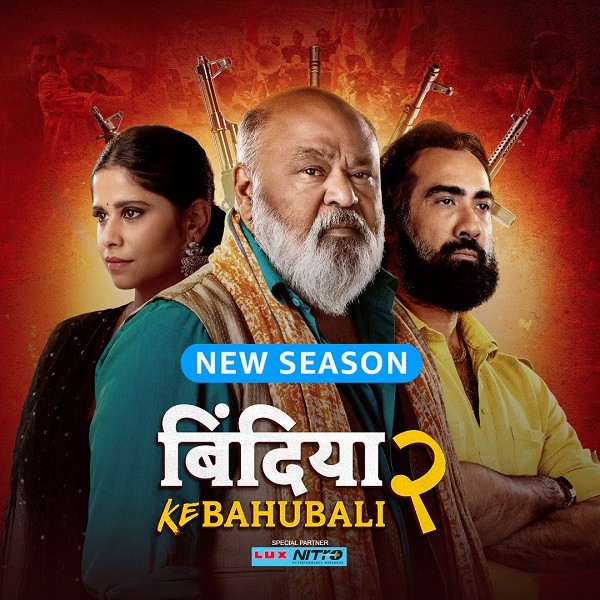

The second season of the new Hindi show Bindiya Ke Bahubali is immediately more urgent than the first season. Given that much of the world building was done in the first season (more specifically, one season divided into two parts), you are immediately witness to the early seeds of war brewing between the Davans and the Bhamirs. But within a broader context lies a quieter subtext of the power dynamics that are brewing between Chhote (Ranvir Shorey) and his father Bada (Saurabh Shukla). In that regard, much of the dynamics of the drama focuses on the family dynamics of the Dawans – with every character either being hungry for power or doubling up as female fatales straight out of a Shakespearean play, something that further fuels the narrative. But having said that, the perennial problem of the show stays – it is overstuffed due to a large number of characters on the show. And while the events are immersive, it will require patience to sit through the talks.
Written by Raj Amit Kumar, Sankalp Rawal, Shivendra Singh and Damon J Taylor, multiple subplots drive the narrative in the second season of Bindiya Ke Bahubali. While there is a tug of war between the Bhamirs and the Davans, a deft deviation opens a can of worms for a particular character who would seemingly threaten to shift the power dynamics towards the Davans. The conflict between Bada and Chacha Davan (Vineet Kumar) is prevalent but lesser than the one between Bada and Chhote, given how the latter is more hungry and ambitious for power, while being ably guided by his wife Imli (Tannishtha Chatterjee). On the other hand, a subplot involving a bag of money has different stakehokders interested too – with Ajji (Sai Tamhankar) showing her first signs on ambition on show, even as her brother Krishna (Aakash Dahiya) and her husband Sukki (Yogendra Vikram Singh) are gently turning against Chhote, in the want for power. And somewhere, there is Babbal (Alok Pandey) vying for revenge with the Davans after a tragedy early on in the season, that has put his family on the backfoot.
Now given that this remained a single season divided into two parts, much of the foreshadow of the show had already transpired in the first season. And so, it automatically did take a little longer for me to recall certain incidents – for instance, a potential murder plot for which Bada was framed and jailed, or a plan to install a power plant with the help of caste-based violence in the narrative. But soon enough, the focus specifically shifts to each of these subplots, something that starts off slowly in a less threatening manner but steadily engulfs the narrative with a much needed bout of urgency.
An example that I can quote here with respect to the drama unfolding is of a Wrestlemania match of WWE, wherein multiple wildcard characters pop-up for the throne, that also includes a money-in-the-bank match (read: a sum of 25 crores that goes missing after the murder of Davan’s accountant). For Davans, the opposition arrives also in the form of a new DSP in town Murali Majhi (Sushant Singh), who is hell bent in framing the Davan’s for the crime in the vicinity, whilst also utilizing the services of the second son of Davan called Babu (Kranti Prakash Jha), who is a part of the police force. Hence for Babu, the conflict remains to safeguard the interests of his family whilst also carrying out his duty, the latter of which he is arm-twisted into at one point.
Babu also remains a key character given his feelings for Sasha (Kallirroi Tziafeta), a hired stripper at the ‘recreation club’ of the Davans. This, except that it is Chhota who maintains an extramarital affair with Sasha, despite being ‘happily’ married to Imali. It is the kind of a sizzler wherein every character is designed to sizzle while having strong repercussions for their actions in the drama. And if you are patient, then you will find yourself engaged in the proceedings that also touches upon interesting bouts of intensity along the way. For instance, the finale shoot out raises the bar of urgency in the drama while making for a compelling watch. The brief passage of play almost resembles a version of The Game Of Thrones – wherein you aren’t sure if a character that you have been rooting for, would survive or not.
One of the criticisms for the drama remains on how overstuffed the events are. It is a recipe of adding every available ingredient in the mix to formulate the world, every as everyone play catch up. The promising subplots are started and abandoned (like what happened to Sasha? An, so much so that they felt like a distraction more than anything else. The result of which a few characters would disappear everytime the focus shifts to a different subplot. And I wouldn’t lie – there was a brief period of lag during the courtroom scenes (after an intense passage of protecting the witness) that had me distracted.
What that would do is scatter the focus of the viewers, who have to adjust from one track to another, while seemingly having to connect the dots. Perhaps a slightly more focused form of storytelling could have been employed to consistently pique the interests of the viewers. That would have added a little fizz to the proceedings – be it in frequent forms of humour or unexpected twists. Another little criticism has got to be a steady fetish of most shows NOT wanting to conclude the story at the end of the season. It again felt like an abrupt halt that left me mildly frustrated given how the show has lasted for 12 episodes of almost 50 odd minutes each. It is fairly compelling, yes – but atleast some of the threads needed to be wrapped up in a foreshadow to the next season.
The dialogues are grounded and wonderfully represent the ‘colourful’ vibe of the heartland of the country. There is a sweetness to the dialect of the characters that adds a layer of authenticity to the drama, even as the lines briefly contribute to the humour of the drama. The music and BGM by Indian Ocean is immaculate, while highlighting the earthiness of the drama efficiently. It is the background score that engages with you while keeping you invested in several scenes that are verbose in nature. The cinematography captures the dusty landscapes of the setting, while creating a sense of authenticity with its depiction. In a way, it does allow the setting to play an important character around which the drama unfolds.
The editing doesn’t quite take into account the multiple lags in the drama, thereby creating certain passages in the proceedings that just add crucial minutes to the overall runtime of the show. Maybe a crisper edit would have warranted an even better impact. Director Raj Amit Kumar does a good job with the proceedings here despite the issue of overstuffing the drama lingering on here. He was in better control of the proceedings here, something that is immediately reflective with the much needed urgency in the drama. Yhe characterization still remains pretty engaging, just that the exploration of a few additional threads (as opposed to a focused narrative style) is what has impacted the overall nature of the drama. But still the direction shines here, in what is a job well done.
The performances are excellent by the members of the cast, and this is literally a casting coup of sorts for the casting director Mukesh Chhabra. Here, I must also add that because of the overstuffed nature of the drama, not all actors fully get a chance to bloom here. Ravi Bhushan Bhartiya as Vikram, Pawan Singh as Munna Rifle, Devashish Mishra as Lala, Manish Mishra as Sutta, Rakesh Sharma as Tota and Neeraj Singh as Bachha, are wonderful to witness here, and each one of them contribute to the colourful nature of the drama. Puja Jha as Soni shines despite a limited screen time, and she makes her presence felt. Govind Namdev as Angad Singh and Resh Lamba as Narad contribute to the distinct flavour of the drama, particularly the latter who is brilliant in that one scene at the start while fully committing to his character. Alok Pandey as Babbal is intimidating and chilling, both at the same, and I feel he will play a significant part in the subsequent season of the show.
Sheeba Chadha as Dharavi is excellent here while being extremely competent in the courtroom scene. Auroshikha Dey as SI Bansi has her moments to shine too, and she supremely impresses here. Sai Tamhankar as Ajji, Tannishtha Chatterjee as Imali, Seema Biswas as Sanka and Preeti Chauhan as Roli have significant upgrades from the last season, and they are supremely competent actors who make their presence felt, in what remained layered performances. Dibyendu Bhattacharya as Raja Babu is playfully conniving with his character and he explores his shades of grey wonderfully well. Kallirroi Tziafeta as Sasha has a wonderful screen presence and she is superb to witness in a character that is far more vulnerable this time around. Daniela Londono Rodriguez as Myra is equally good, while nicely bringing emotions to the table.
Aakash Dahiya as Kisna is superb to witness here, and you witness an upgrade of his ambitions here, wherein he brings some much needed vulnerability to his performance.. Ghansham Garg as SI Deen Bihari will manage to tickle your funny bone with the antics of a corrupt cop, who soon finds himself in a pickle while trying to make everyone happy. Saurabh Shukla as Bada is wonderfully understated and he brings subtle bouts of chills to his character. Yogendra Vikram Singh is a serious talent to reckon with, and as Sukki, he is a dynamite – impulsive to the core but with a playful fizz that makes him standout from the crowd.
Sushant Singh as DSP Murli is phenomenal here, using his body language and expressions with a playful finesse to convey the righteousness of his character. Vineet Kumar as Chacha Davan is subtly scheming and conniving, being a perfect opportunist, and conveying the emotions of his character with a sense of sinister coy. And that remained a sign of a veteran who is at the top of his game! Kranti Prakash Jha as Babu Davan wonderfully owns the internal conflict of his character – be it towards his love, or towards his brother, and his understated approach is excellent to witness here.
Ranvir Shorey has to be one of the most versatile actors today, and he is brilliant to the core as Chhota. A character with no morals but with sky high ambitions, he manages to bring out the sinister trait of his character rather efficiently, while putting forth a performance that is nuanced but also gripping. He is impulsive at one point but vulnerable in another, a dual trait that makes him unpredictable. He is terrific to witness here in a fabulous job done, overall.
Boasting of stupendous performances, the second season of Bindiya Ke Bahubali is a fairly compelling gangster drama that makes for a decent watch. It is slightly overstuffed while suffering from the fetish of a next season (given how the story still hasn’t concluded), but it still creates enough moments to be immersive in many ways, provided you are patient with the drama. If anything, watch it for the performances. Available on Amazon MX Player.