

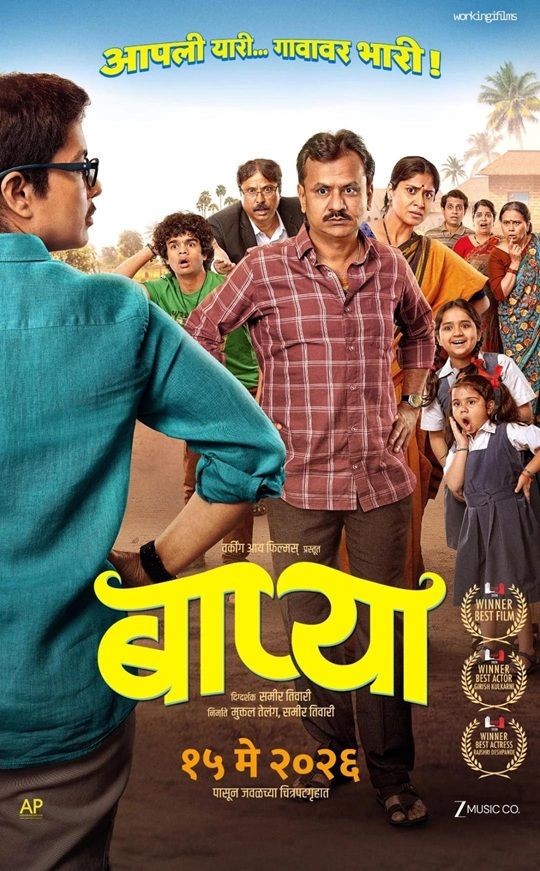
There is a beautiful montage featuring a fish at the start of the new Marathi film Baapya. The fish in question has hues of pink and blue christening its skin – something that makes it increasingly different and a distinct standout from other fish in the sea. Ironically, this trait of the fish is used to highlight the humane side of the protagonist Anil (Girish Kulkarni). In a fleeting shot, you witness Anil appreciating the beauty of the fish that he has just caught – while sending it back in the sea to give it a new lifeline. It remains an early pivotal moment given how the conflict in Anil’s life, would soon throw him in a frenzy – except that his humane ‘accepting’ side would decide the fate of his future. And yet the early signs of conflict are also introduced in the same scene when his lawyer friend (Shrikant Yadav) brings to him a land deal to clear his debt – with the exception that he needs a signature from his estranged wife Shailaja (Rajshri Deshpande). You are witness to the worried and boisterous nature of Anil – another side of his personality, that would form an interesting internal conflict for the protagonist based on a ‘peculiar’ but socially relevant reality that he would soon be a part of.
Written by Sameer Tewari, Vikrant Katkar, Priti Nair, Nikhil Ashok Palande, Gaurav Relekar, amd Manish Bhushan Tiwari, Baapya focuses on a handful of interpersonal dynamics while tackling a sensitive subject of a trans operation – a topic that isn’t been frequently discussed on celluloid. In fact, the lone film that I can think of that dealt with this subject was Ayushmann Khurrana’s 2021 Hindi Film Chandigarh Kare Aashiqui. In fact, the parallels between Manvinder and Anil are uncanny – and yet, Baapya unfolds as a reverse trajectory to the Hindi film, particularly with the character of Shailaja, whose identity is kept under wraps for most of the first act.
There are two sides to Shailaja who would later return in Anil’s life as Dr Shailesh. In the segmented flashback sequences, you witness a shade of Shailaja who is slowly coming to terms with her identity. She likes dressing up in a typical guys’ attire – often frowning at the idea of having to don a ‘Punjabi Suit’. As a teenager, you would often find her twerking with guys at a wedding, often being oblivious of the fact that she is the only female who has gathered some unwanted eyeballs from people around her because of her antics. But in the same breath (and on being pitted as a romantic interest with Anil), you witness a sense of angst and frustration – something that isn’t conveyed enough to her family or Anil, who don’t understand her sorrow or confusion.
But as Shailesh, he is calm and collected – much like her profession of a doctor, maintaining a soothing behavior despite the chaos around him due to the news of his gender change. In a scene, you don’t see him react or retaliate even when Anil slaps him in frustration – a subtext that remains on how being with a feminist gaze, automatically extends to a streak of masculinity that exudes of patience and a running streak of emotions. His pain and angst are traded for a sense of peace – given how he has finally come to terms with his identity and s*xuality.
The setting of Konkan plays a crucial role here – something that extends beyond its scenic visuals and serenity to the people that thrive in the vicinity. The setting of the drama in a small town is inferred to the small mentality of the people who aren’t open with their thinking. Be it the folks of the older generation passing some rather nasty comments at a funeral, or even Anil’s second wife feeling threatened by the presence of Shailaja (who is now Shailesh) – the mindset is accurately tapped into with regards to the writing. But the biggest dynamic being explored is that of Anil and Shailaja’s son Sanju (Aryan Mengaji).
It is interesting to witness on how the younger version of Anil is uncannily similar to Sanju – an age demographic wherein most guys are attracted to the opposite gender. But the thread tying both individuals is Shailaja/Shailesh – with the Shailaja struggling with her identity in an era coinciding with Anil, and Shailesh never fully being able to communicate his love for his child that he had once given birth to, in an era coinciding with Sanju. It remains an interesting dynamic with heartfelt undertones that forms the crux of the drama – even as Sanju and Anil follow the trope of a regular father and son who don’t always see eye to eye.
One of the smaller forms of criticism that I had was with respect to its minor tonal consistency. The idea of wishing to introduce bouts of comedy – often sandwiched between two tonally serious scenes, did break the emotional thread faintly. In a scene, you witness a beautifully woven emotional homecoming followed by a death of a character, only for the comedy to set in when the news breaks in Anil’s household. Another minor form of criticism remained that of convenience mixed with some dramatic moments – be it the idea of a character transforming based on a centrally manufactured incident, or even a transformation that feels slightly abrupt and sudden over an intoxicating night filled with nostalgia and friendship.
Thankfully though, the emotions land in each of the moments – even as you witness a character allowing his friendship to take over his angst, while accounting for acceptance. There is a beautiful theme of friendship, motherhood, and the true meaning of love – that will potentially moisten your eyes by the end of things. So despite the minor bouts of convenience and momentary lapses in tone, if the emotions hit home then that invariably means that the writing has scored too.
The dialogues get their emotional quotient right, something that supersedes the wobbly comedic portions to some extent. As a result, I wasn’t too distracted by the minor tonal lapses in the drama. The music is an absolute winner, with the songs being particularly catchy but also in sync with the tone of the drama. The song by Manjari Fadnis (in her playback singing debut) felt particularly beautiful in the scheme of things – given how the montage held onto the emotional core of the characters. In that sense, the songs were cleverly integrated with montages that conveyed a significant amount of information without hurting the overall runtime of the drama. The BGM is good too, except that it felt a touch overused – almost wanting to account for all the potential emotions (or comedy) that are prevalent in the scene.
The cinematography plays a pivotal role in accounting for a strong emotional core with respect to its characters, while also allowing you room to invest in their journeys. The editing pattern is good while using the technique of montages to pack in enough information without hurting the runtime. Also, the cohesive structure allowed the emotions to be transferred from one scene to another.
Director Sameer Tewari does a sincere job in tackling a sensitive subject, while never fully transitioning into an messaging dump. The characters are lively with a deep emotional core, even as the filmmaker hits all the right notes for the drama to touch your heart. But most importantly, the subject (and the character in question) doesn’t become a caricature at any point – and that was a huge merit to a film that could act as an important conversation starter despite bouts of convenience. In other words, the direction is pretty solid.
The performances are wonderful by the members of the ensemble cast. Raksha Naiga and Vaibhav Misal as the younger versions of Anil and Shailaja are top notch. Ira Parwade and Aarush Chikhale have their moments to shine too, with the latter in particular accounting for a solid emotional core. Atharva Phadnis as Bobdya is ticklish with his act, and he does contribute to some comedic moments in the narrative. Shravani Abhang has a good screen presence, and she does a good job despite a limited screentime. Varsha Dandale, Gauri Kiran, Devika Daftardar and Ananda Karekar are some fine actors here, and all of them have their moments to shine.
Aryan Mengaji as Sanju may appear to be frivolous to begin with, but he accounts for a strong emotional core that becomes the central conflict of his character. And he expertly accounts for the same, with the use of some fine expressions and body language. Shrikant Yadav is sincere and earnest, while putting forth a commendable act filled with restraint and affability.
Girish Kulkarni is such a fine actor (and I cannot stress this enough). As Anil, there is a sense of helplessness engulfing his character that often takes the shape of anger. Be it a societal pressure, or even his own tryst with a twisted fate, there are moments of angst that christens his character. But at the same time, the greatness of an actor can be judged from the fact that he never loses sight of his emotional core. It is so palpable that even some convenient strokes to his character’s transformation are overlooked – even while he scores with his expressions and body language. He was terrific to witness here.
Rajshri Deshpande delivers a grounded and sensitive act as Shailaja and Shailesh. This was invariably two characters packed in a single screenplay, both with varied character traits and interestingly, with one character leading to the transformation of the other. This remained a tricky journey that could so easily have entered the realms of a caricature. But Rajshri pulls off both roles with such finesse and a powerful emotional core, that she makes you quietly empathise with her character. The idea of also getting the dubbing right for Shailesh, was a game changer – a technical detail that I was initially skeptical about. She is a champion performer, and she proves exactly why in this film.
Despite smaller flaws, Baapya is a sincere, masterfully acted drama that balances entertainment with a vital conversation on a sensitive subject. Available in a theatre near you from 15th May 2026.


