

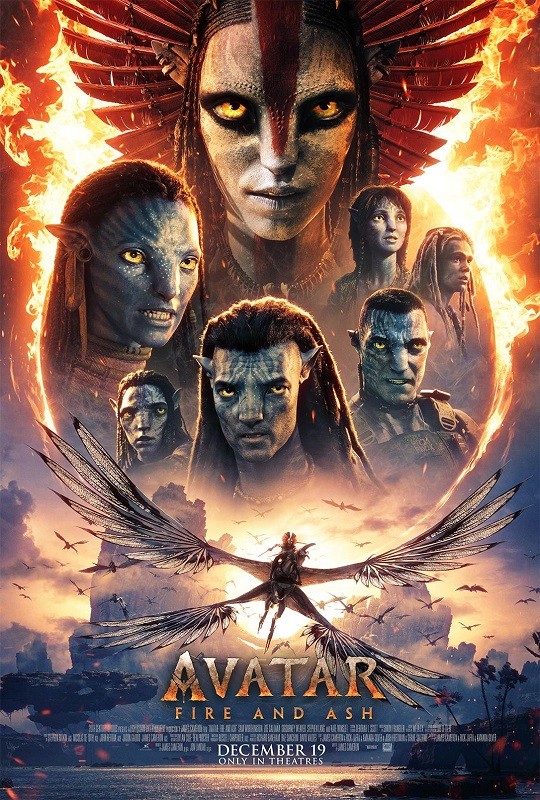
The divisive reviews of Avatar : Fire and Ash did remind me of the recently released show The Family Man. Much of the criticism surrounding the third season of the show was the itch to break a single season into two parts – invariably pausing the action at exactly the halfway mark, even as the wait continues for its fourth season. Likewise, Avatar 3 is an extension of Avatar: The Age Of Water (the reviews won’t tell you that), a film that introduced the viewers to a whole new world of the Na’vi clan, even whilst the conflict of humans intruding Pandora remained a constant. And because this remains a continuation, much of the themes are repetitive in nature too, a thread that is stuck in the pre-reels era wherein there seemed like a genuine appreciation for art as opposed to faster results in a lesser timeframe. It is similar to reviews in the reading space versus consuming them on Youtube, no matter how run-of-the-mill they turn out to be. The art of losing out on world building and characterization is a worrying factor wherein I would take the ‘repetitive’ nature of Avatar 3 anyday as opposed to a shallow attempt at shallow entertainment.
Written by James Cameron, Rick Jaffa and Amanda Silver, the events of Avatar Fire and Ash begins with a newfound streak of grief following the death of Neteyam, the elder son of Jake (Sam Worthington) and Neytiri (Zoe Saldana). The worst affected remains their younger son Lo’ak (Britain Dalton) who reminisces his time witb his brother while quietly living a grief-stricken life, even while dustancing himself from Jake. Neytiri is dealing with a baggage of her own, quietly coping with a sense of loss in a home away from home. In a way, Neytiri is similar to Eywa, the world mother of nature that has begun to see her children being ripped off in extinction by greed-stricken humans that are known to destroy the environment. The threat of capitalism to Pandora and the Na’vi clan is still real, even with the use of familiar elements in play in the form of the deceased-but-now-revived-avatar of Quaritch (Stephen Lang).
It is interesting how one of the initial conflicts is an internal one – one between the youngsters of the Na’vi tribe pitting them against the elders. The difference in ideology is evident during a fleeting moment wherein the use of guns is being discussed. The elders have a more conventional say – guns equals to more killings and more deaths, something opposed to by the youngsters. At the center of the conflict remains Spider (Jack Champion) – a humanoid who would soon be the center of attraction between the humans and the Na’vi tribe. To give him company is Kiri (Sigourney Weaver), a Christ-like entity grown up in the vicinity of nature without being aware of the existence of her mother. It is one of the elemental forms of the drama that would go onto form a recurring theme.
The theme aligning to the title of the film Avatar: Fire and Ash is more to do with destruction – and that marks the introduction of Varang (Oona Chaplin), the visually striking leader of the cult-group Mangkwan – given how fire from a volcano had destroyed their homes, only for the clan to worship the fire and use it as a form of destruction. In a way, the Mangkwan tribe remains opposite to the water-logged Matkayina clan that stands for peace. And when the character dynamics brings Varang and Quaritch together (in a nod to Fire and ‘Hash’ 😂), the lines of morality and survival are set.
One of the core themes from a character perspective remains Spider’s internal conflict of aspiring to serve the humans featuring his biological father Quaritch, or siding with his parents who chose to adopt him. In the same breath, I wished for a little more meat to this dynamic that would go onto be the center point of the eventual war that would transpire. Likewise, I liked how the character of Varang was shaping up – a zero remorse head of the clan with eccentric tones that would potentially be the perfect nemesis for the Na’vi clan. Her introduction of her clan invading the Windtraders (based on the Silk Route Caravan), resulting in a mid-air action sequence to savour did set the ball rolling, at times even spreading in the forest area or in the deep-sea waters of the planet. But the clutch moment arrived when she joined hands with Quaritch – who trades his gun knowledge for ‘pleasure’ while serving a common goal to invade the Na’vi. Ironically from that point, Varang is less threatening and more of a side-chick to Quaritch.
I liked the use of elementals in a bid for survival – a subtext and a nod to universal brotherhood even as you witness the joining of forces between the sea creatures along with aerial support in a finale that is astounding. Even characters joining their Kulus to the elementals, gives a profound idea on an alliance that can only prosper without human intervention. As a layer beneath, it did talk about unity in a very different manner – with different clans having different views on violence and death, while uniting on the common goal of survival. It is almost symbolic to fire and ash – two elementals that go hand-in-hand, one acting as a means of cleansing, and the other the byproduct of survival. In all of it, care is taken to keep the emotional quotient in check – a dying mother seeing her newborn for the first (and the last) time, an indifferent father-son bond that finds its voice at a crucial juncture, and another father-son equation that ends in a tragedy. This, while subtly leaving gaps for a potential fourth part of Avatar. People might complain, but I am not!
The dialogues are laced with emotions that form a connective thread through all the subplots of the film. The lines also dabble with a sense of morality in play that is conflicting to the characters. For instance, you see Varang citing on how she uses the same fire that destroyed her village to destroy other clans – a way of cleansing that feels ‘right’ to her. The BGM reeks of a magnum opus that deftly raises the emotions (and the stakes) in the drama. The cinematography comprising of a slower frame rate is literally of gold standards here – something that can truly be enjoyed on the biggest screen possible (Imax is mandatory). In fact, the frames have the ability to transport you to a world that feels surreal, with every pixel capable of revealing a specific information. Jeez, this remained one of the most memorable IMAX movie watching experiences after F1 this year.
The editing pattern is leisurely, at times indulgent that doesn’t always justify the runtime of 197 minutes. Some sequences linger on for tad too long, as opposed to a crisper edit that could have resulted in an even more impactful watch. But, this is not to say that the editing is poor – it sticks to its themes and creates a world that is filled with emotions even while accounting for the brief cutaways rather seamlessly. Visionary director James Cameron does the unthinkable here – of going the extra mile to create a parallel world that seems surreal and ‘real’ in the same breath. The level of detailing on display here is incredible, something that also at times papers over the cracks in the screenplay. It is no secret that the technical prowess supersedes the written material, even though the latter still holds up on world building and characterization. The director definitely elevates the written material here in a magnum opus to savour from a technical standpoint.
The performances are pretty good by the members of the cast even when the writing at times abandons some character arcs. Bailey Bass as Tsireya and Trinity Jo-Li Bliss as Tuk have their moments to shine. Jack Champion as Spider is decent despite the writing not quite having enough meat to sustain the conflict of his character. Britain Dalton as Lo’ak brings out his ruthless aggressive streak with flair while leaving an impact here. Kate Winslet as Ronal and Cliff Curtis as Tonowari are superb despite a lesser screentime for each of them. Oona Chaplin as the seductive Varang is sharp and intimidating while wonderfully designed to incorporate a new dimension of chaos here. And despite here character arc being incomplete (for the fourth installment?), she leaves a lasting impression. Stephen Lang as Colonel Quaritch remains the perfect antagonist here while bringing chills and intimidatiom in equal proportions to his character. Sigourney Weaver as Kiri is tender while having a calming influence onscreen, even while she brings a lot of raw emotions to her character. Zoe Saldana as Neytiri and Sam Worthington as Jake Sully have their individual emotional arcs of grief and loss, while joining forces on surviving against the humans. In that sense, both of them put forth commendable performances while excelling in combat sequences.
Avatar: Fire And Ash is a phenomenal visual spectacle that demands an IMAX viewing to truly appreciate the impact of the drama and its frames (and nope, anything less would not have the same impact). I can’t emphasize that enough in what has been my best IMAX movie-watching experience since F1 (2025). And this made me go softer on some of its familiar writing beats that most people will label as ‘being repetitive’. Yes, patience is a virtue here (given a punishing runtime of 197 minutes), but why is that a demerit again? Available in a theatre near you and Highly Recommended!


