

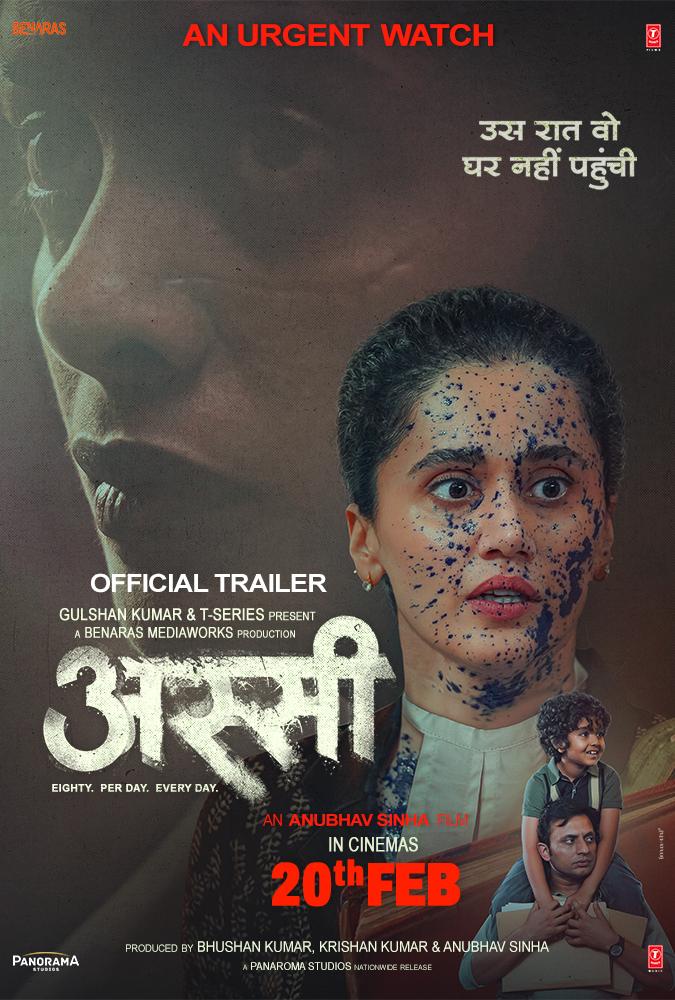
Anubhav Sinha wastes no time in getting straight to the point with his new Hindi film Assi. The cold open of Assi involves an unconscious body of a woman found lifeless next to a railway track, an imagery wherein you fear the worst. The grainy yet chaotic setting is unsettling and immediately paints a fearful figure, both of the times and the society that we live in. Much like the second season of Kohrra, the parallels can immediately be drawn with the cold open – a woman being killed in one, and a woman being assaulted and left to die in another. Both these imageries are a direct commentary on the rotting nature of the society, which in the wake of patriarchy is brutal towards women. And while this chilling cold open sets the tone of the drama to follow, an extended flashback is tactful to introduce the characters to the viewers. It is also interesting on how the character of Parima (Kani Kusruti) is shown to be a Malayali living with her family in Delhi-NCR, an underlying metaphor of an ‘outsider’ who will mostly remain without a voice in the power center of the country. The subtext is subtle but powerful.
Written by Anubhav Sinha and Gaurav Solanki, the relevance of the title Assi remains on a startling figure of the number of women ‘assaulted’ in a day in India. The same always acts as a chilling connective thread involving a red screen with the caption – 20 minutes, a fearful reminder on how a woman is assaulted every 20 minutes. This technique employed in Dhurandhar too, is far more triggering here – even whilst tracing the journey of Parima along the way. The concerned incident involving Parima is brutal, raw, and unforgiving, almost making you a bystander in the most uncomfortable manner possible. The sequence is long and endless, even as the concerned culprits take turns almost like a ‘tournament of thrusts’ – something that made me disgusted, furious, helpless and triggered, all at the same time. And yet, this incident remained just the tip of the iceberg for the drama to follow.
The beauty of Assi lies in its finer detailing with respect to the characters. Whilst Parima is showcased to be a teacher, you see her husband Vinay (Mohd Zeeshan Ayyub) to be an idealist. In an early scene, you see Vinay asking his young son to stop and allow the girls to climb the school bus first. In another, you see him smiling away to glory while watching his wife dance to a Govinda number. Vinay remains a secured person, almost believing the fact that chivalry begins at home – wherein you do need to teach your young sons on how to behave in the society. In the aftermath of the triggering event, Vinay is asked on why did he bring his son to the hospital, to which he calmly replies on how all of this would anyway make it to his home. It is perhaps his way of teaching his son the harsh realities of the society with the purpose of wanting him to understand between right and wrong.
The world of Assi could easily form an intersection with the one in Pink (2016). The premise remains eerily similar – a female being assaulted in a moving van that would extend into an endless court case with the crumbling nature of the police force and judiciary being exposed to the world. It is here on how the character of Ravee (Taapsee Pannu) could easily have been Minal (also Taapsee Pannu) from Pink. And hence, the sense of gravitas and morality of Ravee is understandable, particularly while taking up the case of Parima. You see her fierce side in the airtight courtroom proceedings that sees her plead her case to the judge Vasudha (Revathy), while being challenged by the defence lawyer Navratan (Satyajit Sharma).
The crumbling nature of the system is evident here, even as you are briefly witness to a series of tweaks that lace the narrative. Right from destroying evidence to tampering with the reports, from rich daddies coming to save their children to creating an alibi – Ravee has to deal with it all. It is interesting on how the judge Vasudha may have had an inkling about these false claims too – but despite that having to systematically allow the investigation to transpire. A common thread connecting most female characters here is of helplessness – some from the POV of seeking justice (Parima), some from the POV of demanding justice (Ravee), and some from the POV of imparting justice (Vasudha). In such moments, you see tenderness creep in during the interactions between two females – in a scene, you see Ravee consoling a frightful Parima when the latter couldn’t identify the culprits in the aftermath of the trauma.
One of the interesting characters in the fray remained Kartik (Kumud Mishra), a mysterious character submerged in a sea of trauma following the passing away of his wife in an accident. The trauma for Kartik here is deep – almost being regretful of not being able to be with her in her final moments while also not knowing how to come to terms with her loss. Even for Kartik, it is the system who is to be blamed given the hit and run culprit is probably scott free, and oblivious of Kartik’s loss. It may be noted that Kartik is implied to be in the services – a case that can be interpreted with his form of attention to detailing with a further indication on how he can’t directly divulge details about it.
Some of the other characters make an impact too – the rich father of one of the accused Deepraj (Manoj Pahwa) who is shown to be a bratty patriarch with respect to the females of his own family. An honest but helpless cop (Jatin Goswami) who is shown to silently bear the cross while noticing the defects of the department, and having to bow down to the unsaid demands of his corrupt seniors. In a scene, you see his desperation reach a point wherein he tortures a character in exchange for a forceful confession.
The first hour is dense but hard-hitting almost bringing my buried frustration of all the citings around me to the fore. The feeling remained that of angst mixed with helplessness. But the issue arises in the second hour, mildly with a particular subplot involving a vigilante (read: Chhatri Man) that hijacks the narrative and deviates from the core. I could see what the makers were going for – highlighting the importance of how two wrongs cannot make a right. But in the process of these killings, the drama did fall in its own trap of what it wished to say versus what came across eventually. The best example that I can cite here is of Delhi-6 (2009) – a film that also had a subplot of a ‘Kaala Bandar’ killer roaming freely on the streets. The difference remained on how the subplot in that film was just restricted to the background, while the soul of the film remained uncompromised.
This is not to say that the second hour completely dips. In fact, there is a lot to like in this passage too. Be it Raavi’s hopeless plea on how the particular judgment in question wouldn’t stop similar crimes from taking place even while having ink thrown at her face, or Parima’s slow journey into acceptance – almost being guilty of feeling relieved that ‘someone’ had killed one of the accused in her case before quickly reminding herself on how that is wrong. There is an emotional thread that transforms into a hard-hitting reality even as a young character in court recalls on how her father had committed a similar crime with her mother (read: marital r*pe). Moments like these are gut-wrenching while culminating into an ending that is shocking but haunting in many ways. The screenplay here is well written and deserves to be pondered upon.
The dialogues are powerful and uphold the searing theme of the proceedings really well. The BGM and particularly the sound design, add to the rawness of the narrative – something that is specifically true in the first hour during a traumatic sequence that offers no respite. The same is true for the cinematography too. Be it the grainy frames overlooking the decaying nature of the society, or the tight closeups that add to the edginess of the drama – the frames are designed to make you uncomfortable. Also as an added layer, the frames are also designed from the POV of a young boy in a few instances – giving the viewers an impression on how he is absorbing the situation and characters around him.
The editing pattern is designed to highlight subtexts in the drama, forcing you to ponder on smaller moments without the narrative providing you with easy answers. This may automatically make the drama a niche in many ways, but on the flipside – it adds layers to the narrative allowing you space to dissect every move of the characters. Director Anubhav Sinha does a wonderful job here while meticulously crafting a world without any respite. His direction style is deliberately raw to begin with, something that will make your stomach churn at various instances. And the prolific filmmaker is also committed to explore the complete spectrum of the crime, not shying away from willing to partly deviate from the core subject matter. And while there are traces of over-indulgence, he does maintain a firm grip on the proceedings while definitely leaving a lasting impact.
The performances are wonderful by the members of the cast, and it is again casting director Mukesh Chhabra who must be applauded for the choice of talent on display. The quintet of Abhishek Kaushal as Bunty, Vipul Gupta as Ballu, Sahil Sethi as Sameer, Teji Singh as Ghool, and Abhishant Rana as Nikka will make your blood boil with their antics which are triggering. This also means that it was a great job done on the acting front by each one of them. Veterans like Seema Pahwa, Supriya Pathak and Naseeruddin Shah leave a lasting impact with their performances that are organic and excellent in terms of the impact that they create.
Tripti Thakur as Savita doesn’t have a single line at her disposal, but she still leaves a mark with her stoic stare that conveys emotions of helplessness and resentment. Akshara Padwal as Vidya is absolutely top notch in that one courtroom scene at the end, something that will break your heart and make you furious in many ways. Neelam Gehlot as Suman, Pahal Samyani as Shweta and Sudhana Sankar as Meera have their moments to shine. Advik Jaiswal as Dhruv exudes of innocence while delivering a restrained act of a young boy imbibing the environment around him.
Rajendra Sethi as the senior cop is natural to the core while implying traces of corruption tagged to his character. Jatin Goswami is a wonderful performer, and here as the junior cop you witness his angst and desperation building up with bouts of helplessness creeping in. And Jatin touches upon each of these emotions with a lot of flair. Manoj Pahwa as Deepraj showcases traces of patriarchy with a lot of purpose, coming across as a character who isn’t affable in any way. And this greyness inculcated in his character is brilliantly portrayed in a commendable act. Satyajit Sharma as Navratan is vily with bouts of dismissiveness engrained in his DNA. And this forms the basis of his excellent act that pits him against Ravee in a court of law. He remains an epitome of power and patriarchy, that is reflective through his body language and expressions.
Revathy as Vasudha delivers a dignified performance, being shackled by the system but still allowing her moralities to do the talking. Mohd. Zeeshan Ayyub as Vinay is sincere and earnest while delivering a supremely restrained and measured act. He is deliberately understated in a character that remains an idealist with his morals intact even in the most difficult situation possible. And the pillar of support that he remains to his wife, was transcended through his impeccable act.
Kumud Mishra as Kartik showcases a very different side from his other recent outings in Vadh 2 and Nishaanchi. He is driven by trauma that eventually ties up with his fate, but the grief that he showcases is exemplary in a solid act that rises above the wobbly written material.
Kani Kusruti as Parima delivers an impactful performance, almost using her silence to great effect here. There is restraint but also helplessness that you witness in her eyes that give you a glimpse into her psyche. This remains a haunting performance that makes you empathize with her character, even as your heart goes out to her.
Taapsee Pannu as Raavi delivers another stupendous performance here. One look at Ravee and you know the kind of baggage that she has been carrying – a silent burden of frustration and resentment, reflecting in her conversations with Kartik too. And yet, there is hope in the form of a silver lining to her demeanor, still willing to fight it out despite all odds stacked up against her. Notice how Taapsee switches gears to be softer with her interactions with Parima, but unhinged in courtroom scenes in her bid for justice. She was an absolute treat to witness here.
Despite a minor stumble in the second hour, Assi is a hard-hitting and socially relevant drama backed by solid performances that makes for an urgent watch.
Assi will release in theatres on 20th February’26.


