

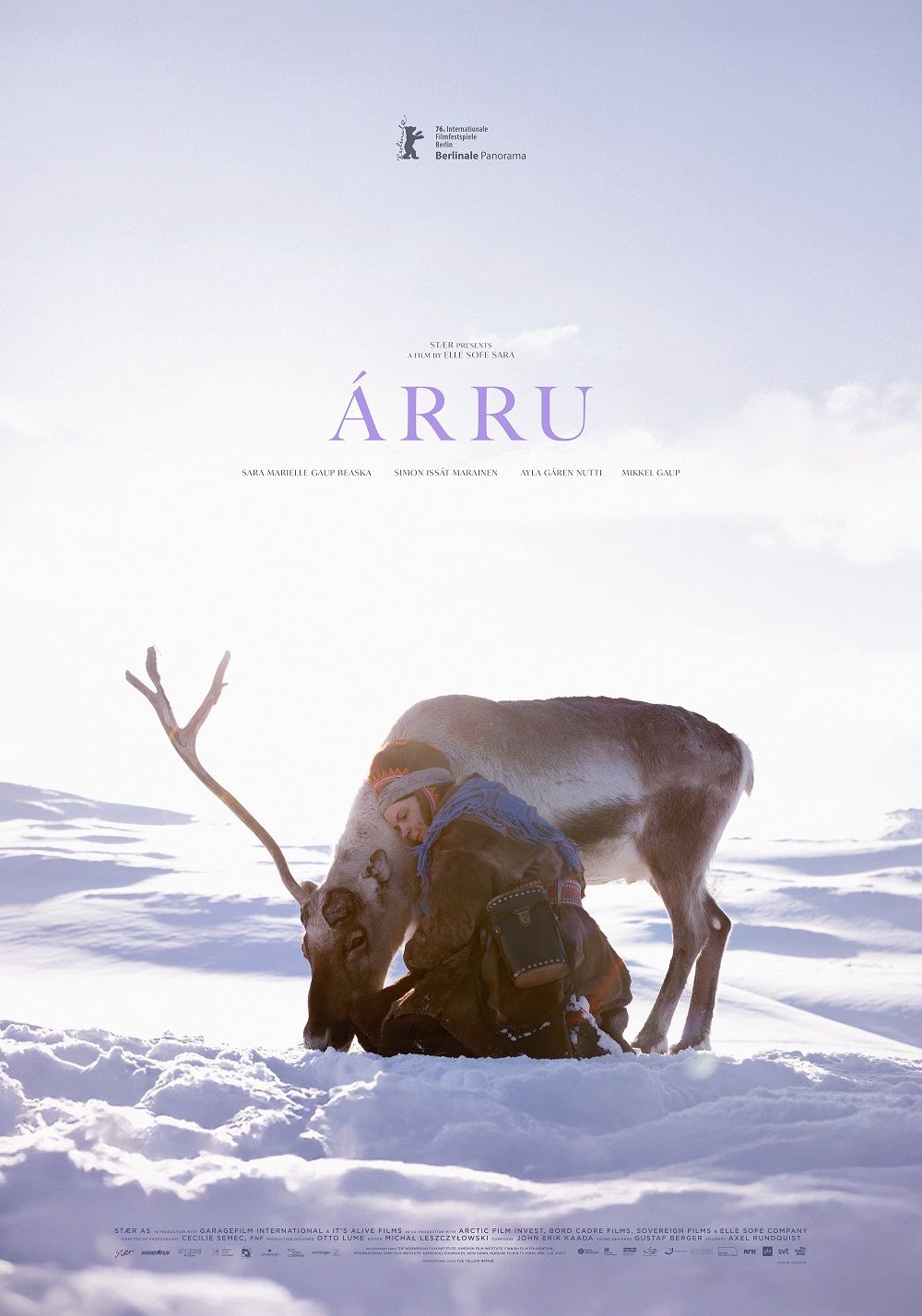
There is a meditative silence accompanying the setting of snow-capped fields that kick-starts the narrative of the film Arru. The drama is quick to establish the bond that the protagonist Maia (Sara Marielle Gaup Beaska) shares with her reindeers. In a pivotal moment, she is witness to a distressed reindeer struggle on the frozen land while having miscarried its baby – a painful sight for any mother. In hindsight, the reindeer would also represent the protagonist in many ways – suppressed and struggling for her rights, while tactfully harbouring a generational trauma that would endanger her own clan – the indigenous Sami tribe. And hence, the heartwarming shot of the protagonist embracing the reindeer, was in many ways – a form of a self hug, while freeing her from the crutches of the frozen.
The subtext remains on how the protagonist chooses to opt for the very freedom for an animal, when she doesn’t have the choice to opt for it herself. In a way, this remains a rendition of a phrase from the film Frozen (2013) – ‘Let It Go’, which ironically acts as an obstacle for the protagonist who is expected to stay quiet with a burning secret. Or that, an obstacle involving the corporatization of her fields by mining companies that would force her to elininate half her herd. The question then remains on how could she ‘let it go’.
Written by Johan Fasting and Elle Sofe Sara, Arru has two conflicts unfolding in parallel with regards to the protagonist, who stays with her brother Danel (Simon Issat Marainen) and her daughter Ailin (Ayla Garen Audhild P. Nutti) as a part of the Sami indigenous tribe who are known to be herders of reindeers. The central conflict remains that of their ancestral land – something that would be taken away by mining companies, in what is a classic case of capitalism, a phenomena that is ruling the roosts. The underlying conflict comes in the form of her uncle Lemme (Mikkel Gaup) who comes to help the protagonist with the protest.
Lemme remains an interesting character given how his morality is intact and shredded in the sane breath. He comes on the back of an experience of staging protests in Canada, so when the protagonist turns to him for help, he does arrive in a jiffy. He beholds a charismatic presence that would transform his voice and movement into something substantial, initially also managing to woo Ailin, the naive teenager who is unaware of her family history.
This makes the character of Maia even more interesting, given how she invariably needs to choose between two kinds of freedom – one involving saving her land and her reindeer herd, and the other, breaking the chain of generational trauma to free her future generation. The choice is between her present and her future, a poignant conflict that slowly begins to consume here. In a beautifully performed scene, you see her being embraced by the spirit of her ancestors – stripped off any prejudice of the society, something that keeps the fire burning within her. You also notice moments of friction that she shares with her teenage daughter who has a mind of her own, and oblivious of the generational trauma induced by Lemme on her mother and her Uncle Danel.
The screenplay is designed to be a semi-musical that heavily focuses on using the yoik folk song as a medium for the protest – something that you witness in a particular instance involving Ailin. This strays from the typical legal battles that are witnessed in dramas, instead replacing the core movement of the protests through a cultural phenomena that is capable of toppling the harshest modes of capitalism. Ironically, the ending is a nod to this cultural phenomena too – wherein the protagonist uses this medium to communicate her angst against her uncle who was a major contributor to her generational trauma.
And although the balance between both these conflicts isn’t seamless and at times slightly outweighing the other, both her obstacles are countered by a sense of hope – hope that tomorrow would be a better day, and that her future generations would get to witness the best of both the worlds. The screenplay is pretty well written here, in a beautiful exhibition of culture to counter the conflicts.
The dialogues are conversational and sparingly used, with the emphasis being on the music and the visuals that add depth to the proceedings. In fact, the music remains one of the unsung heroes of the drama – tactfully using its notes to convey the emotional plight of the characters, while refreshingly using it as a cultural phenomena like in a film like Kneecap (2024), to stage a form of protest. Likewise, the frames exhibit a sharp sense of contrast with the setting that offers an arc of its own. Notice the frozen landscapes at the start signifying a string of conflicts to begin with, only to make way for greener pastures towards the end to signify hope. This, while also successfully accounting for a deep emotional core in the proceedings pertaining to its characters.
The editing pattern employed is leisurely, allowing the conflicts to simmer through its characters, even while retaining its emotional core from one scene to another. Director Elle Sofe Sara creates a meditative ambience that epitomizes the psyche of the protagonist, suppressed but still self-aware about a change for her future generations. I liked how the director creates parallels between reindeers and her own daughter – the future of both that would be in jeopardy if changes are not implemented. The tone maintained is understated and measured, and although the filmmaking does minutely stumble in giving equal preference to both ongoing conflicts, it does enough in elevating the emotional gravitas of the drama. The direction is pretty good here.
The performances are pretty good by the members of the cast. Simon Issat Marainen as Danel is a character similar to his sister, suppressed and fractured while only gathering courage to speak up against his uncle at the end. But while his sister’s form of protest was through the art of singing, his remains vocal – a clear distinction in their psyche. And he does a splendid job here. Ayla Garen Audhild P. Nutti as Ailin epitomizes the youth that is rebellious, without being aware of the trauma induced by generations prior to her. Hence, her gaze remains binary at the start before slowly warming up to her mother and uncle in a fight against the tormentor. She was a treat to witness here.
Mikkel Gaup as Lemme is charismatic but a character with layers, often blurring his lines of consciousness. He also remains an epitome of power, and how absolute power can corrupt individuals with broader moralities too. In that sense, he delivers an instrinsic act that ticks all the right boxes. Sara Marielle Gaup Beaska as Maia is the soul of the film here. You notice her gentle side to her persona at the start, slowly taking you on a journey that is dark and internal to her trauma. She uses her expressions and body language to great use while putting forth a commendable act.
As a part of our Tribeca Film Festival coverage, Arru is a meditative and culturally driven drama on fight against capitalism and generational trauma that features solid performances and makes for a poignant watch.


