

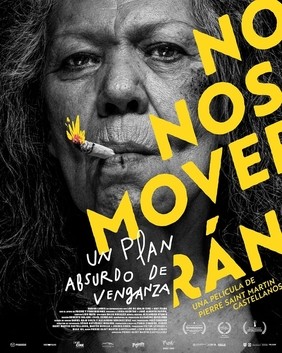
It is interesting how the monochrome frames are used as a metaphor in the Spanish film We Shall Not Be Moved, Mexico’s Official Submission To The Oscars Of 2026. Mounted on the back of the 1968 Tlatelolco massacre wherein the government officials open fired on students participating in peaceful protests, the camera pans on the protagonist Socorro (Luisa Huertas) in the current timeline – a lawyer who had lost her brother in the massacre, decades ago. Socorro represents many such individuals who have been grieving for years, some silently and some a little more vocally – and hence, the use of monochrome is symbolic of their dull and fading lives, awaiting that one moment of justice that would put some of their demons of the past to rest. On a micro level, the monochrome also is representative of the political environment of the country in the aftermath of some of the darkest chapters in the country, wherein even the ambience is reflective of the trauma from the past. It is similar to the ambience created in Baramulla, where the fog represented uncertainty with respect to the future, and sorrow with respect to the hazy past. The term generational trauma could also be applied here, given the life being led by Socorro, the implications of which are seen on her family.
Written by Iker Compean Leroux and Pierre Saint Martin Castellanos, one of the strongest aspects of the film We Shall Not Be Moved lies in the characterization of Socorro. She is a lawyer by profession but you see her living a life of solitude despite the presence of other individuals in her flat. For starters, she resides in an apartment within the Tlatelolco housing units in Mexico City, which was home to the massacre. There is a hint of guilt in her otherwise cheerful demeanor, something that she uses to mask the sorrows of her past. Another implication remains the idea of sticking onto this apartment, while residing in a housing unit where elevators aren’t functional – a trait that tells you a thing or two about Socorro being stuck in time. She wishes to stay away from the noise (read: the 20th floor), but ironically in the vicinity of the erstwhile massacre (read: trauma), silently hoping for justice.
You are witness to Socorro’s personal life being in disarray given how her obsession with seeking justice for her brother, has led to distance herself from her own sister Esperanza (Rebecca Manriquez). Life is all the more hard for Socorro given how she is at the end of her professional career, leaving her mind to further wander and indulge in the realms of justice for her brother. In fact, her obsession over the years has been so desperate, that she had chosen to name her own son after her brother – Jorge (Pedro Hernandez). Jorge remains unemployed, partly due to the systematic failure of the state and partly due to his own obsession of taking care of his mother, something that annoys his pregnant wife Lucia (Agustina Quinci). In fact, you see Lucia being one of the few people that Socorro is shown to be talking too, even as she wishes to share the ghosts of her past while Socorro only wishes her to use her looks for gaining vital information about her brother.
There is an absurdist undertone to the proceedings that evokes a satirical sense of black humour along the way. For instance, Socorro encounters a clue about the soldier who may have killed her brother during the massacre, prompting her to extract revenge. It is an indifferent sentiment for an elderly character who may be at the fag end of her own life, but instead is stuck in time. She arm-twists a fellow personnel Siddartha (Jose Alberto Patino) on the pretext that she had once saved him from going to prison, wanting him to investigate and trace the existence of the soldier while in-turn helping her to extract revenge. There is also her senior masked to an oxygen cylinder (and perhaps her love interest at some point) – Candiani (Juan Carlos Colombo), with whom she indulges in adult talks in order for him to help her with information. It must be noted that Socorro holds no real affinity for Candiani or Siddartha, wanting to use them as pawns in the larger scheme of things.
I liked how the absurdist nature of the drama goes hand-in-hand with the various symbolisms in play. At a vital point in the narrative, you see Socorro contemplating on using her gun to extract revenge for her brother’s death. But as a parallel, you see her being distanced from her own family – some represented through birds and animals. For instance, a moment of anger on her part ends with the death of a pigeon, with whom she shared a warm bond until them. In another instance, you see a cat vomitting after being poisoned, a representation of her own self who finds herself in inner turmoil. It must be noted on how her son Jorge and her daughter-in-law Lucia have left her, along with Siddantha…thereby leaving her with no company, barring her sister whom she isn’t on talking terms with.
The idea of acceptance and the art of letting go are touched upon in a final act that is reflective in many ways, even as Socorro’s character arc circles to a sense of realisation. It isn’t as if she is completely healed, but you see the idea of letting go, almost signalling a sense of change. Be it the realisation of the supposed soldier taking her to a hospital despite being aware of her wanting to kill him, or the idea of burning the final photograph of her deceased brother to ashes, you see a change in Socorro who finally hss decided to move on. Sometimes life is just about sharing a toast with your loved one(s) (in this case Socorro’s sister Esperanza), no matter how burnt the toast is. In that sense, the ending gives the title of the film a new meaning, deviating from the traditional anthem of resilience in the social and political setup. Living in the moment while moving on from your past trauma , is a direct takeaway here summing up a screenplay that is beautifully poetic and achingly poignant.
The dialogues are conversational while bringing in a fresh dimension to the grief which is driving the antics of the protagonist. There is a hint of dark humour in play all along, something that accounts for a contrasting emotion with what the protagonist is feeling within. And yet, it is representative of so many of us who use humour as a medium of escapism while continuing to be stuck in time. The BGM uses silence wonderfully in the narrative here, allowing the rawness of the drama to seep through the narrative. The creative decision to shoot the film in monochrome, added a lot of texture and depth to the drama. The metaphor in play is synonymous with not only the protagonist but similar folks like her who have been grieving in silence. That automatically doesn’t stray you away from the conflict despite its absurdist undertones, while always keeping you emotionally invested in the journey of the protagonist. Also, the frames are claustrophobic, using being restricted to the four walls of the apartment.
The editing pattern allows you to imbibe the melancholic ambience of the drama, pretty effectively. Director Pierre Saint Martin Castellanos in his feature film debut manages to impress with his choice of narrative and characterization. His idea of aspiring to implement contrasting character traits was a tricky proposition, but there is finesse in his craft in a drama that doubles up as a character study. The emotional quotient is prevalent at the micro level, wherein the director chooses to play out the character arc as a tragicomedy. This, even while never losing sight of the core conflict. The direction is excellent here.
The performances are excellent by the members of the cast. The likes of Gabriela Aguirre and Ixchel Flores Machorro have their moments to shine. Roberto Oropezo as Juan and Alberto Trujillo are first rate while delivering subtly competent acts along the way. Juan Carlos Colombo as Candiani and Jose Alberto Patino as Siddartha bring texture to the drama with characters that define the manipulative trait of the protagonist. Pedro Hernandez as Jorge, Agustina Quincy as Lucia and Rebecca Manriquez as Esperanza are sincere and earnest performers that deliver heartfelt performances in various capacities, while effectively contributing to the emotional core of the drama.
Luisa Huertas as Socorro is the soul of the drama here. This remained an increasingly complex character given how she isn’t quite affable to draw you into her journey. Socorro is a flawed character, silently grieving and filled with angst while being stuck in the past, so much so that she expects a similar defiance from people around her. She also is partially manipulative, using people as pawns to serve her life mission of justice. Yet the more you get to know, the more you are invested in her complexities, even empathizing with her and her antics. In short, you slowly begin to resonate with her journey that is emotional, with a hope that she is able to move on someday. And these sentiments unfold like layers in a performance that is brilliant to the core.
Mexico’s Official Submission to the Oscars of 2026, We Shall Not Be Moved is an achingly poignant take on trauma, grief, and acceptance presented with dark humour, and boasting of solid performances that make for a brilliant watch.


